Basic Corgi Training Techniques for Beginners
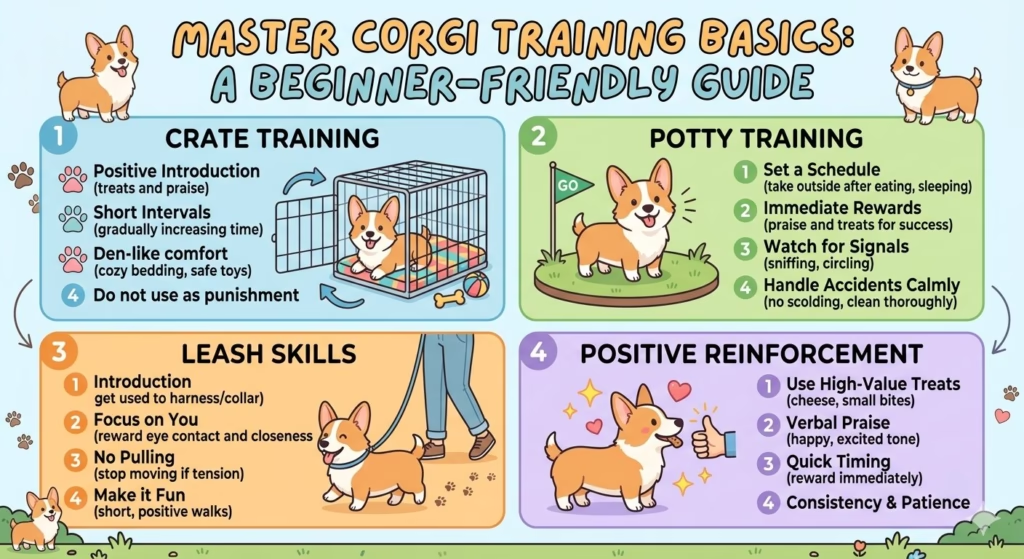 Corgis are not beginner dogs pretending to be easy. They are working dogs who happen to be compact, charming, and irresistibly adorable — and those qualities can lull a first-time owner into underestimating what they actually need.
The good news is that Corgi training basics, approached with consistency and the right framework, are completely achievable without specialist knowledge or professional experience. These dogs are highly intelligent, food-motivated, and genuinely want to engage with you — which means the tools required for success are simpler than most people expect.
What matters most is not which technique you use in week one. It is whether you commit to applying it consistently across the weeks that follow. This guide gives you the foundational techniques — crate training, potty training, leash work, commands, and mental stimulation — structured in the order they are most useful to begin.
 QUICK ANSWER
What Are the Most Important Corgi Training Basics for Beginners?
Corgi training basics for beginners centre on five foundations: crate training for security and routine, potty training with consistent timing, positive reinforcement for all new commands, leash training with early lead acceptance, and mental stimulation to prevent problem behaviours. Starting all five simultaneously from the puppy's first week home produces the fastest and most durable results.
Why Corgis Are Both Easy and Challenging to Train
If you have done any reading about Corgi behaviour before getting your puppy, you have likely encountered two seemingly contradictory descriptions.
- The first: "Corgis are incredibly intelligent and easy to train."
- The second: "Corgis are stubborn and will ignore you completely if they disagree with your plan."
Both are accurate. The same traits that make a Corgi pick up commands with impressive speed — working dog intelligence, strong environmental awareness, high responsiveness to consequence — are the traits that make them excellent at identifying when training is inconsistent, unclear, or not rewarding enough to bother with. A Corgi that ignores a command is not being defiant. It is making a rational calculation based on the information available to it.
This is why corgi training basics for beginners rest on three non-negotiable pillars: clarity, consistency, and consequence. When those three elements are in place, Corgis train at a rate that surprises most first-time owners.
Corgis rank 11th in Stanley Coren's dog intelligence rankings — within the "excellent working and obedience intelligence" category, defined by learning new commands in fewer than five repetitions.
The herding drive is real and present even in companion-bred lines. Nipping, barking, and circling behaviours are not misbehaviour — they are inherited working patterns that need to be redirected, not suppressed.
Energy management matters as much as training. A Corgi that has not had adequate physical and mental exercise in the hours before a training session will struggle to focus, regardless of the technique applied.
Crate Training
Building a Space Your Corgi Loves
Crate training is one of the most misunderstood tools in the first-time owner's toolkit. In South African households, where the cultural instinct is often to allow dogs free range of the home from day one, the concept of a crate can feel restrictive or unkind. In practice, a well-introduced crate does the opposite — it gives a puppy a predictable, safe space in an environment that is, initially, overwhelming.
The crate must never be associated with punishment. It is a den, not a cell. From the first day, it should be paired exclusively with rest, calm, and positive reinforcement.
Week one introduction sequence:
- Place the crate in a family area (not a back room or garage) with the door open.
- Drop high-value treats near the door, then just inside, then at the back. Do not push the puppy inside.
- Begin feeding meals inside the crate — door open initially, then closed for the duration of the meal.
- Introduce a verbal cue ("crate" or "bed") paired with each voluntary entry, reinforced with a treat.
- Build duration gradually: thirty seconds with door closed on day two, then two minutes, then five.
Common crate training mistakes to avoid:
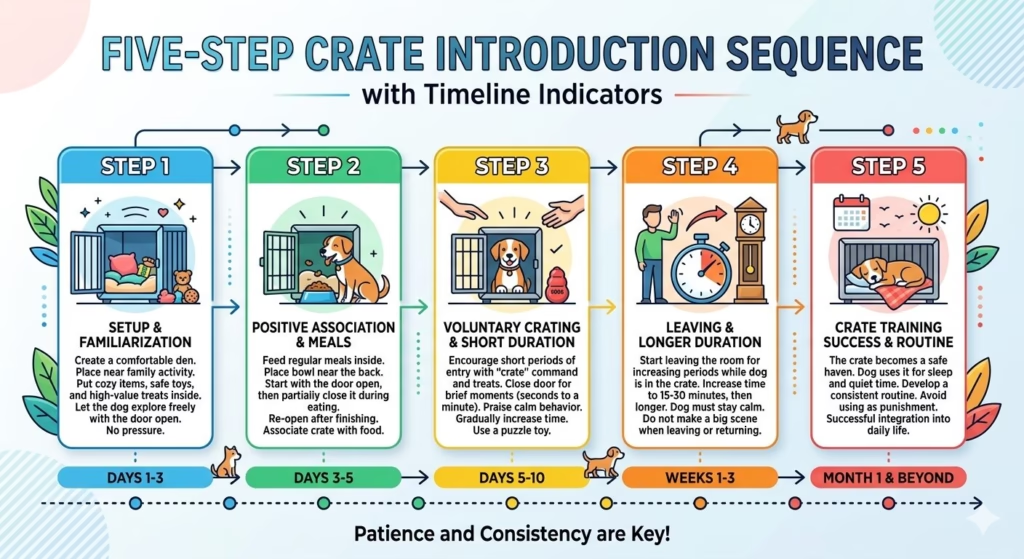
Most Corgi puppies accept crate confinement reliably within two to three weeks if the introduction is managed correctly. A consistent routine — same cue, same location, same calm delivery — accelerates this considerably.
Potty Training
Timing, Routine, and What Actually Works
Potty training a Corgi puppy is primarily a timing exercise, not a discipline exercise. Puppies under twelve weeks have a bladder capacity of approximately one hour per month of age — so a seven-week-old puppy needs to eliminate every hour to ninety minutes during waking hours. Expecting accident-free behaviour before twelve weeks without constant supervision and a proactive routine is not realistic.
The schedule that works
Take your puppy outside at these predictable moments — every single time, without exception:-
- Immediately on waking from any sleep
- Within ten minutes of eating or drinking
- After any period of active play
- Every sixty to ninety minutes during waking hours (under twelve weeks)
- Last thing at night; first thing in the morning
Outdoor reinforcement
When your puppy eliminates outside, mark the behaviour the moment it finishes (not during — interrupting the action causes the puppy to hold the remainder), with a specific verbal marker ("yes" or a clicker click) and an immediate treat. The reward must follow within two to three seconds to associate correctly.
Accident management
If you catch your puppy mid-accident indoors, interrupt calmly (a single "ah-ah") and move immediately to the outdoor spot. If you discover an accident after the fact, clean it and say nothing to the puppy — retrospective correction does not work and adds confusion.
Timeline expectations
- Weeks 8–12: Accidents daily; the goal is reducing frequency, not elimination
- Weeks 12–16: Significant reduction with a consistent routine; overnight dry stretches beginning
- Months 4–6: Reliable outdoors with occasional misses; full bladder control approaching
- Month 6+: Consistent reliability expected if routine has been maintained
Enzymatic cleaner on all indoor accidents is essential — standard household cleaners do not break down the urea compounds that attract puppies back to the same spot.
Basic Commands for Beginners
The First Five to Teach
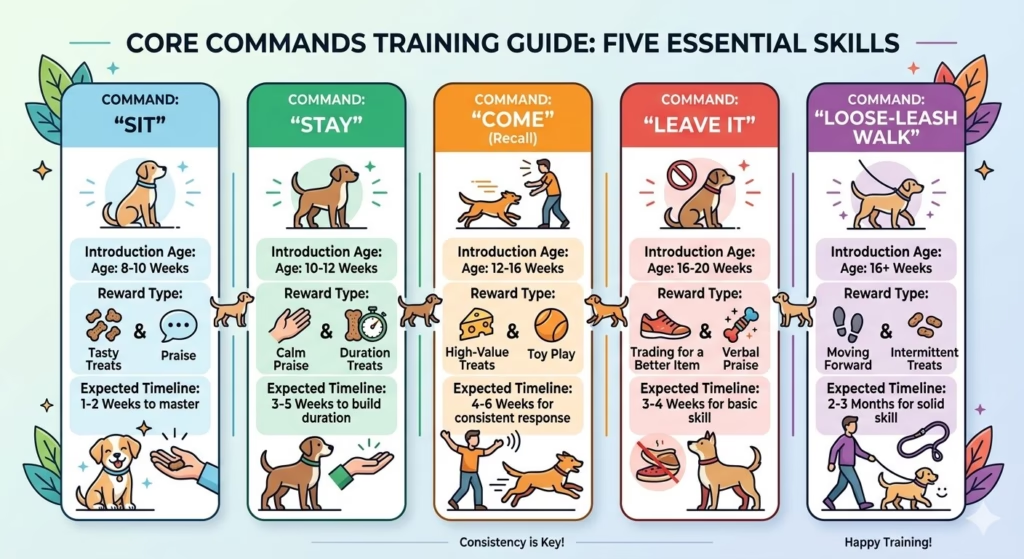
Introducing commands before a puppy is neurologically ready is a common source of frustration for first-time owners. The optimal window to begin formal command training is between eight and twelve weeks — the period during which the human socialisation window overlaps with the beginning of voluntary attention and response to consequence.
The first five commands, in order of priority:
1. Sit
The easiest behaviourally, because the puppy already knows how to sit. Lure the nose upward and back with a small treat; the hindquarters naturally descend. Mark and reward the moment the rear touches the floor. Introduce the verbal cue ("sit") after ten to fifteen successful repetitions of the physical behaviour — not before.
2. Down
From sit, lure the treat toward the floor between the front paws and slowly outward. The elbows touch the floor. Mark, reward. This command requires more patience than sit — some puppies resist the vulnerable position initially.
3. Stay
Build duration first (one second, then three, then five), then add distance (one step back, then two), then add distraction. The three components of stay — duration, distance, and distraction — should never be increased simultaneously. Work on one at a time.
4. Come (Recall)
Teach recall in a safe, enclosed space first. Call the puppy's name followed by "come" in a happy, bright tone. When the puppy arrives, reward extravagantly — this is not a command where a treat and a quiet "good dog" suffices. Every recall in the early weeks should be the best thing that ever happened.
Leave it
Present a treat in a closed fist. The puppy will paw, nose, and attempt to get to it. The moment it withdraws or looks away, mark and reward with a different treat from the other hand. This command has immediate safety implications and is worth teaching in week one.
Leash Training
From First Lead to Confident Walks
Leash training is one of the areas where the experience of walking a dog and the training required to produce a dog that walks well diverge most dramatically. Many first-time owners begin walking their Corgi puppy because it needs exercise — but introduce the lead before they have built the puppy's acceptance of restraint, which results in pulling, spinning, and frustration for both parties. Lead acceptance comes first, walking comes second.
Lead introduction sequence (begin at seven to eight weeks at home):
- Place a lightweight, correctly fitted flat collar or puppy slip lead on the puppy for five minutes while engaged in play or a meal. Remove before distress.
- Attach a short, lightweight lead and let the puppy drag it under supervision for a few minutes per session.
- Pick up the end of the lead and follow the puppy — do not direct yet. Let it set the pace and praise all forward, calm movement.
- Begin to shape direction gently: pause when the lead pulls taut; reward when the puppy returns to a loose lead position.
- Introduce an outdoor environment (garden first, then pavement) once the above is reliable indoors.
Pulling
Corgis, despite their size, pull with surprising commitment. The most effective response to pulling in early training is the stop-and-wait technique: the moment the lead becomes taut, stop moving entirely. No correction, no command — simply stop. When the puppy returns to create slack, mark and move. This communicates one clear rule: pulling stops progress.
Avoid retractable leads during the learning phase entirely. They teach the puppy that extending the lead produces more freedom — the opposite of what you need to establish.
Clicker Basics and Reward-Based Training Principles
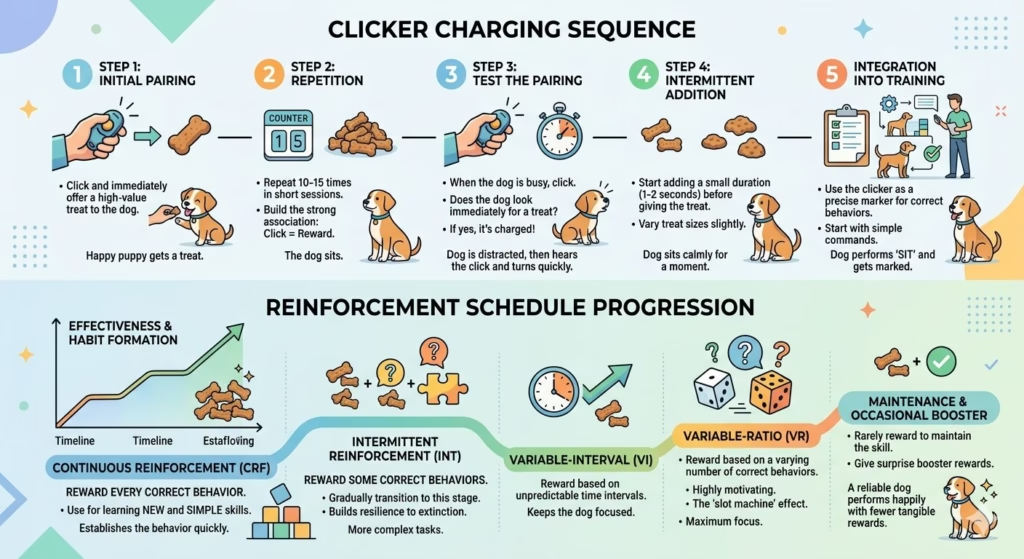
The clicker is a timing tool, not a magic device. Its function is to mark the precise moment of a correct behaviour with a sound that, through classical conditioning, the puppy has learned to associate with reward delivery. The click is not the reward; the reward follows the click.
Charging the clicker (day one):
Click once. Deliver a treat. Click once. Deliver a treat. Repeat ten times. The interval between click and treat should not exceed two to three seconds. After ten repetitions across two to three sessions, the puppy will orientate toward you at the sound of the click — this is the conditioned response and signals that the clicker is charged.
Why timing matters
Research in applied behaviour analysis shows that a marker delivered within one second of the target behaviour produces significantly more reliable learning than delayed reinforcement. The clicker's value is precision — it allows you to communicate "that exact thing you just did" with an accuracy that verbal praise alone cannot achieve.
Reward-based training principles that apply regardless of whether you use a clicker:
- Use the highest-value treats for the most difficult behaviours. Kibble for easy behaviours in low distraction; soft, high-value treats for difficult or distraction-heavy environments.
- Keep sessions short. Three to five minutes for puppies under twelve weeks; five to ten minutes for older puppies. End on a successful repetition.
- Vary your reinforcement schedule once a behaviour is established. Intermittent reinforcement — rewarding every second or third correct response rather than every one — produces more durable behaviour than continuous reinforcement.
- Your energy is part of the training environment. A frustrated or impatient handler produces a shut-down or anxious puppy. If you are frustrated, end the session.
Building a Consistent Training Schedule
Consistency is the variable that most determines whether corgi training basics stick or fade. Dogs do not generalise well — a behaviour learned in the kitchen may need to be retrained in the garden, and then again at the park. A training schedule that accounts for this reality will produce a far more reliable dog than sporadic sessions, however skillfully delivered.
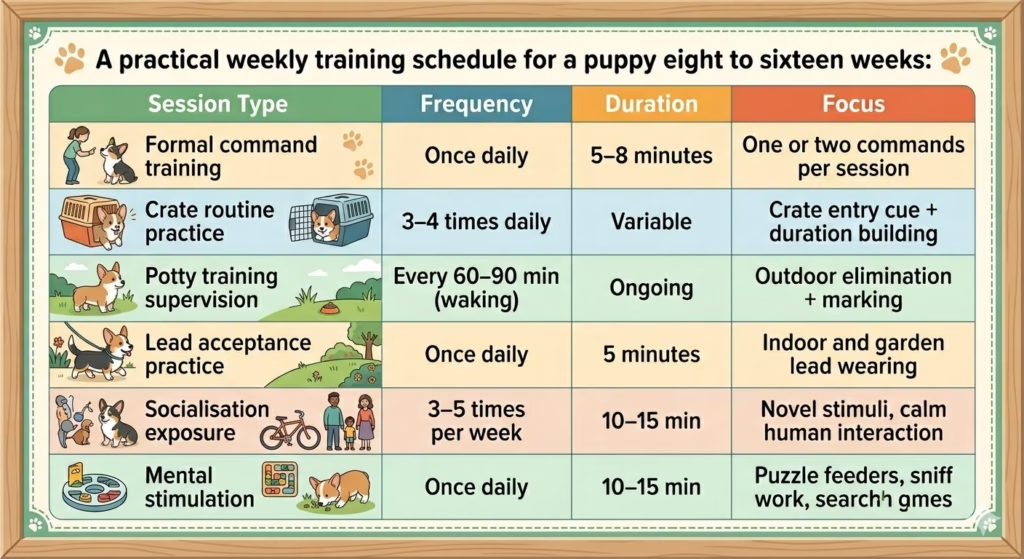
The key to making this sustainable for first-time owners is integration into existing routines rather than treating training as a separate scheduled block. Sit before meals. Wait at the door before going outside. Down during your evening television. Every interaction is a training opportunity — the puppy is always learning, whether you are deliberately teaching or not.
Mental Stimulation
The Missing Piece Most Beginners Skip
A tired Corgi is a well-behaved Corgi — but physical exercise alone will not produce that tiredness. This is a breed with a working dog cognitive profile: they were developed to make decisions, assess the environment, and solve problems over the course of a working day. A Corgi that only receives physical exercise will burn energy without engaging the mental processing capacity that drives most problem behaviours.
Mental stimulation that works:
Sniff work
Scatter-feeding meals in the garden or hiding treats in a snuffle mat taps into olfactory processing — the most cognitively demanding task a dog regularly performs. Ten minutes of sniff work produces fatigue equivalent to a thirty-minute walk for many dogs.
Puzzle feeders
Introduced progressively — Level 1 (simple sliding compartments) before Level 3 (multi-step manipulation). The objective is mild challenge, not frustration.
Training novelty
Introducing a new behaviour or a variation of an existing one provides cognitive engagement that routine command repetition does not.
Problem-solving exercises
Hide a treat under one of three cups and allow the puppy to identify the correct cup. Build to more complex search sequences as confidence grows.
Mental stimulation should be factored into the daily routine alongside physical exercise, not treated as an optional extra. A fifteen-minute mental stimulation session before a formal training session produces a puppy that is focused and engaged rather than over-aroused and difficult to redirect.
For owners preparing a Corgi puppy that has come from a structured breeder environment, the foundations of positive reinforcement and environmental exposure work are often already in place by the time the puppy arrives home. The article Breeder Puppy Prep Checklist for Show Prospects on PemberDiamonds describes what professional breeders do before placement — which directly shapes what you build on at home.
Problem-Solving Common Corgi Training Challenges
Even with a solid foundation, specific challenges emerge. Corgis produce a predictable set of them, and knowing what to expect makes management significantly easier.
Nipping and mouthing
Herding instinct expressed as nipping — particularly at ankles and children — is one of the most common Corgi puppy complaints. The response that works is immediate social withdrawal: a yelp or a calm "ouch," then turning away and ignoring the puppy for thirty seconds. The puppy learns that contact teeth = end of interaction. Do not play games that involve hands and feet as targets during this period.
Barking
Corgis are vocal by nature and by breeding function. The goal is not silence — it is a reliable "quiet" or "enough" cue. Teach this by allowing the bark to begin, then presenting a treat to nose level (the sniff suppresses the bark), marking the silent moment, and rewarding. Build duration of silence before the treat is delivered.
Selective recall
If recall is only reliable indoors, the behaviour has not been generalised — it has only been trained in one context. Proof recall in the garden, then at the park, then at a training class. Each new environment should be treated as if the behaviour is new, with high-value rewards and extravagant praise for the first several successful outdoor recalls.
Jumping
Turn away. Every time. No eye contact, no command, no pushing the puppy down. When four paws are on the floor, mark and reward. Consistency across every family member and visitor is the only thing that makes this work — inconsistency (one family member rewarding jumps with attention) will undo weeks of progress.
For Beagle owners dealing with similar first-stage training challenges — particularly around scent distraction and selective focus — the article Basic Beagle Training Techniques on BeaglePuppies explores how these same principles apply to a nose-forward breed.
 EXPERT INSIGHT
From a certified dog trainer specialising in herding breed behaviour:
"The question I get most often from Corgi owners is: 'Why does my dog know sit perfectly at home and completely ignore me at the park?' The answer is that they haven't been taught to sit at the park — they've been taught to sit in the kitchen. Dogs don't transfer behaviours across environments automatically; they need to be re-taught in each new context, with gradually increasing levels of distraction. What most people call stubbornness is actually a generalisation failure — and it's the trainer's problem to solve, not the dog's.
The insight that changes everything for Corgi owners: treat every new environment as if you are reintroducing the behaviour for the first time. High value treats, easy criteria, extravagant reinforcement. The dog that sits perfectly at home will sit perfectly at the park — but only after you have taught it that 'sit at the park' means exactly the same thing and produces exactly the same outcome. Corgis learn this transfer faster than almost any breed. They just need you to do the teaching."
 FAQ SECTION
1. How do I start corgi training basics if my puppy is already four months old?
Four months is not too late — it is actually an ideal second window. The initial fear imprint period has passed, the puppy has more bladder control and attention span, and the socialisation window, while closing, is still open enough to make meaningful progress. Begin with the five foundational commands in Section 4 and work backward to any crate or potty training gaps. Adjust your expectations for timeline — some behaviours will take slightly longer to establish than they would have at eight weeks, but all are achievable.
2. Can I train my Corgi without a clicker?
Yes. The clicker is a precision tool that speeds up the learning process for new behaviours, but it is not a prerequisite. A consistent verbal marker — "yes" delivered at the moment of correct behaviour — works on the same principle. The critical element is timing and consistency, not the specific marker used. Some owners find the clicker awkward to manage alongside a lead and treats; in that case, a verbal marker is the practical choice.
3. How long should training sessions be for a Corgi puppy?
For puppies under twelve weeks, three to five minutes per formal session is the upper limit — beyond this, attention degrades and learning reverses. For puppies between three and six months, five to ten minutes is appropriate. The quality of engagement matters more than the duration: end every session on a successful repetition, not a failed one. Multiple short sessions across a day are significantly more effective than one long session.
4. My Corgi ignores treats during training. What do I do?
If your puppy is ignoring food rewards, there are three likely explanations. First, the puppy may be too full — train before meals, not after. Second, the treat value may be too low for the difficulty of the environment — upgrade to a higher-value reward (cooked chicken, cheese, liver treats). Third, the puppy may be over-aroused or anxious — reduce environmental stimulation and return to a lower-distraction context. A Corgi that is genuinely disinterested in food is also potentially unwell; consider a veterinary check if this pattern persists.
5. When should I start leash training my Corgi puppy?
Lead acceptance should begin as early as seven to eight weeks, in the home. Early introduction normalises the sensation of collar and lead before it is associated with any destination. Outdoor walking on lead — on public pavement or grass — should be delayed until the vaccination course is substantially complete, typically from twelve to fourteen weeks. The indoor lead work phase is not wasted time; it produces puppies that walk calmly on their first outdoor experience.
6. Is positive reinforcement training appropriate for a breed originally bred to herd?
Not only appropriate — it is particularly well-suited. Herding breeds were developed to work in partnership with a handler, responding to subtle directional cues and working at a distance. The cognitive profile that makes them excellent herding dogs — responsiveness to consequence, environmental awareness, and quick learning — responds brilliantly to reward-based training. Aversive methods with herding breeds frequently produce anxiety-driven behaviours (increased reactivity, displacement barking, avoidance) that compound the original training challenge.
7. How do I manage my Corgi's herding instinct around children?
The instinct to herd — circling, nipping at heels, barking to direct movement — is hard-wired in the breed. Management begins with outlet: give the dog appropriate physical and mental tasks that satisfy the drive (fetch, agility, scent work). Then teach an incompatible behaviour around children — for example, "place" (go to mat and stay) when children are active. The nipping response should be treated as described in Section 9: immediate social withdrawal every single time it occurs.
8. What is the best way to handle a Corgi that barks excessively?
First, identify the trigger: attention-seeking, territorial alerting, anxiety, or frustrated arousal (wanting to access something it cannot reach). Each has a different management approach. For attention-seeking barking, the rule is absolute: never reinforce barking with attention, even to say "quiet." For territorial alerting, interrupt and redirect before the bark escalates into a chain. For anxiety-driven barking, the underlying anxiety is the target — not the barking itself.
9. Should I attend puppy classes with my Corgi?
Strongly recommended, particularly for first-time owners. Puppy classes provide three things that home training does not: structured socialisation with other dogs and handlers, an experienced trainer who can observe and correct handling errors in real time, and a distraction-rich training environment in which to proof early behaviours. Look for classes that use positive reinforcement methods and limit class size to eight to ten puppies maximum.
10. How does early breeder socialisation affect how quickly my Corgi learns at home?
A puppy that arrives from a breeder who has implemented structured neonatal stimulation, varied surface exposure, early lead work, and systematic human handling will learn noticeably faster in the first weeks at home. The neural pathways associated with novel-stimulus tolerance and handler responsiveness are already partially established. For a detailed breakdown of what structured breeder preparation looks like, see the Breeder Puppy Prep Checklist for Show Prospects on PemberDiamonds — it is directly relevant to understanding what your puppy came from.
CONCLUSION
Three things matter most when starting Corgi training basics as a beginner:
Firstly, consistency across people and contexts determines everything. A command taught by one family member in one room is a behaviour on its way to existing — it is not yet a trained behaviour. Generalise deliberately and reward extravagantly each time you do.
Secondly, the crate, the potty routine, and the lead are the infrastructure of a calm, functional home life — not optional extras. Getting these three right in the first four weeks makes every subsequent training goal significantly easier to achieve.
Thirdly, Corgis need their brains engaged as much as their bodies exercised. Mental stimulation is not a bonus feature — it is a management tool that prevents the majority of problem behaviours that first-time owners encounter in this breed.
The Training & Behavior category on CorgiCrew exists precisely for moments like this — where the gap between a challenging behaviour and the knowledge to change it is smaller than it looks. Your Corgi is not being difficult. It is waiting for clarity, consistency, and a good reason to get it right.
 CALL TO ACTION
Ready to build on these foundations? Explore the full range of training and behaviour guides in the CorgiCrew community — where you will find resources covering everything from advanced commands to managing breed-specific quirks with the kind of warmth and specificity that a Google search simply cannot give you. You are not on your own with this — thousands of Corgi owners have walked this path, and the CorgiCrew resource library is built from everything they learned along the way.
[…] how early socialisation translates into day-to-day training foundations for new owners, the article Basic Corgi Training Techniques for Beginners on CorgiCrew provides a practical owner-facing companion to this professional […]
[…] approaches. This is genuinely good news. Use it. For practical application of these techniques, Basic Corgi Training Techniques for Beginners is a solid foundation to build […]
[…] For the practical training implications of Corgi temperament profiles in the home and beyond, the Advanced Corgi Training Techniques guide from CorgiCrew provides a detailed owner-facing […]
[…] foundational obedience skills that underpin everything covered in this guide, Basic Corgi Training Techniques for Beginners is […]