Corgi Behavior Guide
What Every Owner Needs to Know
There is a particular moment most Corgi owners experience within the first few weeks of bringing their puppy home: something small, low to the ground, and utterly determined has just herded the cat, nipped at a child's ankle, and barked at the front door — all within five minutes. Welcome to life with a Corgi. Understanding corgi behavior is not about managing a difficult dog. It is about learning to work with a dog whose instincts, intelligence, and personality are operating exactly as they were designed to — just in an environment that looks nothing like a Welsh hillside.
This guide is for owners who want to go beyond basic commands and genuinely understand what is happening inside their Corgi's mind. Whether you are navigating nipping with a puppy, managing barking tendencies, or wondering why your Corgi seems to have its own firm opinions about everything — the answers begin with the breed's history and end with practical, evidence-based strategies you can apply today.
 What Is Corgi Behavior, Really?
Corgi behavior is the expression of centuries of selective breeding for independent decision-making, physical stamina, and herding precision — traits that make Corgis exceptionally capable working dogs and, in a domestic context, both delightful and challenging companions. Understanding corgi behavior means understanding that virtually every trait that surprises new owners — the barking, the nipping, the stubbornness — is a feature, not a flaw, of a working breed.
The Herding Instinct. Understanding Your Corgi's Core Drive
The Pembroke Welsh Corgi was bred to work cattle — moving animals many times its own size by nipping at heels and using its low profile to avoid kicks. That job required quick decisions, persistence, and the confidence to act without waiting for instruction. In your living room, those same traits express themselves as a dog that moves with purpose, tries to organise the household, and is not easily deterred.
The herding instinct in Corgis, like Beagles, is not a training problem — it is a species-level characteristic that has been selectively intensified over generations. Owners who try to suppress it entirely usually create a frustrated dog. Owners who learn to redirect it — into structured play, obedience exercises, or agility — find that the same drive becomes an asset.
What herding instinct looks like in daily life:
- Circling or attempting to "gather" family members, especially children
- Nipping at heels or ankles when movement is fast or unpredictable
- Intense eye contact and a low, focused posture when preparing to redirect someone
- Strong reactivity to bikes, joggers, or moving animals on walks
- Difficulty settling when the household is active or chaotic
Redirection strategies:
Structured fetch games channelled through obedience cues (Sit → Fetch → Return → Drop → Sit) give the herding brain a legal outlet
Agility and rally obedience are excellent sports for Corgis precisely because they reward the combination of speed, independent thinking, and responsiveness to cues
The Without Cattle structured enrichment plan on CorgiCrew provides a practical framework for meeting a Corgi's herding needs in an urban or suburban home
Barking Tendencies
Why Corgis Vocalise and How to Manage It
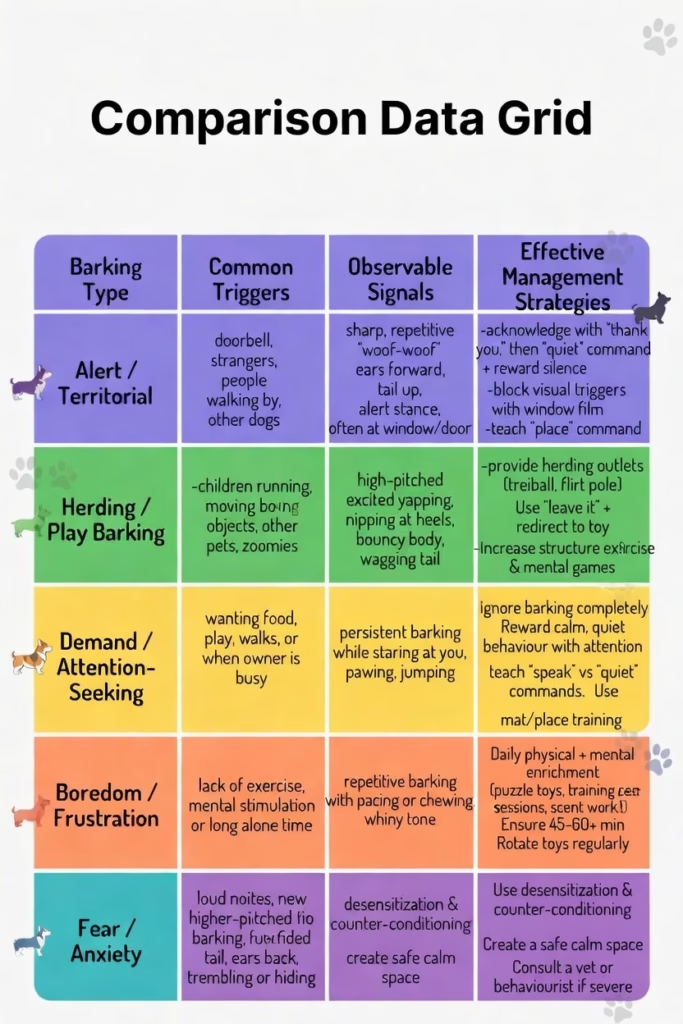 Corgis are a vocal breed, and they come by it honestly. As working dogs, vocalisation was part of their toolkit — they used barking to alert their owners and to communicate with the cattle they worked. In a domestic setting, this translates into a dog that will notify you of visitors, strangers, other dogs, unfamiliar sounds, and — on some occasions — a particularly suspicious leaf.
Barking tendencies in Corgis fall into several distinct categories, and the management strategy differs depending on which type you are dealing with.
The acknowledgement approach for alert barking is one of the most effective and under-used tools. When your Corgi alerts at the door, approach, look, say calmly "thank you" or "I see it," and then give a clear "enough" cue followed by a redirect to a mat or bed. Over time, this teaches the dog that its job is to alert once — and that the human will then take over. It respects the Corgi's instinct while establishing a clear communication structure.
A key fact many owners miss: research on herding breed vocalisation suggests that Corgis have a higher bark threshold for novel sounds than many other herding breeds — meaning the barking you do see is usually triggered by something the dog genuinely perceives as significant. Addressing the environment (reducing unnecessary triggers) is often more effective than attempting to train barking away entirely.
Nipping and Correcting It
A Guide for Every Stage
Nipping is the corgi behavior concern that generates the most urgent questions from owners of young puppies — and with good reason. A puppy with intact herding instincts and sharp baby teeth that has not yet learned impulse control is a combination that can make playtime unexpectedly painful.
It is important to distinguish between:
Puppy mouthing — soft, exploratory contact common in all puppies under 16 weeks as they learn bite inhibition through interaction
Herding nips — directional contact, usually at heels or ankles, triggered by movement
Frustration nipping — harder contact when the dog is overstimulated or a desired outcome is blocked
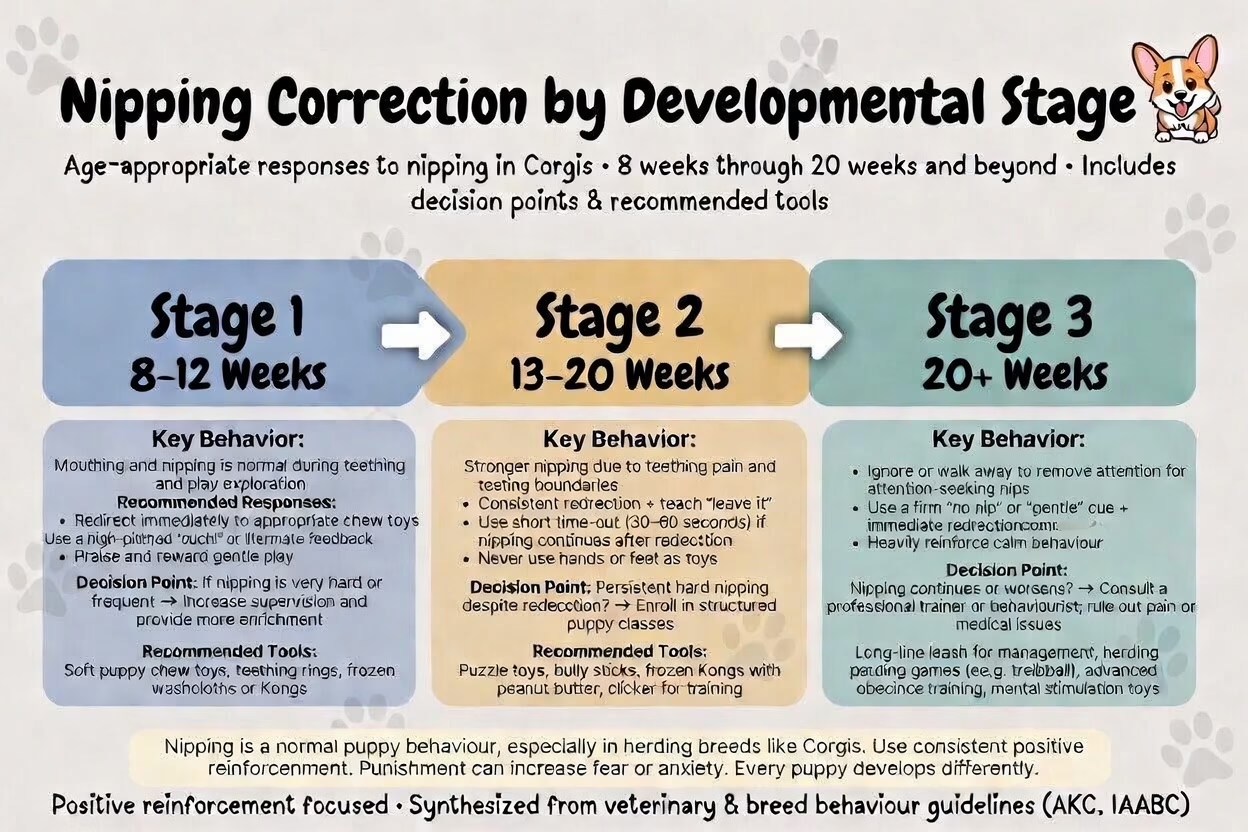
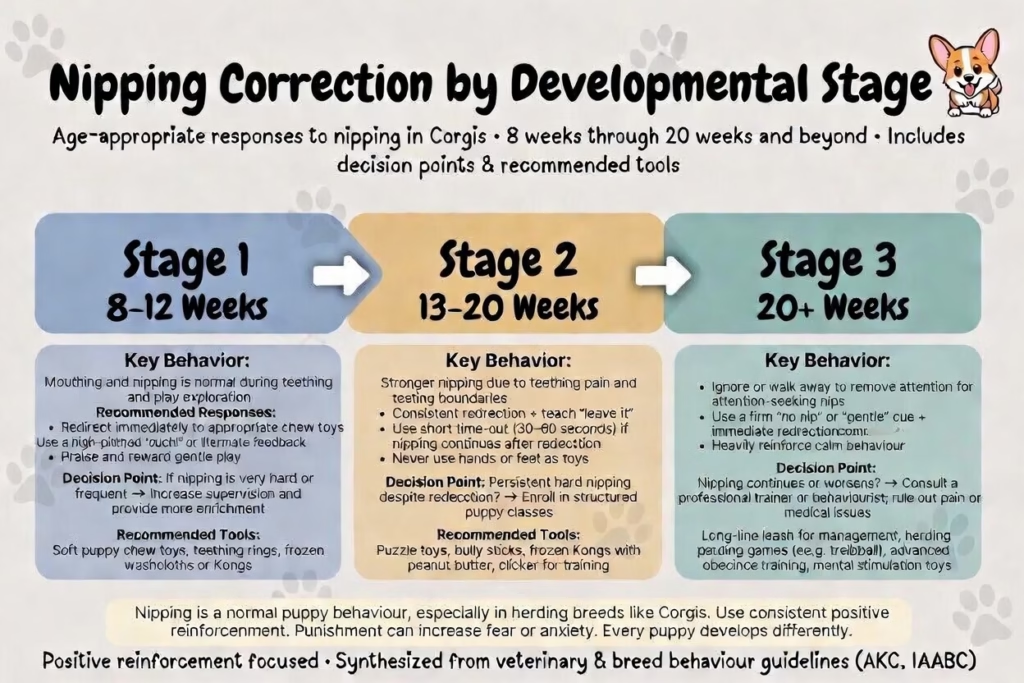
Correcting Nipping by Developmental Stage
8–12 weeks: Focus exclusively on bite inhibition. Allow soft mouthing; respond to any pressure with a calm, high-pitched yelp and brief withdrawal of interaction (3–5 seconds). Never use physical punishment — it increases anxiety and arousal, which escalates nipping in this breed.
12–20 weeks: Begin teaching that teeth never make contact with skin, regardless of pressure. Use management (leash, pen, baby gates) to prevent rehearsal of nipping behaviours. Redirect to appropriate chew toys immediately and consistently.
20 weeks and beyond: By this stage, a puppy that continues to nip during play despite consistent management and redirection likely has an arousal regulation issue or a socialisation gap. A structured positive reinforcement programme focused on impulse control — "Leave it," "Off," and "Place" — is the appropriate response.
For socialisation guidance that builds directly on these correction strategies, Corgi Puppy Socialisation Tips covers the critical developmental windows and how to use them effectively.
Stubbornness and Problem-Solving
Working With a Smart Dog
The Corgi's reputation for stubbornness is real, but the framing is unhelpful. What looks like stubbornness is usually one of two things: a dog that has independently assessed the situation and calculated that compliance is not in its interest, or a dog that has been given inconsistent signals and is hedging its bets. Both are products of intelligence, not defiance.
Pembroke Welsh Corgis consistently rank in the upper tier of working dog intelligence assessments. Stanley Coren's research placed them among the top 15 most intelligent dog breeds in terms of obedience and working intelligence. This means they learn commands quickly — and they learn the exceptions, loopholes, and inconsistencies even faster.
What this means in practice:
- A Corgi that "knows" sit but won't sit in the park is not being disobedient — it is telling you that the cue has not been generalised to that environment. Proof your commands across at least six different environments before assuming they are reliably learned.
- Corgis problem-solve actively. If a behaviour stops working to produce a reward, they will try alternatives. This is exactly what you want — use it deliberately by shaping new behaviours through successive approximations.
- Repetitive, unchallenging training sessions bore this breed quickly. Keep sessions to 5–10 minutes, end on success, and vary the exercise set.
Using the Corgi's intelligence as an asset
- Puzzle feeders and sniff work are excellent for mental stimulation. A Corgi that has worked through a foraging activity is significantly calmer than one that has only had physical exercise.
- Trick training — beyond basic obedience — engages the problem-solving circuitry that herding work once satisfied.
- Teach your Corgi a "job": bringing slippers, closing cupboard doors, or picking up dropped items gives the dog a task to focus on and reduces attention-seeking behaviors.
Separation Anxiety and Attention-Seeking Behavior
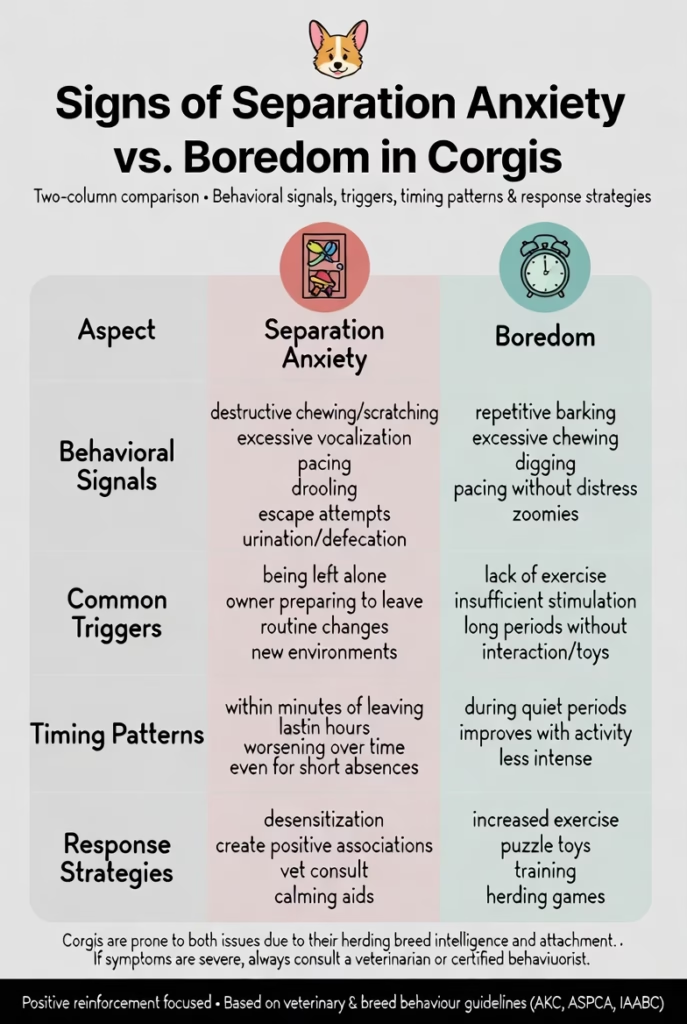 Corgis are intensely social dogs. They were bred to work in close proximity to humans — following commands, anticipating movement, and staying alert to the handler's intentions. In a home environment, this translates into a dog that is deeply oriented toward its people and, in some cases, distressed when left alone.
Separation anxiety in Corgis presents differently from general destructiveness or boredom. The key distinguishing features are:
- Distress begins at the point of departure signals (picking up keys, putting on shoes), not after a period of alone time
- Behaviour during absence includes vocalisation, pacing, self-directed behaviours, or destructiveness near exit points
- Symptoms resolve immediately upon the owner's return
- The dog has difficulty settling even briefly when the owner is present in another room
Building independent settling ability
The goal is not to eliminate the Corgi's social orientation — that would require suppressing a core breed characteristic — but to build the dog's confidence and coping skills when alone. This is a graduated process:
- Practice very short, calm departures (30 seconds) with no dramatic greeting on return — building up duration over weeks
- Teach a reliable "Place" or "Settle" cue so the dog has a clear behavioural anchor when you are preparing to leave
- Provide a long-lasting chew or food-stuffed toy that is only available during alone time — this creates a positive association with your departure
- Never punish anxiety-related behaviour — it is a fear response, and punishment increases arousal and distress
Attention-seeking behaviours — barking at you, pawing, nudging, or otherwise demanding interaction — should be handled with consistent non-reinforcement. Any attention (including "no") reinforces the behaviour. Turn away, wait for a 3-second pause in the behaviour, then reward the silence.
Social Interaction
Corgis With People, Dogs, and Other Pets
Corgis are, by temperament, social and curious dogs who generally enjoy human company. However, their herding background means their social style with other animals — and sometimes with children — can be more directive than some dogs or families expect.
With Children
Corgis are loyal and affectionate with children they know well. The challenge arises with fast, unpredictable movement — running children activate herding instincts, and nipping at heels can follow. Supervision during play with children under 8 is advisable, and children should be taught not to run away from the dog in a way that triggers chase behaviour. Structured play (fetch, trick training with children participating) is far safer than unstructured roughhousing.
With Other Dogs
Most Corgis socialise well with other dogs when socialisation has been conducted correctly during the critical developmental stage between 3 and 14 weeks. Dogs that missed this window may be reactive or bossy with unfamiliar dogs. On-lead reactive Corgis respond well to structured counter-conditioning — gradual exposure at sub-threshold distance, paired with high-value rewards, over multiple sessions.
With Cats and Small Animals
Corgis can coexist peacefully with cats, particularly when introduced during the puppy developmental stage. The herding instinct may still express itself as chasing if a cat runs, so management (baby gates, safe spaces for the cat) during the integration period is important. Small animals such as rabbits or guinea pigs should never be left unsupervised with a Corgi regardless of how well-integrated the household appears.
Obedience Training
Positive Reinforcement and What Actually Works
Positive reinforcement is the scientifically supported training framework for Corgis, and the most effective one. It leverages exactly the trait that makes Corgis challenging — their sensitivity to consequences and their drive to problem-solve — and turns it into a learning advantage.
The core principle: behaviours that produce desirable outcomes are repeated. Behaviours that produce no outcome (or an aversive one) are extinguished. For a breed as intelligent and consequence-sensitive as the Corgi, this creates fast, durable learning when applied consistently.
Foundation behaviours every Corgi should know by 6 months:
- Sit, Down, Stand (in multiple environments)
- Stay (duration, distance, distraction)
- Recall (reliable, high-value reward history)
- Leave it and Drop it
- Leash manners (loose lead walking)
- Place/Settle (goes to a mat and stays there)
Training session structure
- Duration. 5–10 minutes maximum per session; 2–3 sessions daily for young puppies
- Reward rate. High in early learning (every correct response); gradually variable as fluency builds
- Criteria. Only reinforce the behaviour you asked for, in the precise form you asked for it. Corgis will shape their own behaviour toward the minimum required for reward if criteria drift.
For foundational guidance on early commands, the Essential Puppy Training Questions Answered resource on PemberDiamonds covers the framework that underpins these training principles from a breeder's perspective.
Developmental Stages
What to Expect and When
Understanding the developmental stage your Corgi is moving through transforms many concerning behaviours into temporary, predictable challenges with known management strategies.
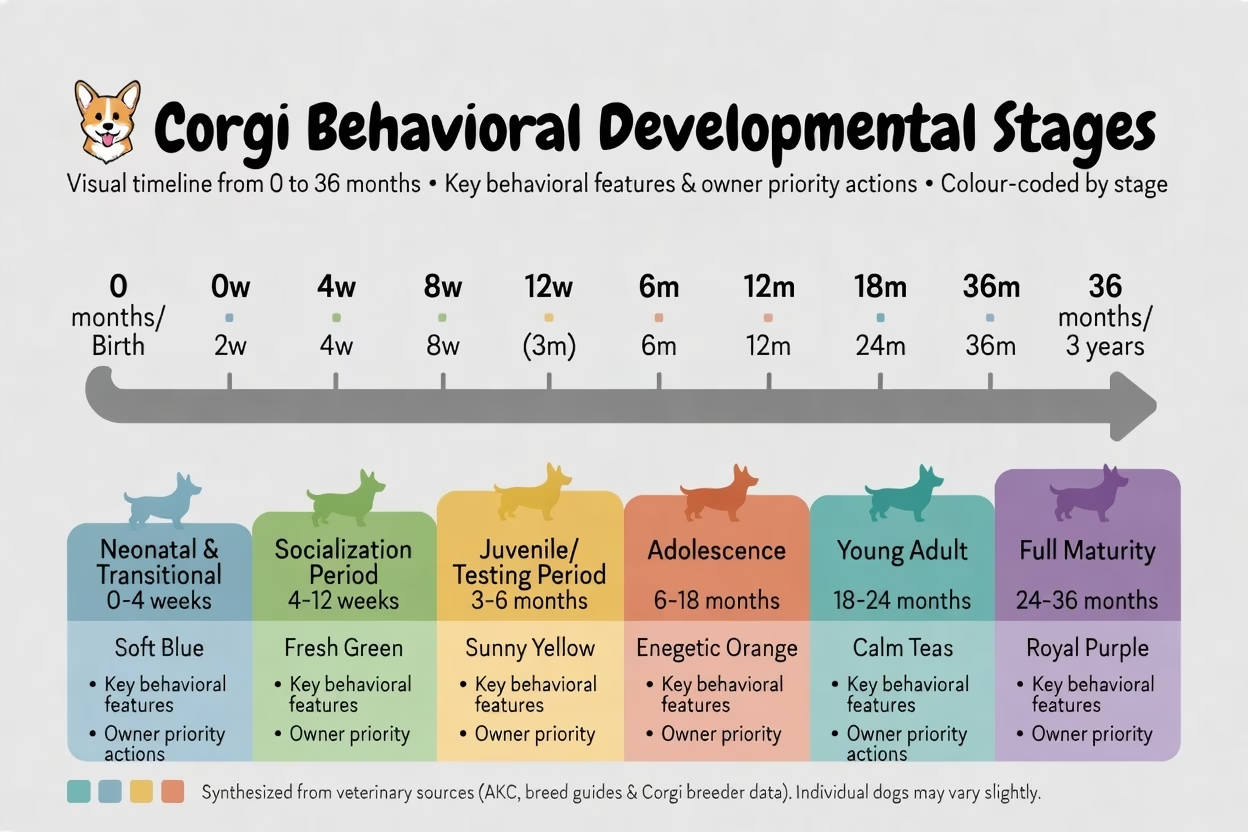
The adolescent stage deserves particular attention. Between 6 and 18 months, Corgis — like all dogs — experience a period of apparent behavioural regression. Recall deteriorates. Impulse control seems to evaporate. Previously reliable commands require significant reinforcement to maintain. This is neurologically normal — the prefrontal cortex (responsible for impulse control) is not fully mature until approximately 18–24 months in most breeds. The worst response is to reduce training during this period. The best response is to increase structure and reward density while reducing the difficulty of tasks asked in high-distraction environments.
When to Seek Professional Help
Most corgi behavior challenges respond well to consistent positive reinforcement training and appropriate management. However, some situations benefit from professional input — and identifying them early leads to better outcomes.
Seek a qualified, force-free behaviour consultant if you observe:
- Growling or snapping directed at family members, particularly with no warning signals preceding it
- Fear responses so intense that the dog cannot function in daily environments (inability to walk on lead, eat, or settle)
- Resource guarding that has escalated to biting
- Separation anxiety that does not respond to graduated absence training within 4–6 weeks
- Any sudden, unexplained change in behaviour in an adult dog — this warrants a veterinary examination first to rule out pain or neurological change
A qualified behaviourist (look for APDT, IAABC, or COAPE membership in South Africa and internationally) will design a behaviour modification plan based on learning theory — not on dominance concepts that have been comprehensively discredited by contemporary behavioural science.
 Expert Insight
From an experienced Corgi owner, trainer, and breed club member with over a decade working with Pembroke Welsh Corgis:
"The single most useful thing any Corgi owner can internalise is that this breed operates on a cost-benefit analysis in real time. Every decision your dog makes — whether to come when called, whether to stop barking, whether to drop the sock — is filtered through 'what do I get out of this?' That is not stubbornness. That is intelligence operating as intended. The mistake owners make is assuming that because a Corgi learned something quickly, it will perform it reliably without ongoing reinforcement. But a Corgi that is not reinforced for recall will gradually recalibrate the cost-benefit equation and decide that sniffing the hedge is currently more valuable than returning to you. The training relationship is not a lesson that ends — it is a negotiation that continues for the life of the dog. The owners who thrive with this breed are the ones who find that negotiation genuinely enjoyable."
One non-obvious insight: Corgis respond strongly to the owner's emotional state — more so than many breeds. A handler who is tense or frustrated will frequently see the dog's behavior deteriorate during training sessions, not because the dog is reacting to the frustration, but because the handler's energy changes their body posture, timing, and reinforcement delivery in ways the dog reads as inconsistent. Calm, deliberate training — even when the session is not going well — consistently outperforms emotionally reactive training with this breed.
 Frequently Asked Questions
1. Why does my Corgi herd children and is this normal?
Yes — herding children is a completely normal expression of Corgi herding instincts. Corgis were bred to move large animals by nipping at heels and circling, and fast-moving children trigger exactly the same instinct. It is not aggression; it is breed-appropriate behaviour in the wrong context. Management (supervision, teaching children not to run from the dog) and redirection into appropriate outlets (structured games, training activities) are the effective response.
2. How do I stop my Corgi from barking at everything?
The most effective approach is to address specific barking types rather than barking generally. Alert barking responds well to an acknowledgement-and-release cue ("thank you, enough"). Demand barking requires consistent non-reinforcement — any response, including telling the dog off, reinforces it. If barking is continuous and anxiety-driven, the underlying anxiety needs addressing, not the barking itself.
3. Are Corgis good for first-time owners?
Corgis can be excellent for first-time owners who are committed to understanding the breed's working dog background and investing in proper training from the start. They are not low-maintenance dogs. Their intelligence, herding instincts, and vocal nature require consistent structure and mental stimulation. First-time owners who research the breed thoroughly and follow a positive reinforcement training programme generally do very well with Corgis.
4. Why does my Corgi ignore commands it definitely knows?
Command reliability is environment-specific until it is deliberately proofed across multiple settings. A Corgi that sits perfectly at home may appear to "forget" the cue in a park — because the cue has not been practised in that environment with sufficient reinforcement history. Additionally, adolescent Corgis (6–18 months) experience genuine neurological changes that temporarily reduce impulse control and responsiveness to learned cues.
5. How much exercise does a Corgi need daily?
Adult Corgis generally require 45–60 minutes of physical exercise per day, but their need for mental stimulation is equally significant. A Corgi that receives adequate physical exercise but insufficient mental engagement — problem-solving, scent work, training — will often display anxiety, boredom, and attention-seeking behaviours. Mental stimulation (sniff work, puzzle feeders, training sessions) can partially substitute for physical exercise on rest days.
6. Can Corgis develop separation anxiety, and how do I prevent it?
Yes — Corgis are predisposed to separation anxiety due to their social, human-oriented nature. Prevention begins in the puppy developmental stage by teaching short, calm alone time from the first week in the home. Avoid constant contact with a young puppy — independence should be practised regularly even when you are home. Never make departures and arrivals emotionally dramatic, as this heightens the dog's awareness of your comings and goings.
7. Is it true that Corgis are one of the most intelligent dog breeds?
Corgis consistently rank in the top 15 of working and obedience intelligence assessments. Stanley Coren's research placed the Pembroke Welsh Corgi at 11th overall in a study of breed intelligence. This means they learn quickly — both the behaviours you intend to teach and the ones you do not. High intelligence requires higher management, more varied training, and greater consistency from owners.
8. What is the best way to correct a Corgi's stubborn behavior?
The most effective approach to what appears as stubbornness is to examine whether the behaviour you want has truly been taught under current conditions, whether the reinforcer being offered is valuable enough relative to the competing environment, and whether the dog has been set up for success. Punishment is counterproductive — it creates avoidance behaviours and breaks down the trust that positive reinforcement training builds.
9. How do Corgis typically behave with other dogs?
Well-socialised Corgis are generally social and confident with other dogs. Dogs that missed the critical socialisation window (3–14 weeks) may be reactive or bossy on lead. Corgis can be directive with other dogs, sometimes attempting to herd them, which other dogs may find provocative. Controlled introductions in neutral spaces and ongoing socialisation throughout the dog's life reduce reactive tendencies significantly.
10. When should I be concerned about my Corgi's behavior?
Seek professional advice if your Corgi displays aggression (growling, snapping, biting) directed at family members, particularly without warning signals. Sudden changes in behaviour in adult dogs — increased aggression, unusual fearfulness, disorientation — should be investigated by a veterinarian first to rule out pain, illness, or neurological change before assuming a behavioural cause.
Conclusion
Understanding corgi behavior is ultimately about understanding a working dog that has been asked to live in a world it was never designed for — and doing so with remarkable adaptability. The three most important takeaways from this guide are: the herding instinct is a feature to be redirected, not a flaw to be eliminated; consistent positive reinforcement is the most effective tool for working with the Corgi's intelligence rather than against it; and the developmental stage your dog is in explains most of the behaviour that surprises or frustrates you at any given moment.
The promise of this guide was to take you past surface-level training tips into a genuine understanding of what drives your Corgi. A dog whose behavior you understand is a dog you can live with joyfully — even when it herds the cat, argues about sit, and barks at the postman simultaneously.
In the Training & Behavior category, the Corgi's story is one of extraordinary breed capability meeting an owner who is prepared to meet that capability with structure, patience, and the right knowledge. The dog you want to live with is exactly the dog you have — it just needs you to understand its operating system.

Call to Action
If this guide has shifted how you see your Corgi's behavior, your next read is waiting: Corgi Puppy Socialisation Tips covers the critical early experiences that shape the temperament and confidence you are now building on. And for a structured approach to keeping your Corgi mentally satisfied in a domestic environment, the Without Cattle enrichment plan is exactly where to go next. This community has everything you need — come explore it.