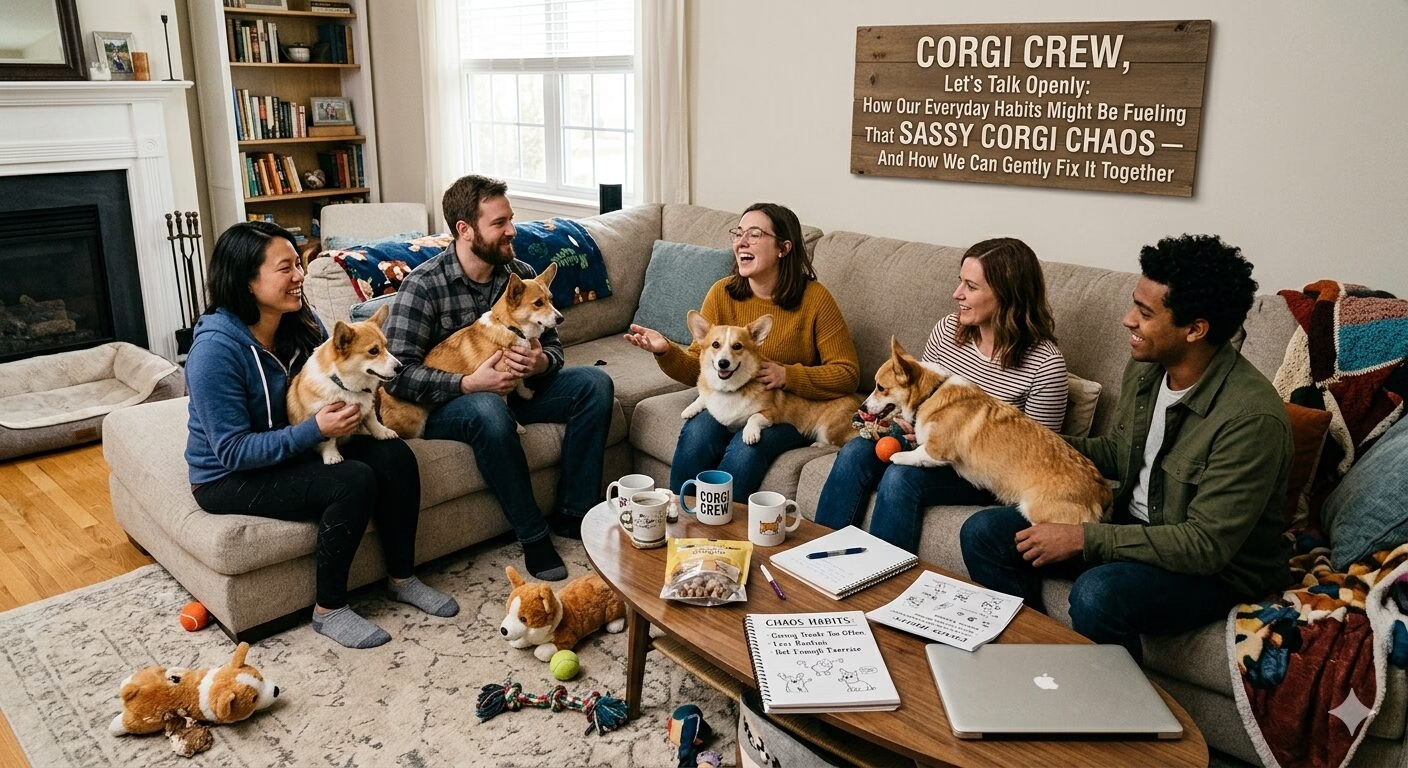
Let's Talk Openly
How Our Everyday Habits Might Be Fueling That Sassy Corgi Chaos — And How We Can Gently Fix It Together
Hand on heart, Corgi Crew — how many of us have looked at our Corgi mid-zoomie destruction spiral and thought, "Where did my sweet puppy go?" One minute they were a fluffy, wide-eyed angel learning to sit for treats. The next, they're body-slamming the sofa cushions, barking at absolutely nothing, and treating the garden fence like a personal challenge course.
Here's the thing nobody tells you clearly enough at the start: that chaos isn't coming from nowhere. A lot of it — more than most of us expect — is coming from us.
If you've ever wondered why your Corgi suddenly turned into a sassy chaos machine with attention-seeking barks, zoomie destruction, or dramatic separation whining, this warm community guide shows how our own everyday habits are often the biggest contributor, and how small, positive changes can bring back the calm and fun we all love. The latest expert consensus from the University of Lincoln (2026) — involving over 180 professional trainers and behavioural scientists — confirms it plainly: corgi misbehavior owner habits matter more than breed wiring does. That's actually great news, because our habits are something we can change.
 QUICK ANSWER
How Do Corgi Misbehavior Owner Habits Fuel the Sassy Chaos?
Corgi misbehavior owner habits — inconsistent rules, unintentional reward of chaos, under-stimulation, and poor response to stress signals — are the primary drivers of attention-seeking, destructiveness, unruliness, and separation anxiety. According to the University of Lincoln's 2026 expert consensus, owner management outweighs breed factors as the dominant cause of misbehavior.
Why Our Habits Matter More Than Our Corgi's Breed Wiring
Let's start with the science, because it's genuinely reassuring once you understand it. In 2026, researchers at the University of Lincoln brought together over 180 professional dog trainers and behavioural scientists for one of the largest expert consensus studies ever conducted on canine misbehavior. Their conclusion? The biggest driver of problem behaviors isn't breed. It's what we — the owners — do every day.
Specifically, four owner habits came up again and again as the dominant contributors:
- Inconsistency — applying rules sometimes but not others, or having different rules on weekdays versus weekends, or letting behaviors slide because we're tired.
- Aversive responses — raising voices, scolding, using punishment-based approaches that communicate threat rather than guidance.
- Missing our Corgi's stress signals — not noticing the yawning, lip-licking, whale eye, or sudden stillness that says "I'm overwhelmed" before a behavior escalates.
- Unmet needs — not enough physical exercise, not enough mental stimulation, not enough predictable routine for a dog whose brain is working overtime.
For the full professional-level analysis of this research and its implications for how dogs are raised, this authoritative breeder guide on the owner's dominant role in canine misbehavior development covers the complete expert consensus in depth.
Here's the empowering part of this for us as a Crew, these are all habit-level problems. They're not about our Corgi being "broken" or having a "bad temperament." They're about patterns we've fallen into — often without realising it — that we absolutely have the power to change.\
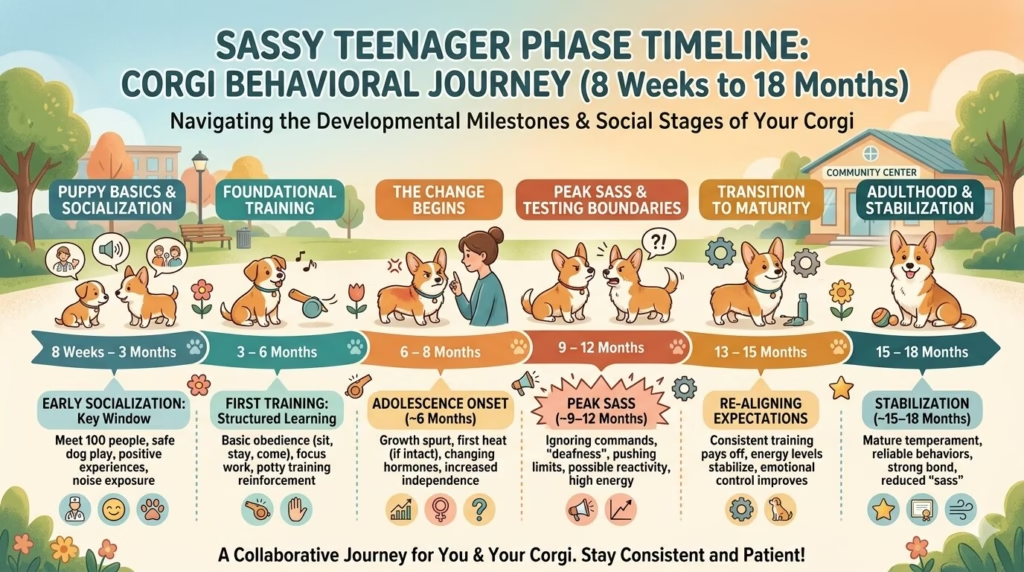
The Sassy Teenager Corgi Behavior Phase — And Why It Catches Us Off Guard
If you got your Corgi as a puppy and things were going beautifully — and then somewhere around six months, everything seemed to fall apart — you are not alone and you did not fail. What you met is the sassy teenager corgi behavior phase, and it is as real and as scientifically documented as human adolescence.
Research published in 2023 by Owczarczak-Garstecka and colleagues confirmed what experienced owners and trainers had been saying for years: adolescent dogs, from roughly six to eighteen months, go through a genuine neurological and hormonal transition that temporarily reduces their responsiveness to previously learned cues, increases their drive toward independence and exploration, and raises their overall arousal baseline. Your Corgi isn't being defiant on purpose. Their brain is doing something real.
Why this phase is especially intense in Corgis:
Corgis arrived at the teenager phase already carrying a herding breed's high drive, high environmental awareness, and strong independent decision-making instincts. Add surging hormones, and you get a dog that suddenly has both the internal energy to pursue its own agenda and a reduced bandwidth for deferring to yours. It's not personal. It's developmental.
What tends to go wrong during this phase — and it's usually us:
- We get frustrated and become less consistent precisely when consistency matters most.
- We reduce walks and training sessions because "they won't listen anyway" — removing the structured activity that would actually help.
- We escalate to raised voices or physical corrections, which typically make the arousal worse, not better.
- We interpret normal adolescent independence as a personality problem and start labeling our Corgi negatively — which subtly changes how we interact with them.
The antidote is advance preparation and community support. Knowing the sassy teenager phase is coming — and that it ends — changes everything about how you move through it.
Corgi Crew Confession Prompt 🐾
Has your Corgi hit the sassy teenager phase? What was the moment you knew things had shifted — and what was the first habit you changed that actually helped? Drop your story in the comments. The Crew wants to know.
Attention-Seeking Behavior Fixes
Are We Accidentally Rewarding the Chaos?
This is the section that most Corgi owners find uncomfortably relatable. The attention-seeking barking, the pawing at your arm while you're on a call, the theatrical whining when you stop making eye contact — these behaviors feel like they come out of nowhere. They don't. They were almost always trained in, gradually and unintentionally, by us.
Here's the mechanics of it, because once you see it, you can't unsee it:
Every time your Corgi barked for attention and you looked at them — even to say "stop" — they got what they wanted: your attention. Every time they pawed at you and you absent-mindedly stroked them, the pawing became more likely. Every time the theatrical whining made you give in and put the laptop down, the whining got reinforced as an effective strategy.
Corgi attention-seeking behavior fixes aren't complicated. They just require consistent redirection:
- Reward the quiet, not the noise. When your Corgi settles independently, even briefly, mark it ("good") and reward it. You're teaching them that calm behavior is the access route to good things.
- Completely ignore attention-seeking behavior — no eye contact, no talking, no reaction. This is harder than it sounds. The behavior will briefly get worse before it gets better (this is called an extinction burst and it means it's working).
- Give attention proactively, before it's demanded. Schedule five-minute connection sessions throughout the day. When you control when attention happens, your Corgi has less need to demand it.
- Teach a "place" or "settle" cue early. A Corgi that has a reliable settle behavior has an alternative to the chaos spiral.
- One specific note for the Crew. Corgis are highly food-motivated, which makes them unusually responsive to positive reinforcement approaches. This is genuinely good news. Use it. For practical application of these techniques, Basic Corgi Training Techniques for Beginners is a solid foundation to build from.
Why Corgis Destroy Things
What Our Routine Is Telling Them
Let's be real about destructive behavior. When a Corgi chews through a sofa cushion or excavates the garden, it is not acting out maliciously. It is coping — or more precisely, it is doing what organisms do when their physical and cognitive needs are consistently unmet: finding a way to discharge the energy themselves.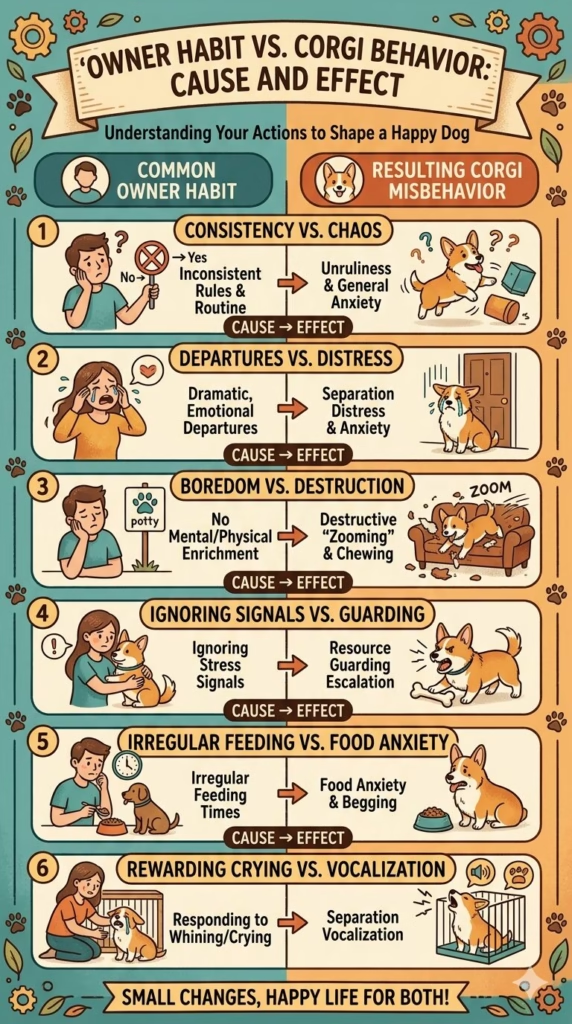
Destructive behavior in Corgis is almost always one of two things:
- Under-stimulation. A Corgi that has not had sufficient physical exercise and mental engagement will find its own stimulation. Chewing, digging, and shredding are all highly effective self-stimulation strategies. They work. That's why the dog does them.
- Stress relief. Dogs that are anxious — about being alone, about inconsistency in their environment, about unresolved arousal from the day — use physical activity, including destructive physical activity, to regulate their nervous systems.
The common owner habits that drive this:
- Leaving a Corgi alone for four or more hours without enrichment and expecting them to simply wait quietly.
- Providing a burst of high-energy exercise in the morning but nothing mental through the day — physical tiredness and cognitive tiredness are not the same thing for a herding breed.
- Punishing the destruction after the fact, when the dog has no cognitive ability to connect the correction to the behavior. This adds stress without removing the cause.
Gentle fixes that work:
- Before you leave, fifteen minutes of sniff-based enrichment — scatter feeding, a snuffle mat, a frozen Kong — engages the Corgi brain far more effectively than a ball chase.
- Rotate toys so novelty remains. The same three toys after two weeks are not enrichment; they're furniture.
- Consider a midday break — a dog walker, a friend, a structured daycare — if alone-time regularly exceeds four hours.
- Do not punish after the fact. Manage the environment instead.
Unruliness and Disobedience
The Inconsistency Trap We All Fall Into
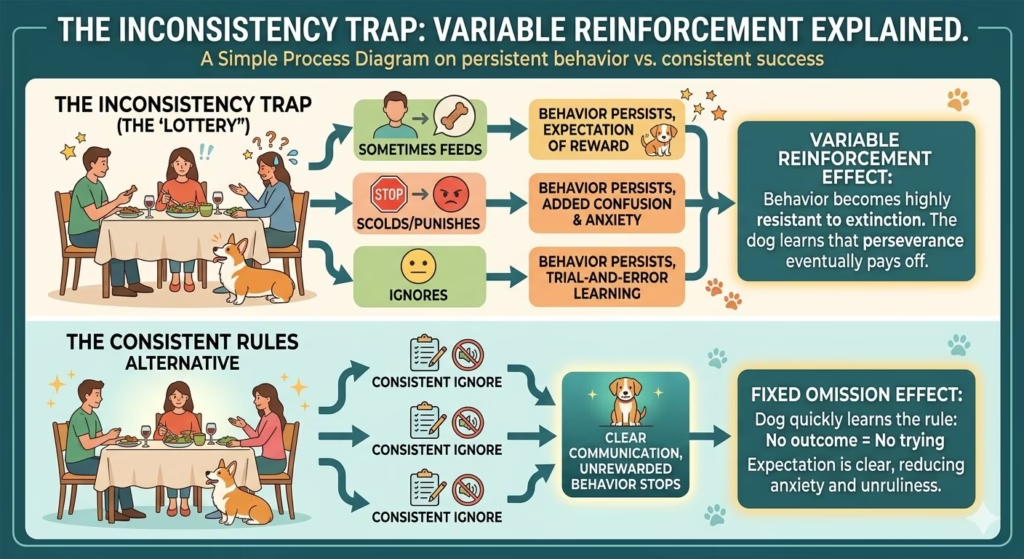
This one's possibly the most widespread corgi misbehavior owner habit of all, and almost every one of us is guilty of it at some point. The inconsistency trap.
Your Corgi jumps up in greeting. On Tuesday evening, you're happy to see them and you let it happen because it's sweet. On Wednesday morning, you're in work clothes and you correct it. On the weekend, your partner thinks the jumping is cute so they respond to it with delight. From your Corgi's perspective, jumping is on a variable reinforcement schedule — sometimes it works, sometimes it doesn't. Variable reinforcement schedules produce the most persistent behaviors. Your Corgi is going to keep jumping.
This applies to every rule in the household:
- On-furniture or off? If the answer varies by mood, the dog will always try.
- Pulling on lead — if it sometimes gets them closer to what they want, they'll keep pulling.
- Counter-surfing — if there was food there once, the expectation never fully extinguishes.
Corgi Crew, the one-rule fix:
Sit down with everyone in the household — partners, children, grandparents who visit — and agree on a list of ten rules that are always, without exception, applied the same way by everyone. Post it on the fridge if that helps. The rules themselves matter less than the consistency of their application.
Combine this with Corgi Puppy Socialisation Tips for a complete behavioral foundation, and you'll see the difference within weeks.
Escaping Adventures
Corgi Truancy Prevention Starts With Us
Corgis were bred to be independently decisive, quick-thinking working dogs. That herding brain does not switch off at the garden gate. When a Corgi escapes — fence-hopping, door-dashing, slipping leads — it is almost always a combination of high environmental drive, a self-rewarding exploration history, and an environment that gave them the opportunity.
Every successful escape reinforces the next one. A Corgi that gets out and spends twenty minutes investigating the neighborhood has been rewarded for escaping. The reward is not neutral — it's twenty minutes of high-value sensory experience that we as owners can rarely compete with in the back garden.
Owner habits that inadvertently enable corgi escaping truancy:
- Fence lines that haven't been audited for gaps, height, or stability since puppyhood (Corgis grow and become more athletic).
- Leaving garden access unsupervised during the period when escape motivation is highest — adolescence.
- Not having a reliable recall that works under high arousal, because recall was only ever practiced in low-distraction environments.
Practical corgi truancy prevention steps:
- Monthly fence audit as a household habit — gates, gaps, dig-unders, jump heights.
- Recall training in genuinely high-distraction environments from six months onwards, using high-value rewards (real meat, cheese) that compete with the external environment.
- Teach a "wait" at every door before it becomes a problem. One second of waiting rewarded is the foundation of reliable door manners.
Resource Guarding and Corgi Aggression Causes
Before It Escalates
We need to talk about this one sensitively but directly, because missing early aggression signs in Corgis is a common and consequential owner habit gap.
Resource guarding — growling, stiffening, or snapping over food, toys, furniture, or people — is not a personality defect in your Corgi. It is a normal dog behavior that, in the absence of good owner management, escalates. The escalation is almost always driven by owner responses to the early signals.
What typically happens:
- Corgi stiffens over a food bowl when approached.
- Owner reaches in to "establish dominance" or show the dog who's boss.
- Corgi escalates to a growl.
- Owner corrects the growl (punishes the warning signal).
- Corgi learns that the growl doesn't work — and skips it next time.
- The bite arrives without the warning it used to provide.
The gentle, effective approach:
- Approach the food bowl with good things: add a high-value treat to the bowl as you pass, consistently, until approaching the bowl predicts good things rather than resource competition.
- Never punish a growl. A growl is communication. Thank it, note it, and address the underlying anxiety — don't remove the warning.
- Seek guidance early. Early signs of resource guarding, caught at the stiffening stage, are highly addressable with positive reinforcement approaches. Late-stage guarding with a history of punishment-escalation is significantly more complex.
For a comprehensive professional perspective on corgi aggression causes and the owner-management chain that leads there, the Potential Paradox article on PemberDiamonds explores the personality dynamics behind these escalation patterns in depth.
Corgi Abnormal Eating Behavior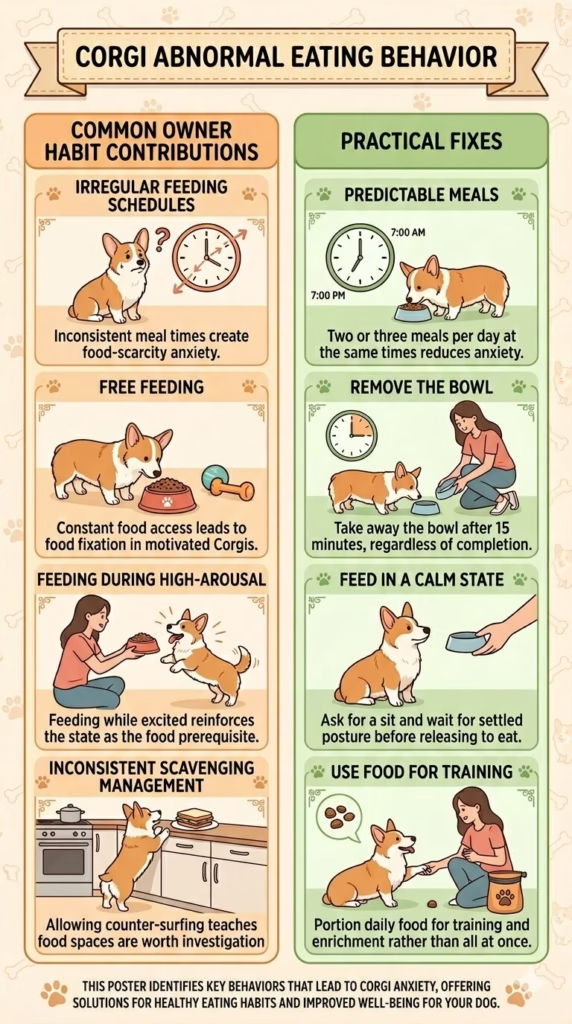
When Feeding Habits Create Anxiety
— eating too fast, guarding food, scavenging obsessively, eating non-food items — is more frequently driven by the feeding environment than by anything inherent to the individual dog.
The most common owner habit contributions:
- Irregular feeding schedules. Feeding at inconsistent times creates food-scarcity anxiety. A dog that doesn't know when the next meal is coming will treat every feeding as potentially the last and eat accordingly.
- Leaving food down all day ("free feeding"). Counterintuitively, constant food access can also create anxiety-driven eating in Corgis who are highly food-motivated — the ever-present resource becomes a fixation rather than a routine event.
- Feeding during high-arousal moments. Feeding a Corgi that is already excited or anxious reinforces the arousal state as the prerequisite for food.
- Inconsistent scavenging management. Allowing counter-surfing or table scavenging occasionally teaches the dog that human food spaces are worth persistent investigation.
Practical fixes:
- Two or three meals per day at the same times, every day. Predictability reduces food anxiety reliably.
- Remove the bowl after fifteen minutes whether finished or not. This creates a clear feeding ritual without free-access anxiety.
- Feed in a calm state — ask for a sit before the bowl goes down, and wait for a settled posture before releasing.
- Use feeding time as training time: portion out part of the daily food ration for enrichment and training rather than serving it all at once.
Separation Distress
The Habits That Accidentally Make It Worse
Corgi separation anxiety community tips invariably circle back to the same insight: the habits that create separation anxiety are almost always established in the first weeks of ownership, before the problem is visible.
The inadvertent patterns that lay the groundwork:
- Constant contact during the first weeks. Carrying the puppy everywhere, allowing them to sleep in contact with you every night, and never allowing calm independent time teaches the Corgi that your presence is the baseline state — and your absence becomes genuinely dysregulating.
- Dramatic departures and arrivals. Long emotional goodbyes and exuberant reunions communicate that your comings and goings are high-stakes emotional events. The dog's nervous system learns to treat them accordingly.
- Responding to crying with return. If early alone-time crying consistently brings you back, the Corgi learns that crying is the effective strategy. The crying intensifies, not because the dog is manipulating you (they're not), but because it has been reliably reinforced.
Gentle adjustments that make a real difference:
- Begin very short, positive alone-time from the first week — one minute in a crate or pen with a high-value enrichment item, then calmly return before anxiety builds.
- Calm, matter-of-fact departures and arrivals. No fuss in either direction. It takes two weeks of consistency to begin shifting the emotional association.
- Build alone-time duration gradually and never in large jumps. If your Corgi is consistently settled for fifteen minutes, the next step is twenty — not two hours.
- If anxiety is already established, a qualified behaviourist's guidance is more effective than extended trial and error. Early intervention produces faster and more durable results than waiting.
Corgi Crew Confession Prompt 🐾
Has your Corgi struggled with separation distress? What finally helped? Share below — your experience might be exactly what another Crew member needs to read today.
Positive Reinforcement for Corgi Chaos
The Gentle Fixes That Actually Work
Here's what the University of Lincoln's 2026 expert consensus makes clear: positive reinforcement isn't just a "nice" approach for people who prefer to be kind. It is the most evidence-supported, most effective, most durable behavioral approach available. For Corgis in particular — highly intelligent, food-motivated, eager-to-please dogs who happen to have an independent streak — it is ideally matched.
The core positive reinforcement loop, applied to Corgi daily life:
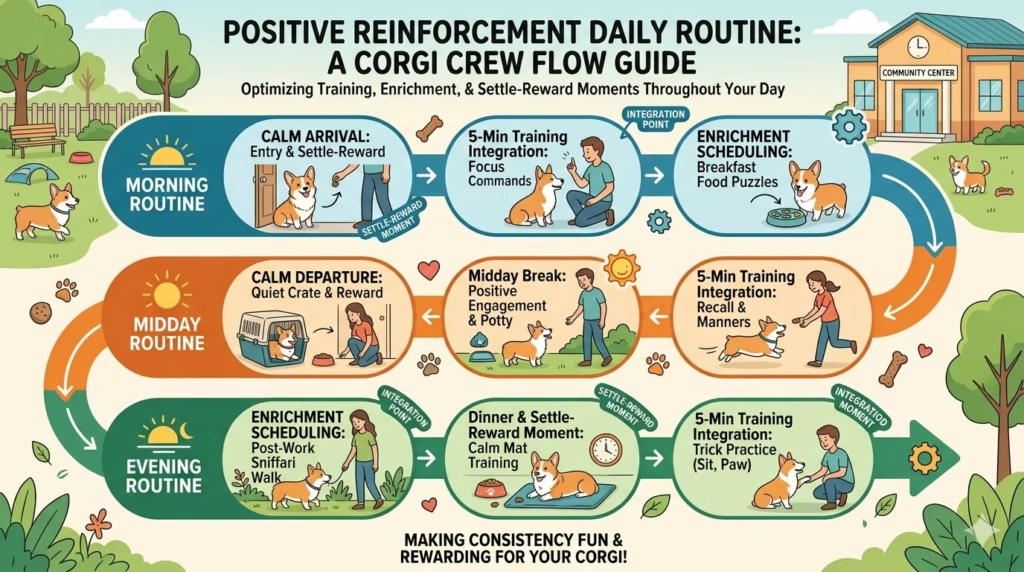
- Catch them getting it right. This requires attention and intentionality. When your Corgi is settled, quiet, walking beside you without pulling — mark it and reward it. Most of us only notice the chaos. Start noticing the good.
- Reward before it's too late. Timing matters. The reward needs to arrive within two seconds of the behavior you want to reinforce. After that, you're reinforcing whatever the dog is doing right now.
- Use what your Corgi values. Not what you think they should want — what they actually want. For most Corgis, that's real food, short play bursts, and access to interesting environments. Use these as rewards deliberately.
- Keep training sessions short. Five to ten minutes, four or five times a day, outperforms a forty-minute session once daily in terms of learning retention and enthusiasm maintenance.
- Build in a success rate. Training should be set at a difficulty where your Corgi succeeds around eighty percent of the time. Consistent failure builds frustration; consistent success builds the learning habit.
The research from the University of Lincoln, and years of community experience shared through the Crew, consistently shows the same thing. Small, consistent habit changes on our side produce remarkable behavioral changes on theirs. You don't need to overhaul your life. You need to shift five or six daily interactions — and do it the same way, every time.
 EXPERT INSIGHT
From a Corgi Behaviour Specialist
"One pattern I see repeatedly in Corgi households — and almost never in the textbooks — is what I think of as the "five-minute overwhelm cycle." Corgis are extraordinarily attuned to their owners' emotional states. They read micro-expressions, posture shifts, and vocal tone changes with a precision that most owners significantly underestimate. What this means in practice is that a Corgi in a household with an owner who is consistently stressed, rushed, or emotionally volatile will often develop behavioral problems that look, superficially, like training failures — but are actually the dog accurately mirroring the owner's nervous system.
The fix, in these cases, is not more training. It is building five deliberate minutes of calm, purposeful connection into the day — not play, not training, not enrichment, but simply quiet proximity: sitting together, gentle contact, no demands from either direction. In my experience, Corgis respond to this within days. The baseline arousal drops, the reactivity softens, and suddenly the training that wasn't sticking starts to stick.
This is not anthropomorphising. It is documented in canine mirror neuron research and in the oxytocin synchrony studies that show dog-owner cortisol levels measurably correlate during shared calm time. Our emotional regulation is, quite literally, our Corgi's behavioral environment."
 FAQ
FAQ
1. Why is my Corgi suddenly ignoring commands they used to know perfectly?
This is the adolescent phase in action — likely beginning somewhere between five and eight months. Neurological changes during this developmental stage temporarily reduce responsiveness to established cues, regardless of prior training quality. The response is to stay consistent, keep training sessions short and rewarding, and not escalate to frustration-based correction. The responsiveness returns.
2. How do I stop my Corgi from attention-seeking barking without just yelling back?
Complete, consistent non-response to the barking (no eye contact, no speech, no movement toward the dog) removes the reinforcement that maintains it. Simultaneously, actively reward every moment of quiet with calm praise and occasional treats. The behavior will temporarily increase before it decreases — this is normal and means the extinction process is working.
3. My Corgi destroys things only when I'm out. Is this separation anxiety or boredom?
Both are possible, and both are owner-management addressable. True separation anxiety involves distress signals (panting, pacing, vocalization) alongside destruction. Simple boredom-driven destruction tends to be more exploratory and less frantic. Either way, pre-departure enrichment, shorter alone-times, and a gradual building of independence tolerance are the first interventions. A behaviourist assessment is worthwhile if distress signs are present.
4. What are the most common owner mistakes with Corgi adolescence?
Reducing exercise and training during the phase (when more structured activity actually helps), escalating to punishment-based responses out of frustration (which worsens arousal), and interpreting developmental independence as personality problems. Knowing the phase is coming and preparing for it — with consistent positive management and community support — produces significantly better outcomes.
5. Can a Corgi's food-guarding behavior be fixed with positive reinforcement?
Early-stage resource guarding responds very well to positive reinforcement approaches: consistently approaching the food bowl with added high-value treats builds a positive association with human proximity at meal time. More established guarding behaviors benefit from a qualified behaviourist's structured programme. The critical rule: never punish a growl, as this removes the warning signal without addressing the underlying anxiety.
6. Is it normal for Corgis to be really clingy, or is that separation anxiety?
Clinginess and separation anxiety are related but distinct. Clinginess — following, seeking constant contact — is common in Corgis and reflects their bonding depth. It becomes separation anxiety when the dog cannot tolerate any absence without distress. Both are influenced by early independence training: Corgis whose owners built calm independent time from the first weeks tend toward clinginess rather than full anxiety, which is manageable with consistent routine.
7. How do I know if my Corgi is reacting to my stress versus just being difficult?
Notice whether the difficult behavior correlates with your own emotional state, routine disruption, or high-pressure periods. Corgis that escalate during owner stress cycles, settle during calm household periods, and respond poorly to rushed or emotionally charged training sessions are very likely mirroring rather than independently misbehaving. Five minutes of intentional calm together before a training session frequently transforms the session quality.
8. Why does my Corgi pull on the lead even though we've been training loose-lead walking for months?
Lead-pulling almost always persists because it occasionally still works — the dog gets closer to something interesting, the owner gives in after sustained pulling, or the rule is applied inconsistently across different walks or walkers. Audit every household member's lead-walking behavior and ensure the pulling never, ever moves the dog forward. Consistent non-reinforcement of pulling, combined with rewarding the moment of loose-lead position, typically produces results within two to three weeks of strict application.
9. At what age should I expect the sassy teenager phase to end?
Most Corgis begin stabilising between fifteen and eighteen months, with significant individual variation depending on whether they are neutered, their overall arousal baseline, and the quality of management during the adolescent phase. Corgis whose owners applied consistent positive management through adolescence typically emerge from it with stronger responsiveness and more reliable behavior than before the phase began. Consistency during the chaos pays dividends.
10. Does the Corgi Crew have a recommended training approach for the whole misbehavior spectrum?
The foundation is consistent positive reinforcement: rewarding what you want, removing reinforcement from what you don't, and applying the same rules across all household members and contexts. This works across every misbehavior dimension covered in this guide. For breed-specific training techniques from the beginning, Basic Corgi Training Techniques for Beginners is the starting point the Crew recommends.
CONCLUSION
Three things are worth carrying with you from this conversation. First, the chaos isn't coming from your Corgi's wiring — it's coming from patterns in how we're managing our everyday interactions, and patterns are changeable. Second, the sassy teenager phase is real, neurologically documented, and survivable — with advance preparation, community support, and the willingness to stay consistent when it feels hardest. Third, positive reinforcement isn't just a method; it is the Crew's most powerful daily tool, ideally suited to the Corgi's food-motivated, intelligent, bond-oriented nature.
Within the Training and Behavior space, the most consistent finding across all the research and all the community experience is the same: small changes, applied consistently, by every household member, over a few weeks, produce behavioral transformations that feel genuinely miraculous. They're not miraculous. They're just the science working. You've got this, Crew. And you've got each other.
 CALL TO ACTION
Ready to put these insights into practice? Start with the foundation. Basic Corgi Training Techniques for Beginners gives you the positive reinforcement building blocks for every behavior this guide covers. And don't miss the Corgi Puppy Socialisation Tips — because strong early socialisation is the soil that everything else grows from.
The Crew is here. Share your experience in the comments — what landed for you today, what you're going to try first, and how your Corgi is doing. Your story might be exactly what someone else needed to read.