Think You Know Corgis? Why the Tanydd Corgi Crew Self-Assessment Is the Most Honest Test You Will Take
Published by Tanydd Corgi Crew — Pembroke Welsh Corgi Kennel
Knowledge and familiarity are not the same thing. You can live with a Corgi for years, develop real instincts for their moods and preferences, and still have meaningful gaps in your understanding of why they behave the way they do — or what the research actually says about how they learn.
The Tanydd Corgi Crew Chapter Self-Assessment was designed precisely to find those gaps. It is an interactive, self-directed quiz built on the full content of Corgi Chronicles: A Training Guide for Pembroke and Cardigan Welsh Corgis. Ten chapters. Twenty questions each. Two hundred questions in total. And a results system detailed enough to tell you not just how you scored, but specifically what you missed, what the correct answer was, and exactly where in the book to go to put it right.
It is free, it requires no registration, it works on any device, and it can be taken as many times as you like. What it cannot be is gamed. That is intentional, and it matters. Here is why.
The Problem with Most Multiple Choice Tests
Most multiple choice assessments have a dirty secret: if you understand how they are typically constructed, you can score reasonably well without knowing the subject. The correct answer tends to be the longest and most detailed option. The wrong answers are either obviously silly or clearly not relevant. And the correct answer clusters at one or two letter positions because test writers unconsciously default to B or C.
None of that applies here. This assessment was rebuilt from the ground up to close every one of those loopholes.
Balanced Answer Positions
Across all 200 questions, the correct answer appears at position A exactly 50 times, at position B exactly 50 times, at position C exactly 50 times, and at position D exactly 50 times. That is a precise 25% distribution at each letter. Within each individual chapter of 20 questions, the distribution is exactly 5 A, 5 B, 5 C, 5 D — with no run of the same correct letter appearing more than twice in a row.
If you select B for every single one of the 200 questions, you will score exactly 50 out of 200 — a 25% result and a solid fail. There is no pattern to exploit. Guessing is statistically worthless.
Plausible Distractors
The three wrong answers for every question are not obviously silly. They are written to represent common misconceptions, partial truths, or the kinds of answers that sound plausible to someone who has a surface familiarity with the topic but has not engaged with the material carefully.
For example, a question about the purpose of dopamine during training does not have “cortisol” as one of its wrong answers alongside two irrelevant options. Instead, all four options name neurotransmitters with plausible roles — and only someone who understands what the book specifically says about dopamine and memory consolidation will choose the right one.
Similarly, a question about reward delivery timing does not offer “within thirty seconds” alongside “never deliver a reward” and “only at the end of the session”. The wrong answers are one minute, five to ten seconds, and thirty seconds — all plausible-sounding windows that someone might genuinely believe are acceptable.
Uniform Option Length and Structure
Every set of four options for every question is written to be approximately the same length and the same grammatical structure. Longer answers are not the correct answers. More detailed answers are not the correct answers. The correct answer is simply the accurate one, presented in the same format as the three incorrect ones.
The ResultA score of 75% or above on this assessment genuinely means something. It reflects real command of the chapter material — not familiarity with how multiple choice tests work. |
What the Tool Contains
The assessment covers all ten chapters of Corgi Chronicles. Each chapter has 20 questions drawn directly from the book’s content — not paraphrased from general dog training advice, but grounded in the specific frameworks, case studies, terminology, and principles that Morgan Heeler-Davies developed for Pembroke and Cardigan Welsh Corgi owners.
The questions test recall and applied understanding in equal measure. Some ask about specific concepts — a tail position, a vocalisation type, a developmental window, a recommended reward timing. Others ask about the reasoning behind a recommendation, the interpretation of a case study, or the principle behind a training approach. Both kinds of knowledge matter, and both are tested.
The Numbers10 chapters. 20 questions each. 200 questions total. Exactly 50 correct answers at each of positions A, B, C, and D. Personalised results after every chapter. Cumulative final results when all ten are complete. |
How to Use the Tool
Enter Your Details
Start by entering your name, your Corgi’s name, their age, and their gender. These four inputs personalise every result card, every recommendation, and every piece of feedback throughout the assessment. Your Corgi’s name and correct pronouns appear throughout — because this is about your dog, not a hypothetical one.
Select a Chapter
You see a grid of all ten chapters, each showing its title and page range from the book. A progress bar shows overall completion. Completed chapters display a grade badge. You can work in any order, though the book’s own sequence is recommended because the chapters build on one another.
Answer the Questions
Each chapter shows 20 questions on a single scrollable page. One correct answer from four options. No timer. Review before you submit. When you are ready, click Submit Chapter.
Read Your Result Card
Every result card includes:
- Your score out of 20 and your percentage
- Your letter grade and the name of the level (Mastery, Proficient, Developing, Needs Work, or Review Required)
- A paragraph of personalised commentary appropriate to your grade level
- A Strengths section listing every question you answered correctly
- A Focus Areas section listing every question you got wrong, with the correct answer shown immediately
- Three specific, actionable next-step recommendations
- For scores below 60%, a prominent callout with a direct link back to the chapter in Corgi Chronicles
Complete All Ten and View Your Final Results
Once all ten chapters are done, your cumulative Final Result becomes available. It shows your total score across all 200 questions, your overall letter grade, a chapter-by-chapter breakdown grid, personalised recommendations based on your performance pattern, and a call to action linking to Corgi Chronicles.
The Reset button in the top right corner of every screen from the chapter grid onward lets you clear everything and start again at any point — useful for retaking after revisiting weak chapters in the book.
Understanding Your Grade
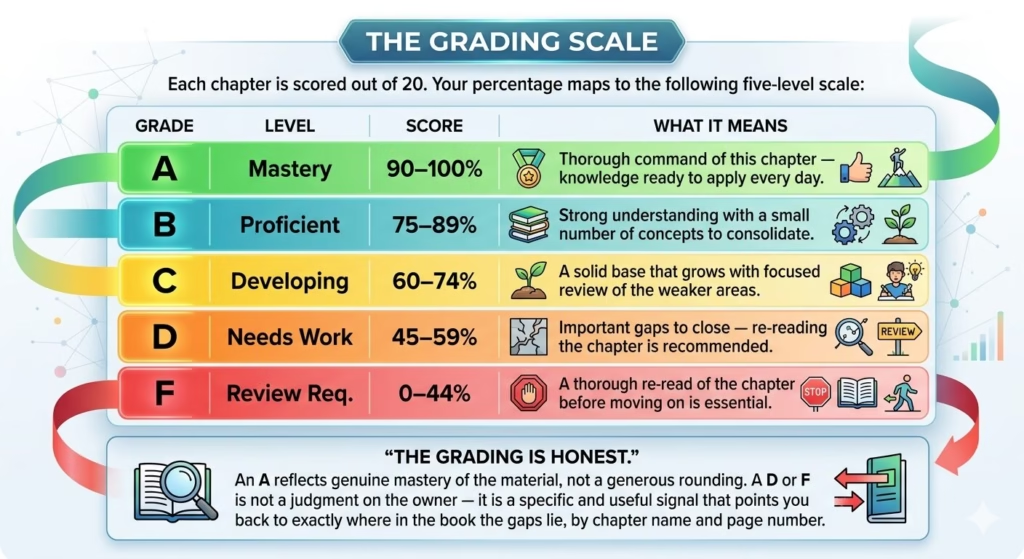
Because the answer positions are balanced and the distractors are plausible, these grades are earned. A grade B means you understood the material well. A grade F means a re-read of that chapter will produce a meaningfully different result next time — and the Focus Areas section tells you exactly which questions to study before you do.
The Ten Chapters and What They Test
Here is the specific knowledge territory covered in each chapter’s twenty questions:
- Understanding Corgi Communication (pp. 9–24) — tail positions (horizontal, raised, tucked, stiff-high), ear positions, the Corgi Lean, bark types (staccato, rumbling, high-pitched, herding yips), stress indicators, confidence signals, and the principle of individual communication variation
- The Science of Connection (pp. 25–32) — dopamine and memory consolidation, the three developmental windows (neonatal, socialisation, juvenile), neuroplasticity, the one-to-two second reward window, motivational variation across individuals, high-value rewards, tone modulation, and the reward map
- The Art of Canine Communication (pp. 33–43) — calming signals, whale eye, play bows, piloerection, distance-increasing signals, appeasement versus submission, slow blinking, the difference between stress signals and confidence signals, and the necessity of whole-body assessment
- Navigating Corgi Behavioural Challenges (pp. 44–48) — herding instinct management, the threshold concept, reactivity, resource guarding, separation anxiety, destructive chewing, management as prevention, counter-conditioning, and the role of enrichment and exercise
- Unleashing the Potential of Corgis (pp. 49–57) — shaping through successive approximations, canine sports suited to Corgis, proofing across environments, building confidence gradually, mental enrichment including scent work, and the foundation of all advanced training
- The Heart of the Human-Corgi Bond (pp. 58–64) — the sources of attachment, the role of oxytocin, earned trust through repeated consistency, the damage caused by unpredictable owner behaviour, the distinction between quality time and physical proximity, and secure attachment styles
- Adapting to Changing Landscapes (pp. 65–71) — life stage transitions, adolescent hormonal regression, senior modifications, new environments, multi-dog household management, seasonal behaviour changes, and the principle of continuous adaptive ownership
- Strategic Approaches to Canine Excellence (pp. 72–77) — realistic goal-setting, structured training progression, transitioning reinforcement schedules, managing plateaux, the growth mindset, benchmark assessment, and the strategic use of professional input
- Health, Nutrition and Training Intersection (pp. 78–95) — IVDD risk and training modifications, PRA adaptations, obesity and joint stress, dental health and reward-based training, hydration, omega-3 and glucosamine for joint support, food allergy management, and the mind-body connection in behaviour
- Ongoing Learning and Advanced Concepts (pp. 96–99) — the evolution of canine science, concept training principles, cooperative care, canine cognition research, force-free training history, the value of training clubs, enrichment variety, and the lifelong learning commitment
The Educational Case for Self-Testing
The testing effect — the finding that retrieving information from memory consolidates it more durably than re-reading — is one of the most replicated results in the cognitive science of learning. The mechanism is well understood: when you attempt to retrieve an answer and get it wrong, then see the correct answer, the discrepancy creates a strong encoding event. The correction sticks not because you read it passively, but because your brain was actively engaged in the moment of learning it.
This is why the Focus Areas section of every result card shows the correct answer immediately for every question you missed. It is not just so you know what the answer was. It is so the knowledge embeds at the moment you are most primed to receive it — right after a genuine attempt.
For Corgi owners, the practical implication is significant. The material in Corgi Chronicles is not abstract theory. It describes the dog in front of you, in real time, every day. The more fluently you hold this knowledge — the less you have to think about it — the more naturally you respond to what your Corgi is communicating. Self-testing is how fluency is built.
Who Should Use This Assessment
- Families preparing to collect a Tanydd Corgi Crew puppy, who want to arrive informed and confident from day one
- Owners of adolescent Corgis navigating the challenging six-to-eighteen-month period, who want to understand the developmental science behind what they are experiencing
- Long-time Corgi owners who want to check whether recent research has updated their understanding in areas like learning theory, enrichment, or health management
- Anyone working through a specific behaviour challenge, who wants to confirm their foundational knowledge is solid before beginning a behaviour modification programme
- Partners and household members who share the dog’s care but may have engaged with the book less deeply than the primary trainer
What a Good Score Actually Means
Because this assessment was designed to resist guessing and superficial pattern recognition, a strong result carries real weight.
An A on Chapter 1 means you have a thorough working understanding of how Corgis communicate through body language and vocalisation. You can distinguish a neutral tail from a submissive one, a stress signal from a confidence signal, a herding bark from an alert bark. That knowledge will show up in how you read and respond to your dog every day.
An F on Chapter 9 means there are gaps in your understanding of how your Corgi’s health profile interacts with their training capacity — gaps that are worth closing, because they affect decisions you may already be making about exercise, treats, and session length.
Both results are useful. One confirms what you know. The other tells you precisely where to direct your next hour of reading.
About Corgi Chronicles
Corgi Chronicles: - A Training Guide for Pembroke and Cardigan Welsh Corgis by Morgan Heeler-Davies is the reference work this assessment is built on and the resource that Tanydd Corgi Crew recommends to every puppy family. If you have not yet read it, the self-assessment is an excellent way to identify the chapters most relevant to where you currently are in your journey — and to give yourself a specific reason to engage with those chapters in depth.
Begin Your Assessment
The Corgi Chronicles Chapter Self-Assessment is now live! Click the button above to start your assessment. The book is available at https://www.pemberdiamonds.co.za/corgi-chronicles.
Enter your details. Choose a chapter. Answer honestly. The results will tell you something true about what you know — and something equally useful about what you do not yet.