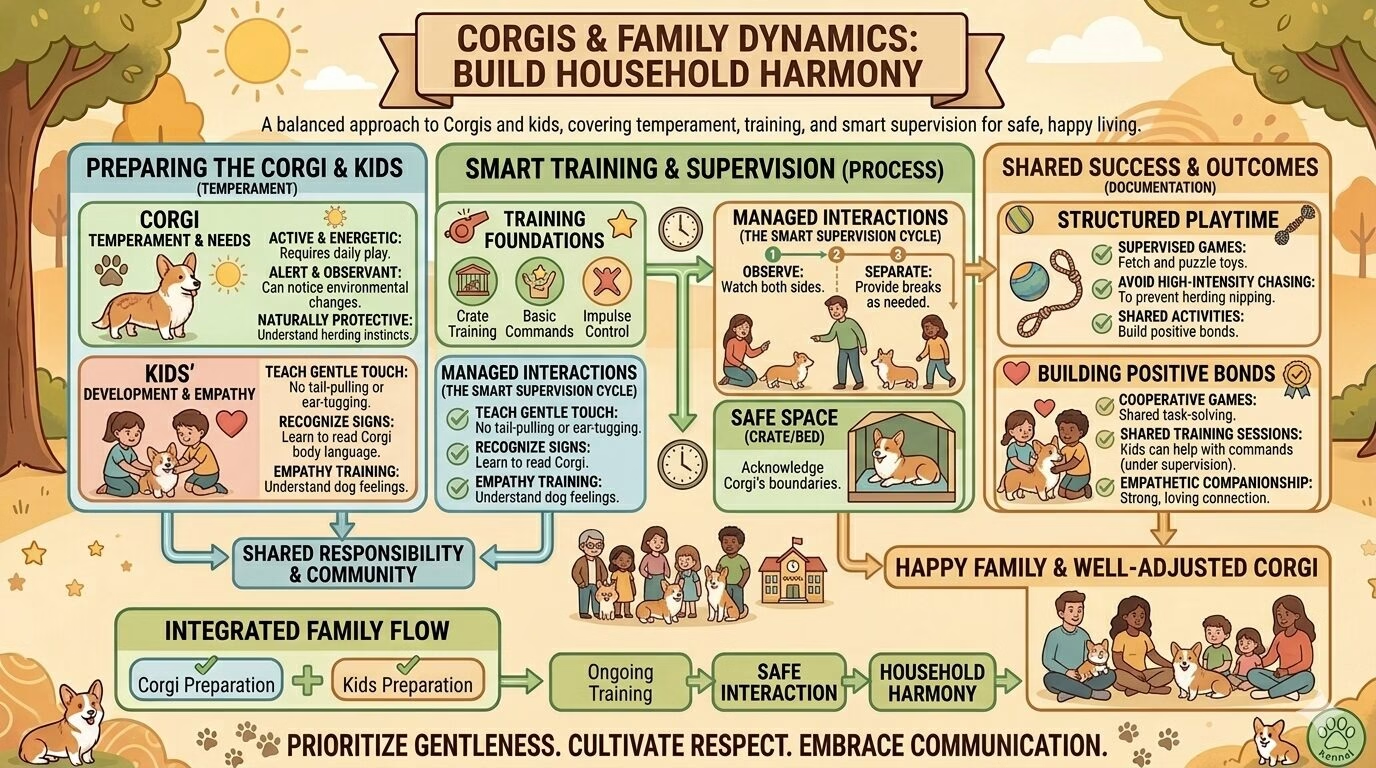
Corgis and Family Dynamics
Corgis are not the obvious choice when someone pictures the quintessential family dog. They are compact, opinionated, and possessed of a herding instinct that was purpose-built for moving cattle — not for tolerating a toddler's unpredictable grabbing. And yet, in the right household with the right groundwork, corgis with kids can become one of the most rewarding combinations in dog ownership.
The challenge is that the groundwork is non-negotiable. A Corgi placed into a family home without structured introduction, consistent rules, and age-appropriate supervision for the children does not fail because the breed is unsuitable. It fails because the family dynamic was never built with the dog's instincts in mind.
This guide is for families who want that relationship to work — and who are willing to do the actual work of building it. Whether you already have a Corgi or are considering bringing one home to a household with children, you will find a practical, evidence-based framework here for creating genuine household harmony.
 QUICK ANSWER
Are corgis good with kids?
Corgis with kids can work exceptionally well when both the dog and the children receive proper preparation. Corgis are intelligent, loyal, and responsive to consistent handling — but their herding background means they may nip at running children if untrained. With positive reinforcement, supervised interaction, and age-appropriate boundaries set from day one, most Corgis adapt readily to family life.
Understanding Corgi Temperament in a Family Context
A Corgi's temperament is not a fixed personality type — it is a set of breed tendencies that interact with training, socialisation, and environment to produce the dog you actually live with. Understanding those tendencies is the first step to working with them rather than being surprised by them.
Pembroke Welsh Corgis were bred as working herding dogs on Welsh farms, where their role required them to be alert, quick-moving, vocal, and capable of making independent decisions under pressure. Those traits do not disappear in a suburban living room. They express differently, but they are present — and in a family with young children, they will find expression one way or another.
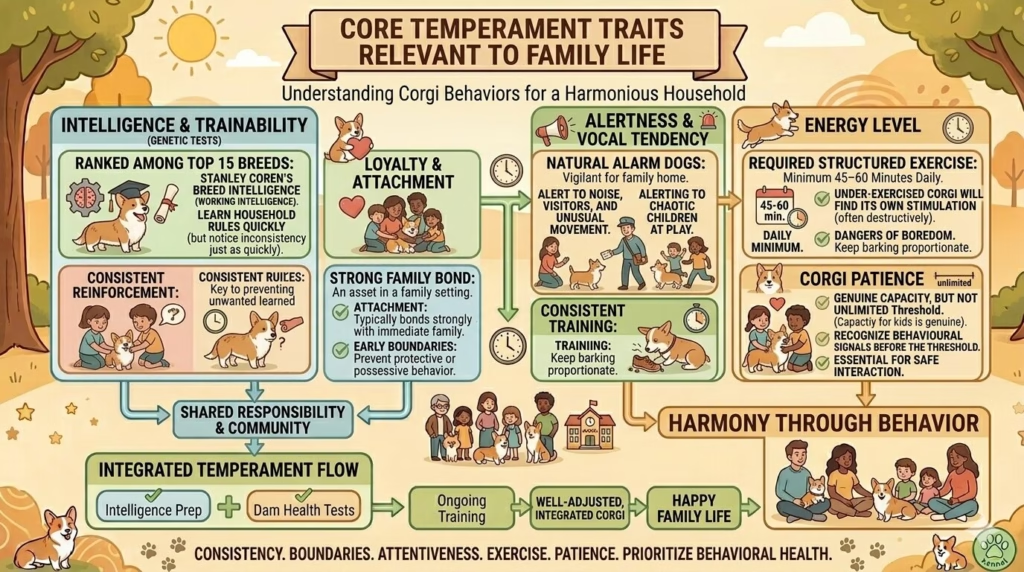
Core temperament traits relevant to family life:
- Intelligence and trainability. Corgis rank among the top 15 breeds for working intelligence in Stanley Coren's widely cited breed intelligence rankings. This means they learn household rules quickly — but it also means they notice inconsistency just as quickly.
- Loyalty and attachment. Corgis typically bond strongly with their immediate family group. This is an asset in a family setting, but it can produce protective or possessive behaviour if boundaries are not established early.
- Alertness and vocal tendency. Corgis are natural alarm dogs. In a family home, this means they will alert to noise, visitors, and unusual movement — including the chaotic movement of children at play. This is manageable, but it requires consistent training to keep barking proportionate.
- Energy level. Corgis require a minimum of 45–60 minutes of structured exercise daily. A Corgi that is under-exercised in a family home is a Corgi that will find its own stimulation — often destructively.
- Corgi patience. The breed has genuine capacity for patience with children, but it is not unlimited. Every Corgi has a threshold, and recognising the behavioural signals before that threshold is reached is essential for safe interaction.
What Age of Child Works Best with Corgis?
There is no single age of child that is universally "right" for a Corgi, but there are developmental stages at which the risk of mismatched interaction is highest. Understanding these stages allows families to calibrate their supervision and preparation accordingly.
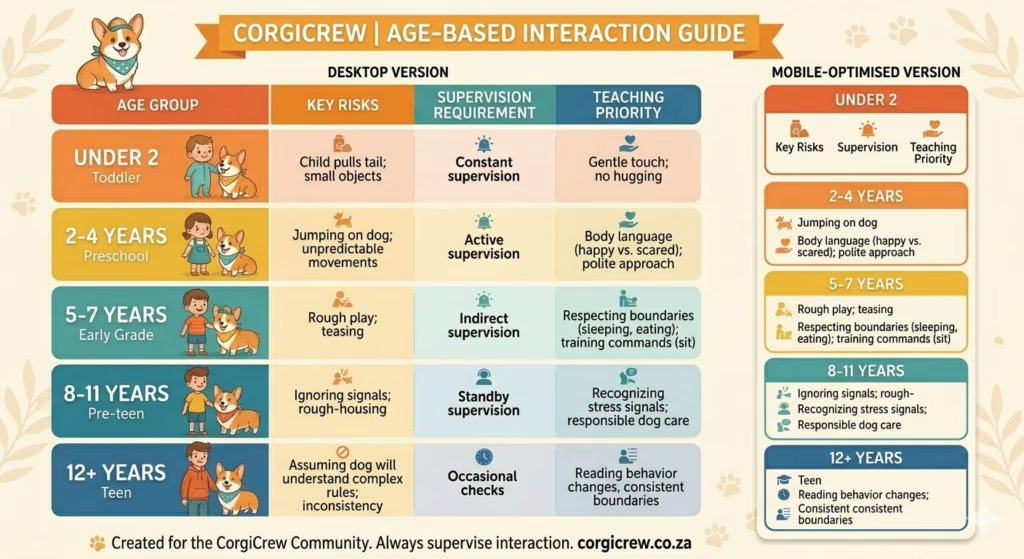
The most vulnerable period for the Corgi–child relationship is typically ages two to four. Children at this developmental stage do not yet have the motor control to move predictably around a dog, and they naturally interact with animals at face level — a combination that significantly increases the risk of reactive behaviour from even a well-tempered dog. This is not a reason to avoid the combination; it is a reason to ensure that during this stage, no interaction between the child and the Corgi occurs without a parent physically present and actively managing the exchange.
The Herding Instinct
Managing Nipping Around Children
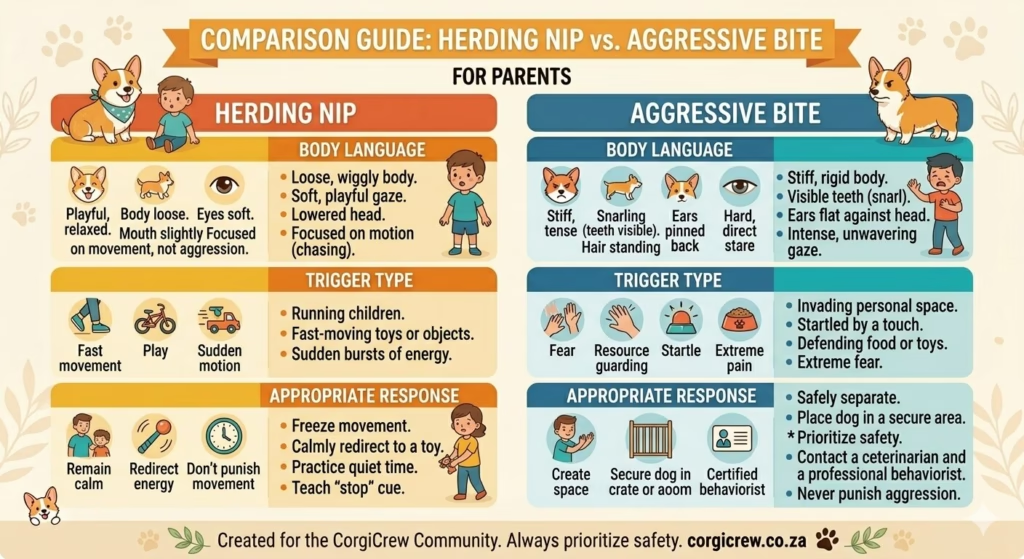
The Corgi's herding instinct is the single most frequently misunderstood element of the breed in family contexts. Families who research Corgis online often encounter reassurances that the breed is "gentle" and "great with kids," and then find themselves dealing with a dog that nips at their child's heels during play. The nip is not aggression — but that distinction provides limited comfort to the child who experienced it.
Herding nips from Corgis are instinctive, movement-triggered behaviours. The dog is not biting from fear, pain, or territorial aggression — it is responding to the stimulus of fast, unpredictable movement exactly as its working ancestors would have responded to a wayward heifer. The child running across the garden activates the same neural pathway as the cattle on the Welsh farm.
Practical management framework
- Never allow running in the dog's immediate vicinity without prior training. If the Corgi's herding response has not been addressed through training, children should walk — not run — near the dog until the behaviour is under management.
- Train a reliable "leave it" and "settle" command. These commands interrupt the herding-response sequence before nipping occurs. Basic Corgi Training Techniques for Beginners covers the foundational obedience framework for these commands in detail.
- Redirect, not punish. When a Corgi begins to stalk or circle a moving child, redirect to a structured activity — sit, down, place — rather than correcting the behaviour physically. Punishment at the point of instinctive behaviour produces anxiety, not learning.
- Increase structured exercise. A Corgi that has received 45–60 minutes of structured physical and mental exercise before the high-activity period of the day (after-school, early evening) has significantly lower arousal and is less likely to shift into herding mode.
- Identify and manage triggers. Running, high-pitched squealing, sudden direction changes, and children rolling on the floor are common herding triggers. Identify the specific triggers for your dog and implement management accordingly.
- Research on dog-bite incidents in family settings consistently shows that the majority of bites to children involve dogs that the child knew, in the family home, during "playful" interaction. The herding nip that is not managed, corrected, and trained out does not typically stay at the nip level indefinitely.
Teaching Kids Dog Safety
A Non-Negotiable Foundation
Teaching kids dog safety is not a single conversation — it is an ongoing curriculum that evolves with the child's developmental stage. The principles are simple; the implementation requires repetition and parental consistency.
Core dog safety rules for children (age-appropriate delivery):
Do not disturb a dog that is sleeping, eating, or in its crate. The crate or designated rest space is the dog's sanctuary; entering that space is never permitted for children. This rule has no exceptions and no age at which it becomes optional.
No face-level contact. Children should never place their face near the dog's face, including "hugging" in ways that position the child's face near the dog's muzzle. This is the most common pre-bite interaction pattern documented in paediatric dog-bite research.
Ask before you pet. Even in the family's own home, children should learn the habit of approaching the dog from the side, allowing the dog to sniff the back of the hand before petting begins.
Quiet feet near the dog. Running around a Corgi activates its herding instinct. Children should learn to walk, not run, in the dog's immediate area.
Recognise stop signals. Children from approximately age five upward can be taught to recognise the Corgi's stress signals: yawning, lip licking, turning away, stiff posture. When these signals appear, the child moves away from the dog — not toward it.
Teaching delivery by age
For children under five, rules must be enforced by parents — the child cannot be expected to self-regulate. For children five to eight, rules should be actively taught through short, repeated demonstrations and immediate reinforcement when followed. For children nine and older, the "why" behind each rule should be explained — children who understand that the rule protects both them and the dog are significantly more consistent in following it.
Supervising Play Between Corgis and Children
Supervision is the most commonly under-specified element in family dog guidance. "Always supervise" is advice that sounds actionable but tells a parent nothing about what to look for, when to intervene, or how to intervene without creating conflict. Effective supervision of Corgi–child interaction is specific and active.
What effective supervision looks like:
- Proximity. For children under seven, supervision means the parent is within arm's reach of the interaction — not in the same room, not visible from the doorway, but physically capable of intervening within two seconds.
- Attention. Supervising play while simultaneously using a phone, cooking, or managing another task is not effective supervision. The parent's primary attention must be on the interaction.
- Intervention threshold. Intervene before the dog or child reaches threshold — not after a reaction occurs. For the Corgi, threshold signals include, fixed stare, low body posture, stiffening of the tail, ears back, or any cessation of normal movement to focus intensely on the child.
- De-escalation. When threshold signals appear, calmly remove the dog to its rest space. Do not shout, do not physically restrain the dog aggressively, and do not use the moment as a training event. The priority is reducing arousal.
Duration management
Interaction sessions between young children and Corgis should be time-limited, especially in the first months of the relationship. Sessions of 10–15 minutes with clear start and end points — the dog is "invited" into the interaction space and "released" back to its own area — teach the dog that child interaction is bounded and predictable. Unbounded interaction, where the dog and child have continuous access to each other for hours at a time, is where chronic stress accumulates for the dog and where reactive incidents become more likely.
Bonding Activities That Build a Lasting Relationship
The Corgi–child relationship is not built through passive coexistence — it is built through shared, structured activity. Bonding activities that involve both the child and the dog in a common task develop the dog's positive association with the child, the child's sense of responsibility and empathy, and the household's overall sense of the dog as a valued family member.
Effective bonding activities by age group:
Ages 5–7
Scatter feeding: the child scatters the Corgi's kibble across the garden, encouraging natural foraging behaviour. Low-risk, high-engagement, and builds a positive food-based association between child and dog.
Basic trick training with parental guidance: asking the Corgi to sit, shake, or lie down, with the child providing the treat reward. Keeps the interaction structured and success-oriented.
Ages 8–11
Structured daily walks: a child old enough to hold the lead reliably can walk the Corgi on a slack lead under close parental supervision. This is one of the most effective bonding activities available — it combines exercise, teamwork, and positive reinforcement.
Puzzle toy setup: the child prepares the Corgi's enrichment toys before the dog is given access. This positions the child as the source of good things in the dog's world.
Ages 12+
Participation in basic obedience training sessions: teenagers can practise known commands with the Corgi independently, reinforcing the dog's training while building the adolescent's sense of ownership and responsibility.
Grooming participation: Corgis require regular brushing, particularly during shedding season. Involving older children in the grooming routine builds calm, contact-based bonding.
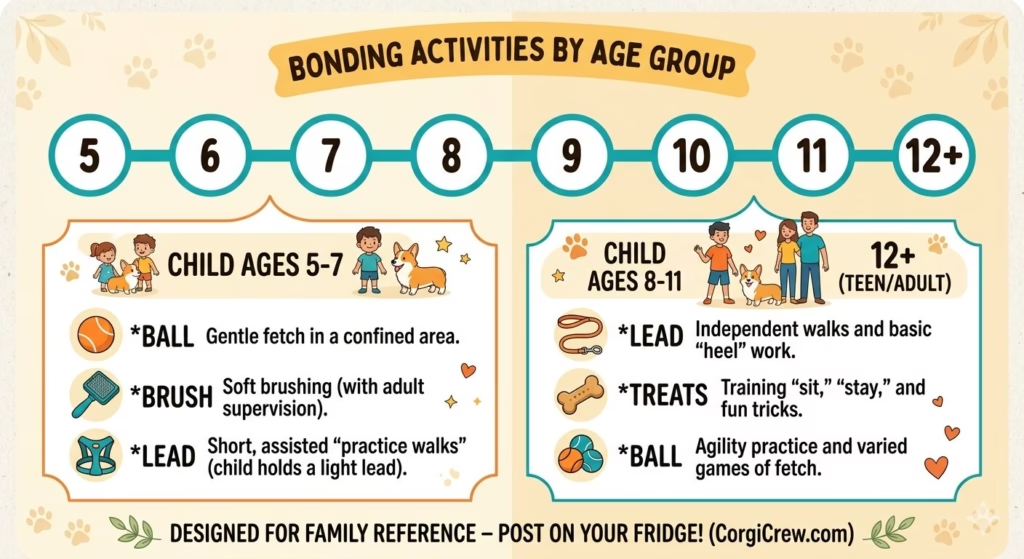
The through-line across all of these activities is structure — the interaction has a beginning, a middle, and an end, and the child's role is clear. Unstructured interaction between children and dogs, while seemingly low-stakes, is where the relationship is most likely to drift toward patterns that create problems later.
Integrating a New Corgi into a Family with Children Already Present
The integration process when bringing a Corgi puppy or adult into a household with children already in residence requires sequenced introduction — not simultaneous access. The instinct for children who have been anticipating a new dog is to rush the introduction, and the instinct for parents is to let that enthusiasm play out. Both instincts should be overridden.
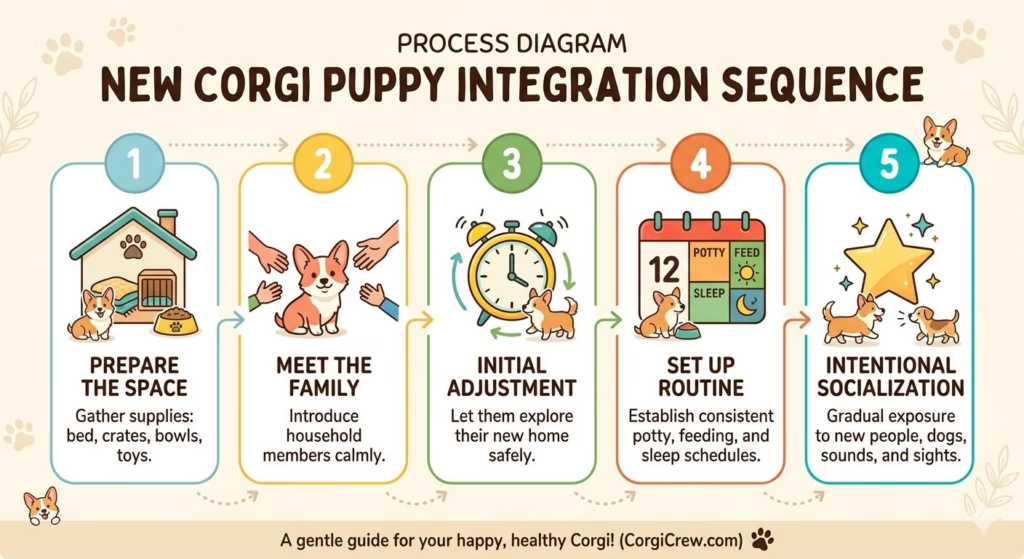
Integration sequence for a new Corgi puppy
- Prepare the space before arrival. Designate the Corgi's rest area, feeding area, and play area before the dog arrives. Ensure children understand which areas are the dog's own and that access to those areas is restricted.
- Controlled first meeting. The first meeting between the puppy and the children should take place in a calm, familiar environment — garden or quiet room — not the front door. Children should be seated, not standing, and should allow the puppy to approach them rather than reaching for the puppy.
- Short, positive sessions in the first week. Limit interaction to 10–15 minute structured sessions for the first seven to ten days. The puppy's sensory world has just been completely reset — overstimulation in the first week creates anxiety patterns that are difficult to unwind.
- Maintain the puppy's schedule. Feeding times, nap times, and toilet-break intervals should be maintained regardless of the family's activity level. Children who disrupt the puppy's schedule — waking it to play, keeping it up past its natural sleep window — inadvertently create an overtired, reactive animal.
- Begin socialisation intentionally. The developmental window between 3 and 12 weeks is the most critical period for socialisation, but the 8–16 week window — which is when most families bring a puppy home — is still highly significant. Structured positive exposure to the household's normal activity during this window shapes the Corgi's baseline tolerance for family life. The Corgi Puppy Socialisation Tips guide on this site provides a week-by-week framework for this process.
Integrating an adult Corgi
- Adult Corgis, including rescues, can integrate successfully with children — but the process typically takes longer than puppy integration, and the dog's prior history with children (if known) should inform the pace. For a Corgi with no documented history with children, a slower, more gradual integration sequence is appropriate, with direct professional assessment if any concerning behaviour appears in the first weeks.
- A Corgi sourced from a responsible breeder who has completed the health screening and temperament documentation described in Understanding Corgi Health Certifications on PemberDiamonds provides a more predictable baseline for family integration — the stable temperament characteristic of well-bred Corgis is a product of both genetics and early developmental handling.
Household Harmony
Setting Rules That Work for Everyone
Household harmony in a family with a Corgi is not achieved by managing the dog exclusively — it is achieved by managing the entire household system. That means rules that apply to the children, rules that apply to the adults, and rules that apply to the dog, all operating consistently.
The three-layer household rule framework:
Layer 1 — Physical boundaries
The Corgi has at least one designated rest space (crate or bed) that is inaccessible to children at all times.
Feeding occurs in a designated area with children kept at a minimum distance of two metres.
The Corgi is not permitted to sleep in children's bedrooms during the integration period (the first 12 months).
Layer 2 — Behavioural expectations (children)
No roughhousing with the Corgi — no wrestling, no chasing, no riding.
No feeding the Corgi human food without parental instruction.
No interaction with the Corgi when the dog is showing signs of wanting space (turning away, moving to rest area, yawning).
Layer 3 — Behavioural expectations (adults)
Consistent enforcement of rules across all adults in the household. A rule that Dad enforces but Mum ignores is not a rule — it is a source of confusion for both the Corgi and the children.
Positive reinforcement is the primary training tool. The Corgi learns faster, retains longer, and remains more stable emotionally when desired behaviour is rewarded rather than undesired behaviour punished.
The adults model the handling behaviour they want the children to develop. A Corgi that is handled calmly and respectfully by adults will learn that calm, respectful handling is the household norm.
For families new to dog ownership and the specific demands of herding breeds, Myths About Corgis Debunked on PemberDiamonds addresses several common misconceptions that can undermine household harmony — including the belief that Corgis are "small dogs" whose behaviours require less management than large breeds.
 EXPERT INSIGHT
Specialist Observation — The "Arousal Ceiling" in Corgi–Child Households
Most families focus their management efforts on the moments when the Corgi and children are in direct contact. What they consistently underestimate is the cumulative arousal effect of a full day in a busy household — the comings and goings, the school-run noise, the sibling arguments, the television. Corgis are high-vigilance dogs. They are monitoring the household environment continuously, and every stimulus registers as a small arousal increment. By the time the family sits down to dinner, a Corgi that has had six or seven hours of low-level household stimulation may be at 80% arousal capacity — and dinner, with its movement, noise, and food proximity, can push it over threshold without any single trigger being obviously "enough."
The practical implication is a concept I call proactive decompression: building at least two periods of enforced quiet into the Corgi's day — not just rest, but actual low-stimulation time with no access to the household's activity. A crate-trained Corgi that spends 45 minutes in a quiet room mid-morning and again mid-afternoon arrives at the high-activity evening period with a much lower cumulative arousal baseline. Families that implement this consistently almost universally report a reduction in reactive incidents without changing anything else about their management approach.
The second observation — one that rarely makes it into general breed guides — is that Corgis are exquisitely sensitive to emotional tone in the household. A family going through a period of stress, conflict, or disruption will almost always see a corresponding shift in the Corgi's behaviour. The dog is not "acting out" — it is responding to genuine signals in its environment. Managing the Corgi's behaviour in those periods without addressing the household tone is working against the grain.
— From practice-based observations in family dog integration consultancy.
 1. Are corgis good with kids under five?
Corgis can live successfully with children under five, but this combination requires the highest level of supervision — constant, hands-on parental presence during all interaction. The risk is not that Corgis are dangerous; it is that children under five move unpredictably, grab without warning, and interact at face level — all of which can trigger a startle or herding response in even a well-trained Corgi. The breed can absolutely work in this setting with appropriate management in place.
2. Will a Corgi nip my child?
A Corgi with an unmanaged herding instinct may nip at running children — not from aggression, but from breed-instinct response to fast movement. This behaviour is highly trainable and manageable through positive reinforcement, exercise, and consistent rule-setting. The risk is significantly reduced — not eliminated — when the dog receives structured training from early in its life. An adult Corgi that has never been trained out of herding behaviour requires more work to address this than a puppy started early.
3. How do I introduce a Corgi to a baby or toddler?
Introduce the Corgi to the baby or toddler in a calm, familiar space with the child held securely or seated. Allow the Corgi to approach and sniff at its own pace — never force the interaction. Keep sessions to five to ten minutes initially. Ensure the Corgi has had adequate exercise beforehand to reduce arousal. Never leave the Corgi and child together unsupervised, regardless of how calm early interactions appear.
4. How much exercise does a Corgi need in a family with young children?
Corgis require a minimum of 45–60 minutes of structured exercise daily, which does not include free play in the garden. In a family setting, this should be a dedicated walk or active play session — not simply access to a garden. Adequate exercise directly reduces the likelihood of herding-instinct behaviours around children, as well as general destructive or anxious behaviour in the home.
5. At what age can a child walk a Corgi unsupervised?
There is no universal age, but a general guideline is that children under 10 should not walk a Corgi without an adult present. From approximately 10–12 years, a child who has been trained in lead-handling and knows the dog's commands well may walk the dog in a low-traffic, familiar area with parental sight line. Fully unsupervised walking should not occur until the child is confident, the dog is reliably responsive, and the environment is assessed as safe.
6. Should a Corgi be crate-trained in a family home?
Crate training is strongly recommended for Corgis in family homes — not as punishment, but as a management tool and a space the dog can retreat to when it needs distance from household activity. A well-crate-trained Corgi has a reliable safe space that children learn to respect, which significantly reduces the likelihood of the dog being pushed past its tolerance threshold during high-activity family periods.
7. How do I teach my child to read a Corgi's body language?
From approximately age five, children can be taught to recognise the Corgi's space-seeking signals: the dog turning away, moving to its bed or crate, yawning repeatedly, or looking away rather than making eye contact. Teach the rule: "when the dog moves away, we let it go." Role-play the recognition with the child using photographs or video of dog body language. Repetition and positive reinforcement from parents when the child applies the rule correctly builds reliable habit over two to three weeks.
8. Can a Corgi that has never lived with children be rehomed to a family?
Yes, with careful integration and realistic expectations. An adult Corgi with no prior experience of children will need a longer adjustment period than a puppy or a Corgi raised with children. The integration sequence — designated spaces, controlled first meetings, time-limited interaction — applies here with slower progression at each stage. Professional assessment from a canine behaviourist is worthwhile before committing to the placement if the dog's history is unknown.
9. What are the most common mistakes families make when getting a Corgi with kids?
The most common mistakes are: allowing unmanaged, continuous access between dog and children from day one; failing to train a reliable "leave it" or "settle" command; not providing adequate daily exercise for the Corgi; inconsistent rule enforcement across adults in the household; and interpreting the herding nip as aggression rather than instinct — either dismissing it entirely or responding with punishment rather than training.
10. How long does it take for a Corgi puppy to settle into family life?
Most Corgi puppies settle into a consistent household routine within eight to twelve weeks of arrival, provided the integration is structured and the daily schedule is predictable. Full behavioural establishment — where the dog's responses to the children, the household rules, and the daily structure are consistent and reliable — typically takes six to nine months. Families who rush the process, or who are inconsistent in the first months, typically see a longer and more difficult adjustment period.
CONCLUSION
Three things determine whether a Corgi–family relationship succeeds: understanding the breed's instincts and working with them rather than around them; building the management structure — supervision, rules, training — before it is needed rather than after an incident prompts it; and treating the relationship as something that is actively constructed through consistent effort, not passively received through the luck of a good-natured dog.
Corgis with kids is a combination that works. It works because the breed is genuinely intelligent, loyal, and adaptable — not in spite of its herding nature but partly because of it. A Corgi that respects its family's structure is a dog that has been given clear information about its world. That clarity is the foundation of the household harmony this guide has described.
The Lifestyle & Activities category on CorgiCrew is built on the premise that a well-integrated Corgi enriches family life rather than complicates it. Every tool in this guide — the supervision framework, the bonding activities, the integration sequence — moves you one step further toward that outcome.
 CALL TO ACTION
If you are building your understanding of what Corgis need to thrive in a family environment, the groundwork starts before the dog even arrives. Read Corgi Puppy Socialisation Tips for the developmental framework that shapes a well-adjusted family dog, and Basic Corgi Training Techniques for Beginners for the obedience foundation that makes everything in this guide work in practice. The community has the tools — use them.