You Have Eight Windows With Your Corgi. Are You Making the Most of Them?
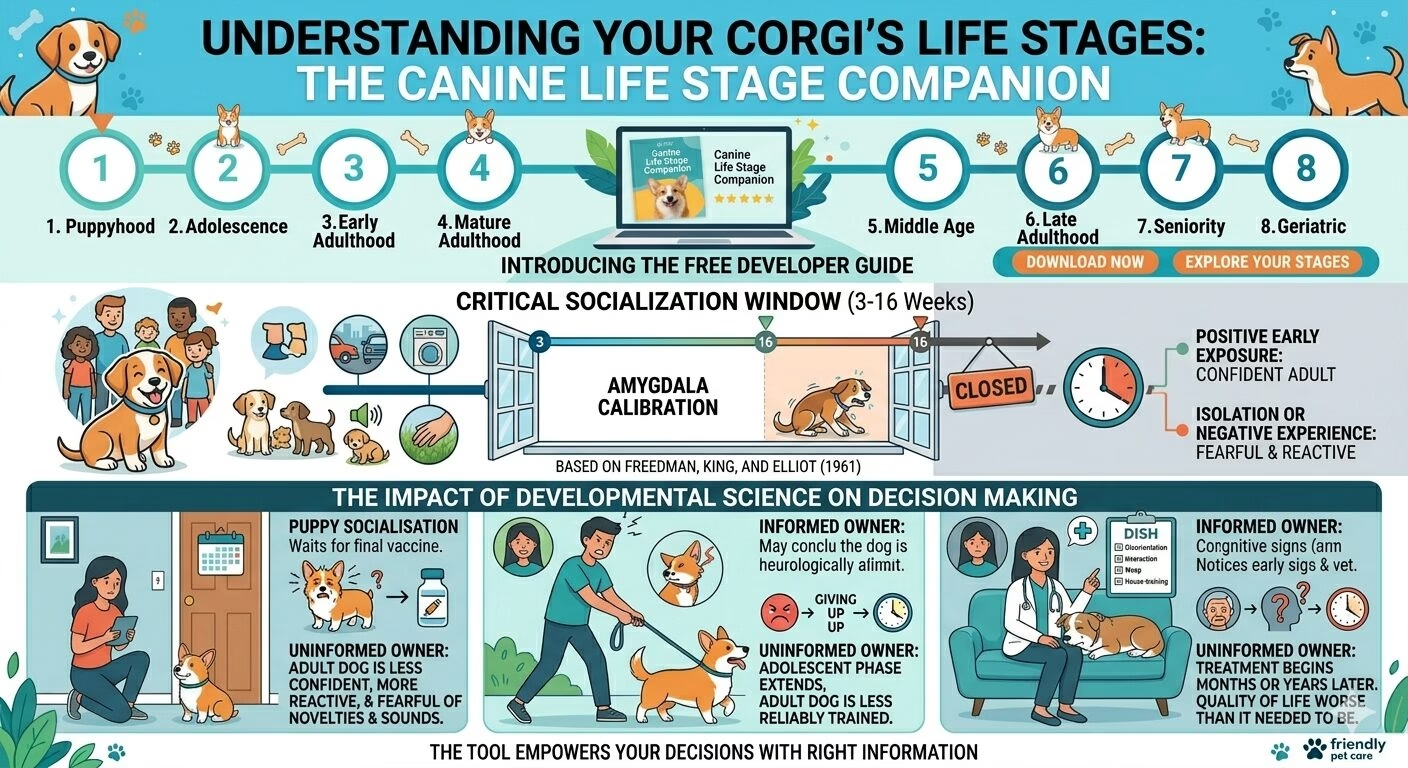
Introducing the Canine Life Stage Companion — a free developmental guide that tells you exactly which of your Corgi's eight life stages you are in right now, what the research says about it, and precisely what to do.
There is a particular kind of regret that Corgi owners sometimes describe. It usually surfaces at about eighteen months — when the adolescent phase is ending and the young adult phase is beginning — and it sounds something like this: I wish I had known about the socialisation window before it closed. I wish I had known the adolescence was neurological and not permanent. I wish someone had told me what to do in those specific weeks.
The Canine Life Stage Companion was built for exactly this. It is a developmental guide that knows how old your Corgi is, tells you precisely which developmental stage you are in right now, and gives you the research-backed guidance specific to that stage — before you need it, not after.
It is the one tool in this set that becomes more valuable the earlier you use it.

Eight Stages. Eight Sets of Priorities.
Dog ownership feels continuous. In reality it is a sequence of discrete developmental phases, each with its own neurological characteristics, its own critical tasks, and its own most common mistakes. Missing the tasks of a stage does not mean they can simply be completed in the next one. Some windows close.
The window that cannot reopen
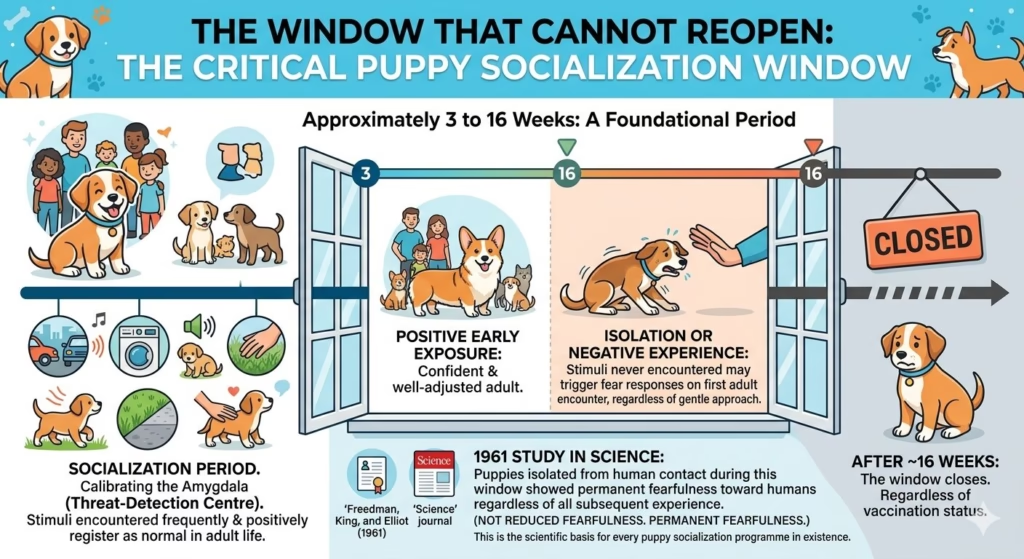
The socialisation window runs from approximately 3 to 16 weeks. During this period the amygdala — the brain's threat-detection centre — is being calibrated. Stimuli encountered frequently and positively become registered as normal in adult life. Stimuli never encountered may trigger fear responses on first adult encounter, regardless of how gentle or positive that adult encounter is.
Freedman, King and Elliot published a study in Science in 1961 demonstrating that puppies isolated from human contact during this window showed permanent fearfulness toward humans regardless of all subsequent experience. Not reduced fearfulness. Permanent fearfulness. This is the scientific basis for every puppy socialisation programme in existence.
The socialisation window closes around week 16 regardless of vaccination status. Many owners — following well-meaning but outdated advice — wait until vaccination is complete before beginning socialisation. The vaccination series typically concludes around 16 weeks. The window is already closing.
The AVSAB (American Veterinary Society of Animal Behavior) Position Statement on Puppy Socialisation: 'The primary and most important time for puppy socialisation is the first three months of life. Puppies should receive socialisation before the vaccine series is complete. The risk of behavioural problems from insufficient socialisation exceeds the risk of disease in most environments.'
The Life Stage Companion shows you exactly how many weeks remain in the socialisation window if your Corgi puppy is currently in it. It is the only tool that operates as a real-time developmental alert.
The stage that most owners misunderstand
At some point between six and nine months, many Corgis seem to forget commands they knew perfectly at five months. They become selectively deaf. They test boundaries that were not previously tested. Their owners — understandably — conclude that something has gone wrong.
Nothing has gone wrong. A study published in Biology Letters by the Royal Society in 2020 formally confirmed what breeders have observed for decades: canine adolescence is a neurologically distinct developmental phase during which dogs show significantly reduced responsiveness to known commands specifically with their primary carer. Not with strangers. With the person they know best.
The resistance is directed at the attachment figure — precisely as human adolescent resistance is. It is neurologically driven by a second wave of synaptic pruning in the prefrontal cortex and the action of gonadal hormones on the brain. It has a defined duration. It ends.
The tool's adolescence stage gives you the full context, the specific management guidance, and the most common mistake to avoid — which is applying escalating corrections to neurologically-driven behaviour, making both the behaviour and the relationship worse.
The stage most owners do not think about until it is too late
Canine Cognitive Dysfunction Syndrome affects an estimated 14 to 35 percent of dogs over 8 years of age, rising to over 68 percent in dogs over 15. It involves the accumulation of the same brain proteins associated with Alzheimer's disease in humans. Early identification allows earlier intervention and better outcomes.
The tool uses the validated DISH criteria from the Canine Cognitive Dysfunction Rating Scale — the same clinical instrument used by veterinary professionals — to give senior dog owners a structured monitoring framework. Most owners attribute the early signs to simply getting old. The tool names them as medical events that deserve attention.
How to Use It
Welcome screen
Enter your name, your Corgi's name, date of birth, gender, and select Corgi as the breed. The tool calculates the exact age in days and opens directly to the current developmental stage. If your puppy is in the socialisation window, a critical alert tells you immediately.
The stage content
Each stage delivers seven sections. The neurological context explains what is happening in the brain at this stage in plain language — not jargon.
The most important action is the single highest-priority task at this stage, grounded in the research. The biggest mistake is the most common owner error at this stage and why it makes things worse. The four focus areas are concrete priorities for this developmental window. Watch for is a list of signals warranting attention or veterinary discussion. The Corgi-specific panel applies the general framework to your breed. The primary source citation names the specific paper, authors, journal and year behind every claim.
Navigation
A colour-coded timeline bar at the top shows all eight stages. A navigation bar at the bottom has previous and next buttons and stage dots. You can browse the entire developmental arc at any time — reading ahead to understand what is coming, or looking back to understand a stage your Corgi has already passed through.
The stage banner
Each stage shows whether your Corgi is currently here, has already passed through, or is approaching — with a weeks-remaining estimate for upcoming stages. This is the tool telling you: this is where your Corgi is in the arc of their whole life. Read this now.
What Changes When You Know This
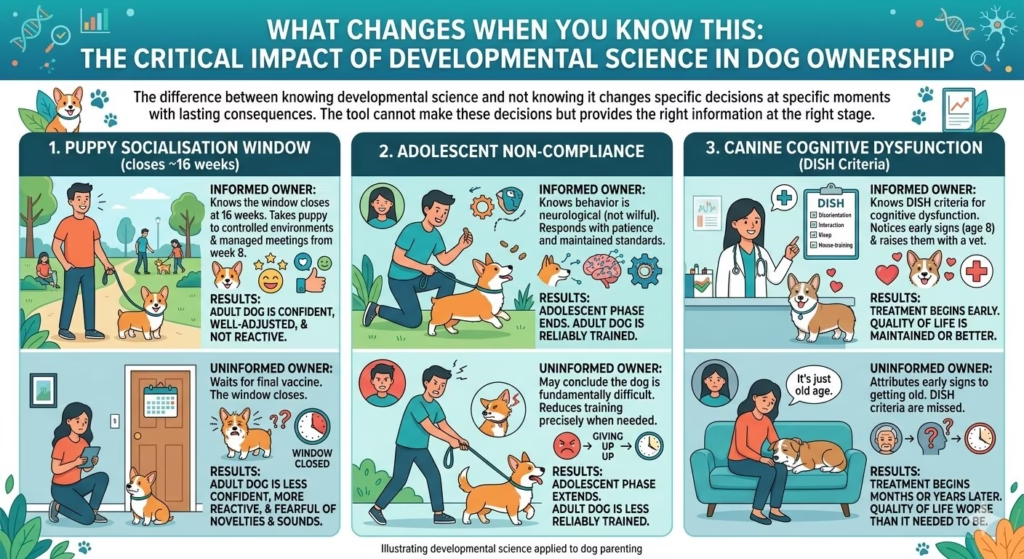
The difference between knowing developmental science and not knowing it is not trivial. It changes specific decisions at specific moments — decisions with lasting consequences.
- An owner who knows the socialisation window closes at 16 weeks takes their puppy to controlled environments and managed meetings from week 8 rather than waiting for the final vaccine. An owner who does not know this waits. The window closes. The adult dog is less confident in novel environments, more reactive to unfamiliar dogs, more fearful of certain sounds. None of this is inevitable.
- An owner who knows adolescent non-compliance is neurological rather than wilful responds with patience and maintained standards.
- An owner who does not know this may conclude their dog is fundamentally difficult and reduce training investment precisely when consistency matters most. The adolescent phase extends. The adult dog is less reliably trained. None of this is inevitable either.
- An owner who knows the DISH criteria for canine cognitive dysfunction notices the early signs in their 8-year-old Corgi and raises them at the next veterinary appointment. An owner who does not know this attributes the same signs to getting old. Treatment begins months or years later. Quality of life is worse than it needed to be.
The tool cannot make these decisions for you. It can make sure you have the right information at the right stage to make them correctly.
An Honest Counterpoint
The developmental stage boundaries in this tool are population-level averages drawn from research conducted predominantly on mixed-breed dogs in research facility conditions. Individual variation is real and significant. Your Corgi may enter adolescence at 5 months or 7 months. The socialisation window may be somewhat broader or narrower for your specific puppy. The tool provides the best available guidance — not a guarantee that your individual dog will follow the exact timeline.
The guidance in this tool is also necessarily general within each stage. The adolescence section cannot account for the specific combination of your Corgi's temperament, training history, environment, and household dynamics that shape how adolescence actually presents for your dog. Professional guidance from a qualified trainer or behaviourist who has observed your specific dog remains irreplaceable for complex or escalating behaviour challenges.
And the tool is not a substitute for regular veterinary care. Developmental guidance and veterinary medicine are complementary, not interchangeable. The Watch For sections and the senior stage vet guidance point toward your veterinarian — not away from them.
Frequently Asked Questions
My puppy is 10 weeks old. What should I be doing right now?
Open the tool, enter the birth date, and read Stage 3 — the Socialisation Window. The key priorities at 10 weeks: puppy classes with vaccinated dogs in a controlled environment, exposure to a wide range of people including children and men with hats and beards, car travel, varied surfaces underfoot, urban sounds, and brief periods of alone time to build independence. Every week in this window is neurologically significant.
My Corgi is 8 months old and seems to have forgotten his training. Should I be worried?
No — but you should be informed. This is the adolescent phase documented by Asher et al. (2020). The reduced responsiveness to commands is neurologically driven and temporary. Maintain training standards, use higher-value rewards, increase mental stimulation, and do not interpret this as a permanent character change. The tool's adolescence stage has the full management plan.
How do I know if the tool's stage boundaries are right for my Corgi specifically?
You use them as approximate guides, not precise thresholds. The neonatal, transition, socialisation and juvenile boundaries are consistent across breeds within a few days. Adolescence onset varies more — some dogs enter it earlier or later than 6 months, and smaller breeds tend to mature slightly faster. If your Corgi's behaviour is inconsistent with the current stage description, look at the adjacent stages — the boundaries are gradual transitions, not hard switches.
Can I use the tool for a dog I am getting from you as a puppy?
Yes — and we actively encourage it. We will give you your puppy's birth date at collection. Enter it in the tool before collection day and read the socialisation window content thoroughly. You will arrive prepared to make the most of the remaining weeks of the most critical developmental period of your Corgi's life.
My Corgi is 4 years old and settled. Is there anything useful in the tool for this stage?
The mature adult stage (3 to 7 years) is often the most overlooked. The tool's guidance here focuses on maintaining cognitive engagement — which the research shows directly affects the rate of cognitive decline in the senior years — and monitoring weight and dental health, the two most common preventable health problems in this age group. The biggest mistake at this stage is reducing training engagement because the dog seems settled.
At what age should I start using the senior stage monitoring?
The tool opens the senior stage from age 7 years, which is the threshold used by the BSAVA Manual and most clinical veterinary references for small-to-medium breeds. Annual veterinary health checks are recommended from age 7. The DISH monitoring criteria in the tool should be reviewed regularly from age 7 and any of the four DISH signs reported to your vet promptly.
Tanydd Corgi Crew · Pembroke Welsh Corgi Breeders · Tamboeckey Beagles