Senior Corgi Care and End-of-Life Decisions
Ageing in a Corgi is a series of manageable changes, and this guide follows them from the first grey muzzle to the final decision.
This article builds on Physical Development in the Corgi — read that first if you are new to how a Corgi’s body is built and how it changes across life.
What Does a Senior Corgi Actually Need?
What does an ageing Corgi need from you, and how will you know when caring for them has become more than comfort can carry?
Short answer: senior corgi care comes down to three jobs. Keep the dog lean and moving. Catch pain and confusion early, because Owners often mistake both for “just old age”. And agree on measurable signs of a good life before a crisis forces the decision. When good days stop outnumbering bad ones despite proper pain control, a veterinarian-guided goodbye is an act of care, not a failure of it.
The rest of this guide earns that answer. It sets out what the research shows about the body and brain of an older Pembroke Welsh Corgi, how to organise daily care, and how to approach end-of-life decisions with less guilt and more clarity.
What Counts as a Senior Corgi?
A senior Corgi is a dog in the last quarter of its expected lifespan. That is the working definition used in the 2019 AAHA Canine Life Stage Guidelines, which divide a dog’s life into five stages: puppy, young adult, mature adult, senior and end of life (Creevy et al., 2019). The guidelines deliberately do not fix one age for everyone, because the right age depends on breed and size.
For a Pembroke Welsh Corgi, the sums are straightforward. The Pembroke Welsh Corgi Club of America (PWCCA) says Pembrokes typically live 12 to 15 years, and the American Kennel Club lists 12 to 13. A quarter of 12 to 13 years is three years or so, which puts the start of the senior stage at roughly 9 to 10 years old. Many Owners notice changes earlier, around 8, and nothing is wrong with starting senior-style care then.
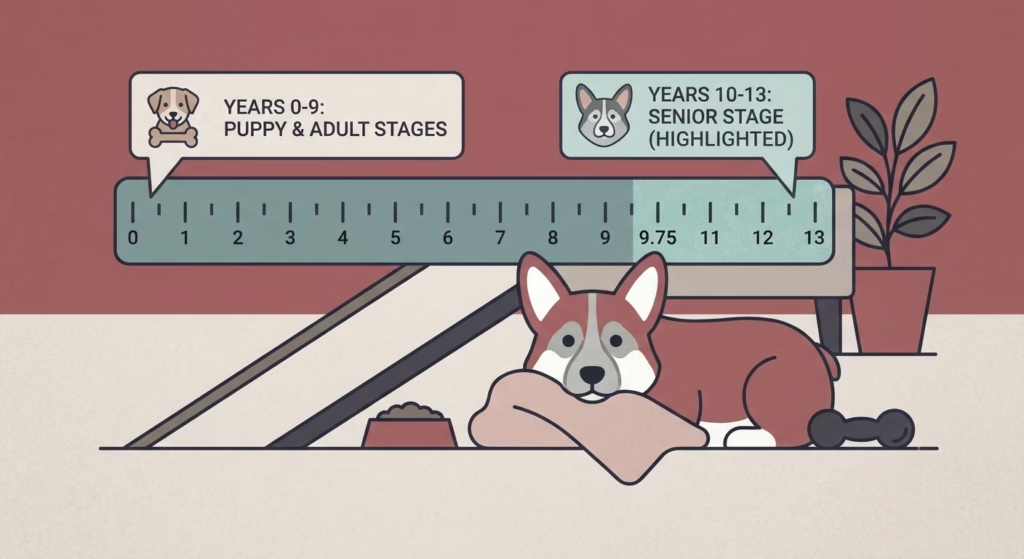
The senior stage is defined by remaining lifespan, not a fixed birthday, which is why a Corgi’s senior years start earlier than a small terrier’s.
Three points about the word “senior” are worth getting straight early.
First, senior is a care category, not a diagnosis. A 10-year-old Corgi can be fit and playful. The label simply tells you when preventive care should change: more frequent check-ups, earlier screening and closer attention to weight and mobility.
Second, ageing is the gradual loss of physical reserve, not a single disease. The dog still does everything it used to, but with less margin. A slippery floor that was never a problem at five becomes a hazard at eleven.
Third, end of life is now recognised as its own stage. The 2016 AAHA/IAAHPC End-of-Life Care Guidelines recommend treating it as the final life stage, with its own planning and care (Bishop et al., 2016). It can begin at any age if illness makes it so, or it can follow a long and comfortable senior period.
A few terms appear throughout this guide, so here they are in plain language:
- Palliative care: treatment aimed at comfort rather than cure. It can be given alongside treatment that targets the disease itself.
- Hospice care: palliative care for a dog with a terminal diagnosis, from that diagnosis until death. In the AAHA/IAAHPC guidelines it covers death by euthanasia and “hospice-supported natural death”, where comfort measures continue under veterinary supervision until the dog dies naturally (Bishop et al., 2016).
- Euthanasia: a veterinarian ending a dog’s life painlessly, by injection, to prevent suffering.
- Quality of life: the sum of what makes a dog’s days better or worse for that individual dog. It is not the same as being free of disease.
- Canine cognitive dysfunction (CCD): an age-related brain disorder, sometimes called canine dementia, that affects memory, awareness, sleep and behaviour.
“End-of-life decisions” in this article means two linked choices: when to shift the goal from cure to comfort, and, when comfort can no longer be maintained, when to choose euthanasia.
What Does the Research Say About Ageing Corgis?
The evidence on senior Corgis is thinner than the evidence on dogs in general. Few studies follow Pembrokes specifically into old age, so this section combines breed-specific findings where they exist with larger studies of dogs overall, and says which is which. The lens throughout is the one that fits this stage of life: ageing as a sequence of life-stage changes, quality of life as something that can be assessed in a structured way, and grief as the predictable cost of attachment.
How does a Corgi’s body age? The spine, the joints and the hind end
A Pembroke’s shape comes from genetics, and so do some of its late-life risks. Short legs are linked to an extra copy of the FGF4 gene on dog chromosome 18, an inherited change that produces the breed-defining short-limbed form called chondrodysplasia (Parker et al., 2009). A second FGF4 copy, on chromosome 12, is linked to chondrodystrophy: discs that lose water and degenerate early, which raises the risk of intervertebral disc disease, or IVDD (Brown et al., 2017). Whether an individual Corgi carries the chromosome 12 copy varies, and DNA testing can show which.
Why does that matter at 11? Discs that began to degenerate in middle age keep changing. A senior Corgi may bulge or herniate a disc during an ordinary day, from a jump off the sofa or a slip on tiles. The signs range from a stiff, hunched back and reluctance to move, to wobbling, dragging a foot, or sudden hind-leg weakness. Any sudden change in the back legs needs a veterinarian the same day.
The joints age too. Years of load on the hips, knees, elbows and spine produce osteoarthritis, which is painful and progressive. It is manageable, and much of the day-to-day management is in the Owner’s hands: weight, floors, exercise and pain medication prescribed by a veterinarian.
The best-known late-life neurological condition in the breed is degenerative myelopathy (DM). DM is a slowly progressive disease of the spinal cord. Jerold Bell, a clinical geneticist at Tufts University, describes the typical course in Pembrokes: onset usually between 8 and 14 years (average 11), starting with hind-leg weakness, scuffing of the toes and crossing of the hind legs, and progressing over six months to two years to dragging of the hind legs (Bell, PWCCA). In advanced cases, bladder and bowel control are lost and the front legs weaken. Bell states that DM itself is not a painful disease and that no treatment changes its course.
A mutation in the SOD1 gene was identified in 2009 as a major risk factor, in a study led by Awano and colleagues that compared affected dogs from several breeds, including Pembrokes, with unaffected dogs (Awano et al., 2009). Pembroke DM was then described clinically by Coates and colleagues (Coates et al., 2007). Two features of the genetics matter for Owners. A dog needs two copies of the mutation to develop DM, but most dogs with two copies never do.
Expert Insight — Jerold Bell, DVM (Tufts University). Bell’s analysis for the PWCCA points out that the SOD1 mutation is extremely common in Pembrokes, so the test result alone predicts clinical disease poorly. A “clear” result rules DM out, but an “at risk” result does not confirm it, and several other conditions of the spine and hips can look identical. His practical conclusion is that a confirmed diagnosis needs a pathological examination of the spinal cord, and that dogs with suggestive signs should first be checked for treatable look-alikes. (Paraphrased from the PWCCA article; the page is undated and may pre-date newer work, so check currency at the fact-check stage.)
The numbers in Bell’s article show why. He reports that 52.7% of Pembrokes tested were homozygous “at risk”, 35.1% were carriers and 12.2% were homozygous normal. On those figures, only about 1.1% of the at-risk group go on to develop clinical DM. An earlier controlled study he cites, drawing on the UC Davis veterinary database from 1990 to 1999, found DM diagnosed in 0.6% of Pembrokes, about 1 in 167 (Bell, PWCCA).
Most Pembrokes carry at least one SOD1 mutation, yet few develop degenerative myelopathy, so the test is a prompt to watch closely, not a prediction (Bell, PWCCA).
Nothing alters the underlying course of DM, but how a dog is nursed may change how long it stays mobile. Kathmann and colleagues studied 50 dogs with suspected DM and, in 22 of them, compared three levels of physiotherapy (Kathmann et al., 2006). Nine dogs received intensive daily physiotherapy and survived a mean of 255 days from the point studied. Six received moderate physiotherapy and survived a mean of 130 days. Seven received none and survived a mean of 55 days. Dogs that received any physiotherapy also stayed able to walk for longer.
The study was retrospective, the groups were small, and the dogs had suspected rather than confirmed DM, so the result is a signal, not a promise. “Survival” in studies like this largely reflects when Owners chose euthanasia, so it measures how long a dog stayed manageable and comfortable, not only the biology of the disease. Even so, the direction is consistent with what rehabilitation specialists advise: raise the question of physiotherapy, massage and supported exercise as soon as hind-leg weakness appears, not after mobility has gone.
Does weight really change how long a Corgi lives?
The strongest experimental evidence in canine ageing comes from a lifetime feeding trial, and it is about weight. In the Purina lifetime diet-restriction study, 48 Labrador Retrievers from seven litters were paired by sex and size within litters (Kealy et al., 2002). One dog in each pair was fed 25% less than its pair-mate from 8 weeks of age until death. The food was identical; only the amount differed.
|
 Research Spotlight
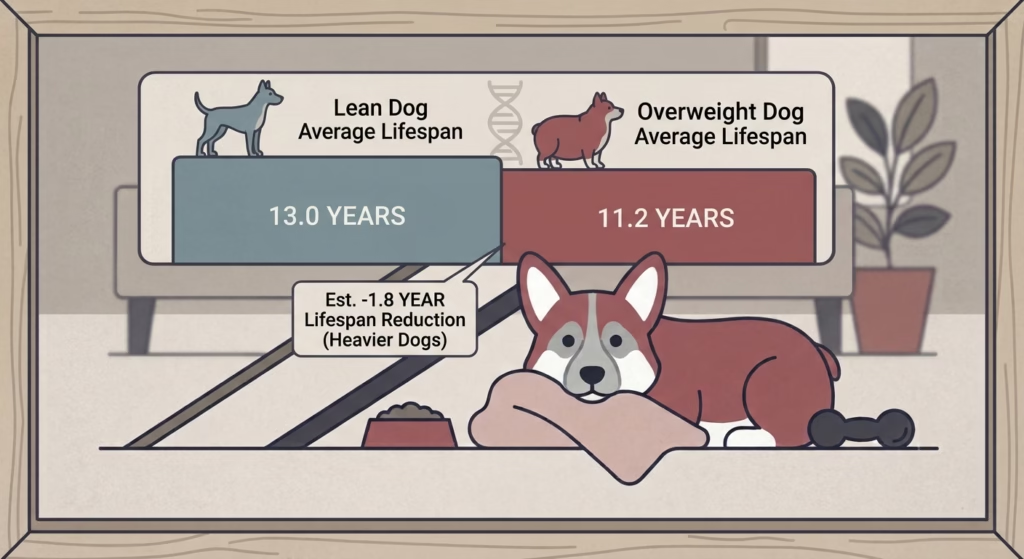
Lean-fed Labradors lived a median of 13.0 years against 11.2 years for their pair-mates in a lifetime feeding trial (Kealy et al., 2002).
A second, much larger study looked at real pet dogs. Salt and colleagues reviewed records for 50,787 neutered, client-owned dogs of 12 breeds, aged 6.5 to 8.5 years, and compared those in overweight condition with those in normal condition (Salt et al., 2019). In every breed, the overweight dogs had a higher risk of death at every age examined, with hazard ratios from 1.35 in German Shepherd Dogs to 2.86 in Yorkshire Terriers. Median life span was shorter in every breed. The gap ranged from 12.1 versus 12.5 years in German Shepherds to 13.7 versus 16.2 years in Yorkshire Terriers.
There are limits. Corgis were not among the 12 breeds, and the study shows that weight and life span moved together, not that excess weight alone caused the difference. The nearest chondrodystrophic breed in the group, the Dachshund, followed the same direction as the others. The practical reading is cautious but clear: for a dog whose spine and joints already carry extra mechanical risk, leanness is the single most controllable lever an Owner has.
One refinement matters in old age. Seniors lose muscle, and muscle loss can hide behind a steady scale weight. A Corgi can be “the right weight” and still be fat and weak. Ask the veterinarian to score muscle condition as well as body condition at each visit, and aim to lose fat, never muscle.
What happens to the ageing Corgi brain?
Canine cognitive dysfunction is the dog counterpart of a dementia-type illness. Dogs with CCD show deficits in learning, memory and awareness, and changes in sleep, social behaviour and house training. The brain changes seen after death in these dogs resemble early stages of Alzheimer’s disease in people, though the two conditions are not the same.
The core problem is that CCD is common and rarely diagnosed. Salvin and colleagues surveyed Owners of community-based dogs aged 8 to nearly 20 years (mean 11.67), using an 84-item questionnaire covering six behavioural areas, and analysed half of the 957 responses, 497 dogs (Salvin et al., 2010). On the basis of 27 significant behaviour items, they estimated CCD prevalence at 14.2%. Only 1.9% of the dogs had been diagnosed by a veterinarian.
The same group later turned the survey data into a rating scale, the Canine Cognitive Dysfunction Rating scale (CCDR), to help tell CCD from normal ageing (Salvin et al., 2011). To build it, they split the 957 responses into a development group of 479 dogs and a test group of 478, with nine veterinarian-diagnosed dogs placed in each. Nine confirmed cases per group is a small number, which is why scales like this work as screening aids that flag dogs for examination, not as diagnoses.
Part of the gap is the Owner’s interpretation. Owners often read confusion, restlessness and broken sleep as an expected part of age and never mention them to the veterinarian. Part of it is diagnostic: CCD is a diagnosis of exclusion, so other causes have to be ruled out first, and those causes are common in old dogs.
|
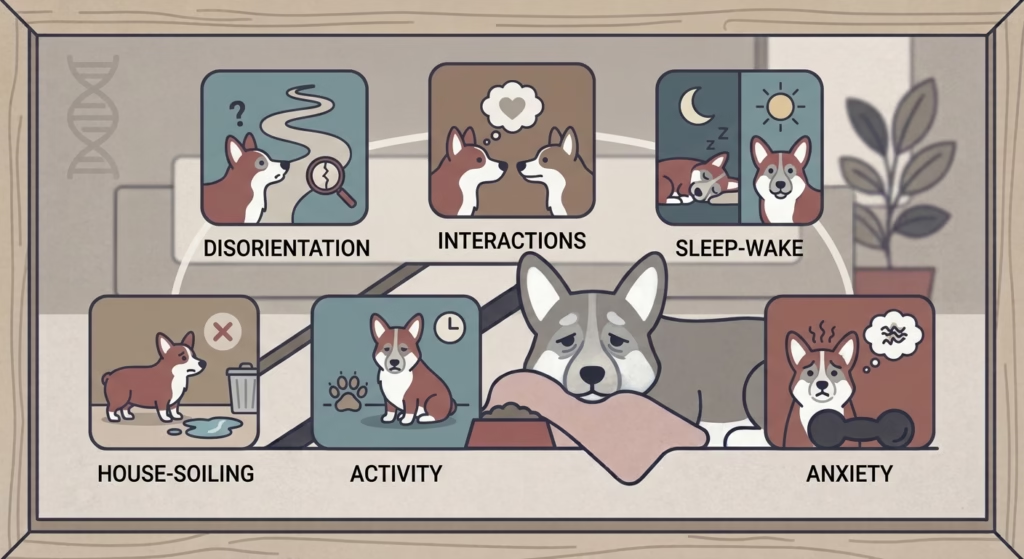
The six DISHAA areas give Owners a checklist for noticing cognitive change early, before it becomes a night-time crisis (Landsberg et al., 2012).
What helps? The honest answer is that evidence for treatment is modest, but not empty. In aged Beagles, a diet enriched with antioxidants combined with a programme of behavioural enrichment reduced age-related decline in learning tasks (Milgram et al., 2004). That study was in research colony dogs, so it supports the idea more than a product. For a Corgi at home, the practical version is a predictable routine, daily mental work such as scent games and short training sessions, good lighting at night, and a conversation with the veterinarian about diets and medicines registered in South Africa.
Why do Owners miss pain in old dogs?
Pain is probably the single most undertreated problem in senior dogs, and the reasons are mostly about people, not dogs. Dogs are stoic. Chronic pain develops slowly, so the Owner’s picture of “normal” shifts with it, and the signs are easy to misread: slower on walks, reluctant on stairs, less playful, more irritable, licking a joint, or sleeping more.
Belshaw and Yeates, in a 2018 narrative review, argue that assessing chronic pain and quality of life in dogs should be based on multiple signs, including health status, the environment, the dog’s relationship with the Owner and interaction with other animals (Belshaw and Yeates, 2018). They also discuss a “caregiver placebo effect”, where Owners who have started a treatment tend to report improvement that objective measures do not confirm. A separate piece of Belshaw’s doctoral research on canine osteoarthritis found that most decisions about osteoarthritic dogs are made by Owners using unvalidated assessments with little veterinary guidance (Belshaw, 2017).
Structured tools exist to reduce guesswork. The Canine Brief Pain Inventory asks Owners to score pain severity and its interference with everyday activity on set scales (Brown et al., 2007). Current AAHA pain guidelines recommend assessing pain at every visit and treating it with several approaches together, such as medication, weight management, rehabilitation and home changes (Gruen et al., 2022).
The practical point is that the Owner is the best observer a dog has, but needs a method. A monthly two-minute video of the dog walking, climbing a step and rising from rest, filmed in the same place, shows change that memory smooths over.
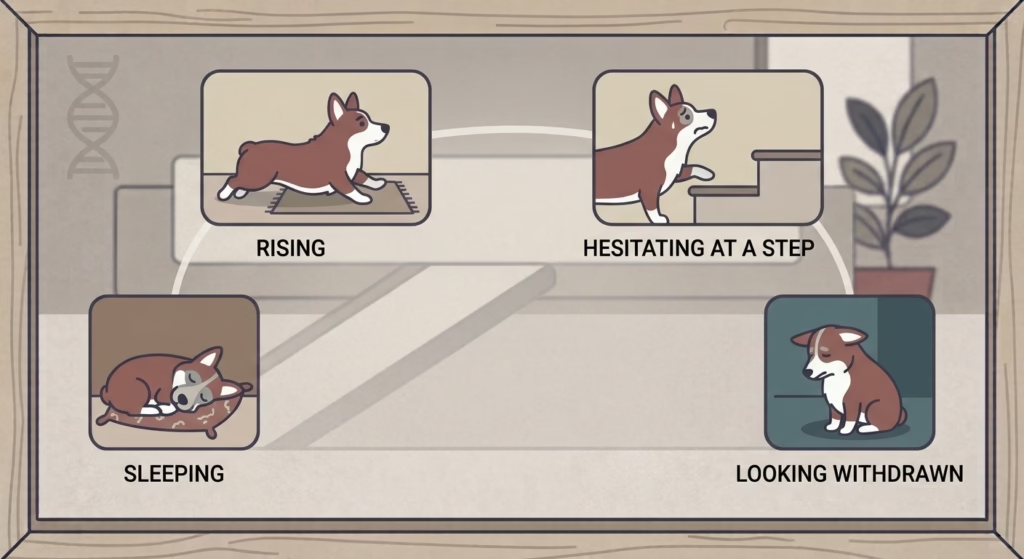
Pain in old dogs shows up as small changes in how they rise, climb, sleep and behave, which is why a same-place video helps.
What else changes in an old Corgi, and what is breed-specific?
Most of what shows up in older Corgis is what shows up in older dogs generally, and no verified Pembroke-specific prevalence figures were found for the conditions below. They are listed because each changes what an Owner should ask the veterinarian.
- Eyes and ears. A bluish haze in the lens of an older dog is common and usually does not stop the dog seeing (nuclear sclerosis). A whiter, denser change suggests cataract and deserves an eye examination. Because dogs with eye and ear disorders had higher odds of CCD in the Dog Aging Project (Yarborough et al., 2022), sight and hearing loss are worth checking when behaviour changes, not assuming.
- Dental disease is painful, can reduce appetite, and is one of the most common reasons an older dog eats less. Veterinary guidance generally treats age as one of several anaesthetic risk factors rather than a barrier on its own, so an old dog with a painful mouth should be assessed individually, not refused dental care because of its birthday.
- Bleeding risk. Von Willebrand disease, an inherited bleeding disorder, is among the conditions reported in Pembrokes. If a dog’s status is unknown, tell the veterinarian before any surgery or dental extraction. (Verify against a primary source before publishing.)
- Heart, kidneys and hormones. Heart murmurs, kidney disease and hormonal disorders such as Cushing’s disease become more likely with age in all dogs. They are usually found by blood tests, urine tests and blood pressure checks, not by watching the dog.
- The chance of cancer rises with age. Any new lump, or an existing one that changes, should be examined; most are not dangerous, but only a veterinarian can say which.
Can quality of life be measured, and how reliable are the scales?
Veterinarians and Owners need some way to talk about whether life is still good enough, and several quality-of-life scales exist. The best known in end-of-life care is the HHHHHMM scale, developed by veterinary oncologist Alice Villalobos and first published in Veterinary Practice News in 2004. The letters stand for Hurt, Hunger, Hydration, Hygiene, Happiness, Mobility, and More good days than bad. Each factor is scored from 0 to 10, with 10 ideal, and Villalobos’s original format treats a total above 35 as acceptable for continuing hospice-style care.
Each factor asks a concrete question. Under Hurt, the first question is whether pain is controlled and breathing is easy, and the scale treats trouble breathing as outweighing other concerns. Hunger asks whether the dog eats enough, with or without hand feeding. Hydration asks whether the dog drinks enough or needs fluids under the skin. Hygiene asks whether the dog can be kept clean and free of pressure sores. Happiness asks whether the dog still shows joy and interest. Mobility asks whether the dog can rise and move without help. The last factor asks whether good days still outnumber bad ones.
Its strength is that it turns a vague dread into seven answerable questions and a trend that a whole family can see. Its limit is evidence. Belshaw and colleagues ran a systematic rapid review of published canine quality-of-life instruments and found 52 of them, of which only 11 had any evidence of reliability or validity, and the quality of those 11 varied (Belshaw et al., 2015).
There is a second limit. HHHHHMM was designed for hospice patients, many of them dogs with cancer. A Corgi with arthritis and otherwise good health could score “acceptable” overall while living with pain that is not properly controlled. That is why Hurt comes first on the scale, and why the total should never be used to argue against a lower score on Hurt, Hunger or Mobility. A low score on any one of those three deserves action even when the sum looks fine.
Scores are also personal. Two family members will often score the same dog differently, and the Owner’s own hopes can tilt the numbers either way, which is the “caregiver placebo effect” Belshaw and Yeates describe. Having two people score independently, and then compare, is a simple way to see where the picture is unclear.
The sensible way to use HHHHHMM, then, is as a conversation tool. Score it on the same day each week, write down the date, and look at direction rather than the number. A Corgi that slips from a 55 to a 38 in a month has told you something, whatever the threshold says. Scores should be compared with the veterinarian’s own assessment of the dog, and between family members, who often see different things.
What does attachment theory say about grief, and what do Owners experience?
Attachment theory, set out by John Bowlby, holds that grief is the price of a bond: the stronger the attachment, the stronger the response when it is broken (Bowlby, 1980). The research on pet loss fits that pattern. Adams, Bonnett and Meek surveyed 177 clients from 14 veterinary practices in Ontario whose dog or cat had died 6 to 43 days earlier (Adams et al., 2000). About 30% reported severe grief. The strongest predictors of grief were the level of attachment, euthanasia, perceptions of society’s attitudes to pet death, and the quality of professional support from the veterinary team.
Two ideas help make sense of that. The first is that grief for a pet is normal and proportionate to the bond, not an overreaction. The second is that it is often disenfranchised grief, a term coined by Kenneth Doka for sorrow that is not openly acknowledged or socially supported (Doka, 1989). Many Owners hide how much a dog’s death hurts, and that makes it harder.
Euthanasia appears on the list of risk factors because it is a decision, and decisions can be second-guessed. The AAHA/IAAHPC guidelines, which the American Veterinary Medical Association endorses, set out the choice plainly: after a terminal diagnosis, an Owner may choose planned euthanasia, or hospice care until a natural death, with comfort measures continued under veterinary supervision (Bishop et al., 2016). The guidelines note that pet euthanasia is both legally and socially accepted in a way that human euthanasia is not, so the decision sits mostly with the Owner and the veterinarian.
The practical use of the research is to move thinking forward in time. Owners who decide early, with the family and the veterinarian, what they will watch for and what they will do, make the actual decision with less distress than those who meet it first in an emergency room.
How Does a Corgi Change From Age 8 to the Final Months?
Corgi ageing has no sharp edges. The four stages below follow the AAHA framework and run roughly in order, but individual dogs move through them at different speeds, and illness can move a dog straight to the final stage at any age.
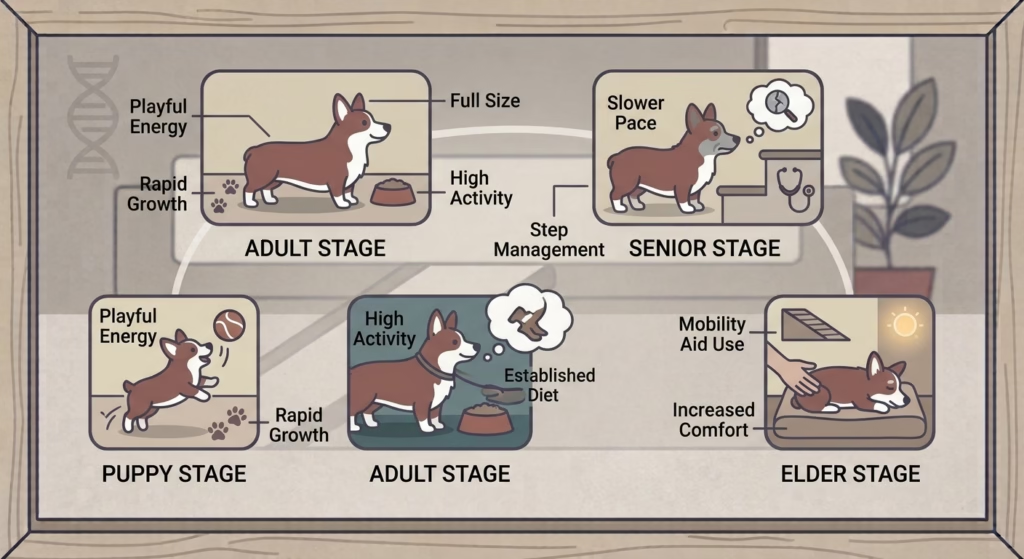
Care changes at each stage, from prevention in the mature years to comfort planning at the end, and the age ranges here are guides, not rules.
How can you tell normal ageing from illness?
The most useful rule is speed. Normal ageing is slow and symmetrical: it happens over months, to the whole dog. Illness is more often sudden, one-sided, or accompanied by pain.
The table below is a guide, not a diagnosis.

| Usually part of normal ageing | Needs a veterinarian |
| Slower on walks over several months | Sudden hind-leg weakness, crossing or dragging of a foot |
| A bluish haze in the lens of the eye | A white, dense eye or a red, painful eye |
| Sleeping more, in short, easily interrupted naps | Pacing, panting or whimpering at night, or not settling at all |
| Greying around the muzzle | Weight loss while eating normally, or a swollen belly |
| Taking a moment to rise after rest | Unable to rise, or crying out when lifted or touched |
| A little less interest in long walks | Refusing food for more than a day, or repeated vomiting |
When something sits on the right-hand side, the question is not “is this just age?” but “what is causing this, and can it be treated?”
Mature adult (about 6 to 8 years): lay the groundwork
Nothing is wrong yet, which is exactly why this is the best time to prepare. The aim is to start senior-stage habits before they are needed.
- Get a baseline. Ask the veterinarian for a full examination with blood and urine tests, a dental check, and a recorded body condition score and weight. Future changes can only be judged against a starting point.
- Film the gait. One short video of walking, trotting and standing up, taken now, will be useful for comparison in three years.
- Hold the line on weight. Because lean dogs delay joint disease (Kealy et al., 2002), this is the stage to fix weight drift, not the senior stage.
- Make furniture and stairs safe. Teach the dog to use a ramp or steps while it is still agile enough to learn in its own time.
- Ask the breeder or source for family history. Late-onset spine problems and DM tend to run in families. A recorded history in the dog’s line is more useful than any single test result.
Early senior (about 9 to 11 years) shift to watching
This is the stage the AAHA definition marks as senior for most Pembrokes, and it is when the first signs of age usually show. Stiffness after rest, slower stairs, a grey muzzle, cloudier eyes, and a little less appetite for long walks are common and manageable.
- Move to six-monthly check-ups. Many veterinarians recommend twice-yearly senior examinations. Ask what is advisable for this dog.
- Treat the first signs of arthritis. Early pain control, weight management and gentle rehabilitation keep a dog moving for longer than waiting until it limps.
- Start the quality-of-life diary. Use the HHHHHMM questions monthly while the dog is well, so there is a record of what “well” looks like.
- Screen for the quiet problems. Sensory loss, dental disease and early cognitive changes are usually found by asking about them specifically.
A good senior check-up is more than a quick listen to the chest. It should include a history from the Owner (appetite, thirst, sleep, toileting, mobility and behaviour), weight and body and muscle condition scores, an orthopaedic and neurological examination, a look at the eyes, ears and teeth, and blood, urine and blood pressure tests when the veterinarian advises them. Bring the gait videos and the quality-of-life diary, because they replace a vague “he seems a bit slower” with something the veterinarian can assess.
Advanced senior (about 12 years and beyond) protect comfort
By now, a Pembroke is at or beyond the typical lifespan. Degenerative myelopathy usually begins around age 11 in affected dogs (Bell, PWCCA), and the odds of CCD continue to climb by roughly half with each added year (Yarborough et al., 2022). Many dogs in this stage still enjoy life enormously; they simply need more help.
- Add mobility aids. Non-slip flooring, support harnesses, raised bowls and orthopaedic bedding make a measurable difference.
- Shorten walks, increase them in number. Two or three short outings do more good than one long one for a dog that tires.
- Prepare for hind-end decline. If the back legs begin to scuff or cross, ask for a neurological examination, and discuss rehabilitation early.
- Stay alert to the sudden. Collapse, laboured breathing, sudden blindness or inability to stand need a veterinarian the same day.
Hind-end weakness in an old Corgi has several possible causes, and the signs overlap. Degenerative myelopathy, a herniated disc, arthritis in the hips or knees, and weakness from general muscle loss can all produce scuffing, a wobbly rear end or difficulty rising. As Bell notes, a SOD1 test can rule DM out but cannot confirm it (Bell, PWCCA), so a veterinary neurological examination, and sometimes imaging, is how a treatable cause is separated from an untreatable one. The cost of skipping that step is a dog treated for the wrong thing, or an Owner told “it’s just DM” while a painful, fixable problem goes unaddressed.
Night-time is often where advanced senior problems first appear. A dog that was settled all night at ten may start waking, panting, circling or wanting company at twelve. Note the times, and look for a pattern: if it follows a hard day’s walking, think pain; if it happens at the same hour each night with no obvious trigger, think about cognitive changes; if it comes with frequent drinking and urinating, ask for blood and urine tests.
Appetite also changes. Many older Corgis become fussier or slower to eat, and some lose muscle even when they are eating enough. Smaller, more frequent meals, warming food slightly, and checking the mouth for pain are all reasonable first steps, and unexplained weight loss always deserves an examination.
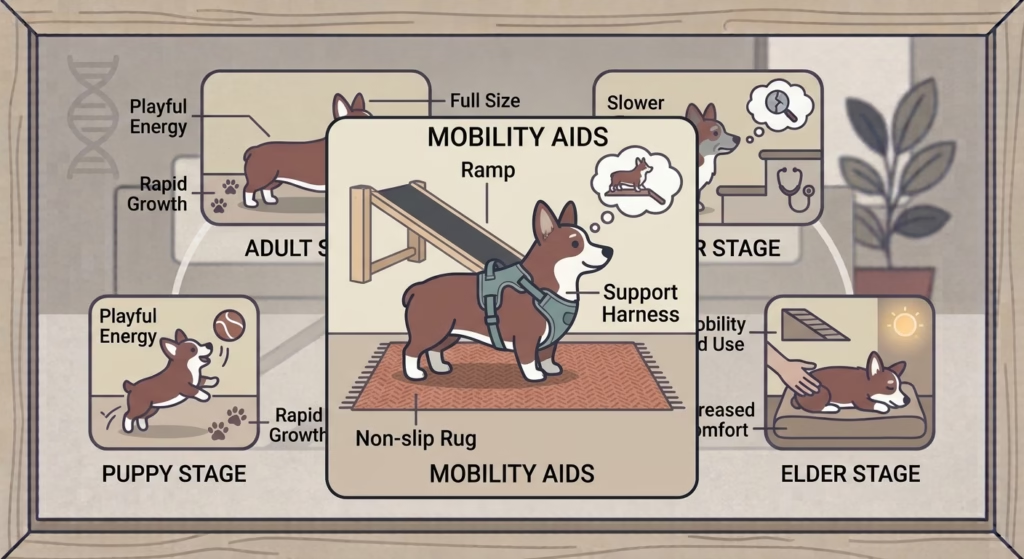
In the advanced senior years, small changes at home, such as ramps, rugs and supports, carry more weight than any single treatment.
End of life planning for comfort
The AAHA/IAAHPC guidelines treat this as a distinct stage that begins when the dog has a terminal diagnosis, or when decline has reached the point where comfort is the main goal (Bishop et al., 2016). It may last days or many months. Dogs with degenerative myelopathy, for example, can progress slowly, and Bell describes a course of six months to two years from first signs to dragging of the hind legs (Bell, PWCCA).
- Agree on goals. The conversation with the veterinarian shifts from “what can we fix?” to “what would make today good?”
- Decide the triggers in advance. Write down which changes would mean it is time to talk about euthanasia, so the decision is not made in the worst hour.
- Arrange the practicalities. Know who will come to the house or where you will go, and what aftercare you want, before it is urgent.
- Look after the family. Children, other pets and the Owner’s own grief are all part of the plan.
What changes in the final weeks varies by illness, but some patterns recur. Appetite usually falls first, then interest in favourite things, then the ability to stand and keep clean. Dogs often sleep more deeply, withdraw from the family, or seek out a quiet, cool place. Laboured or open-mouth breathing at rest, or pain that medication no longer controls, changes the situation from planning to urgency.
There are two broad routes through this stage, and both are legitimate. In planned euthanasia, a veterinarian ends the dog’s life peacefully at a time the family has chosen with them. In hospice-supported natural death, comfort care continues under veterinary supervision until the dog dies on its own (Bishop et al., 2016). Natural death is not automatically gentler: it needs a family prepared to give medication, nursing and round-the-clock attention, and a veterinarian willing to step in if comfort fails. Choosing between the two is not a test of love.
What Shapes How a Corgi Ages, and What Does Ageing Shape in Turn?
Senior care does not sit alone. A handful of other topics drive how a Corgi ages, and the end of a dog’s life reaches back into several more. Seeing the links helps an Owner act early on the parts they can change.
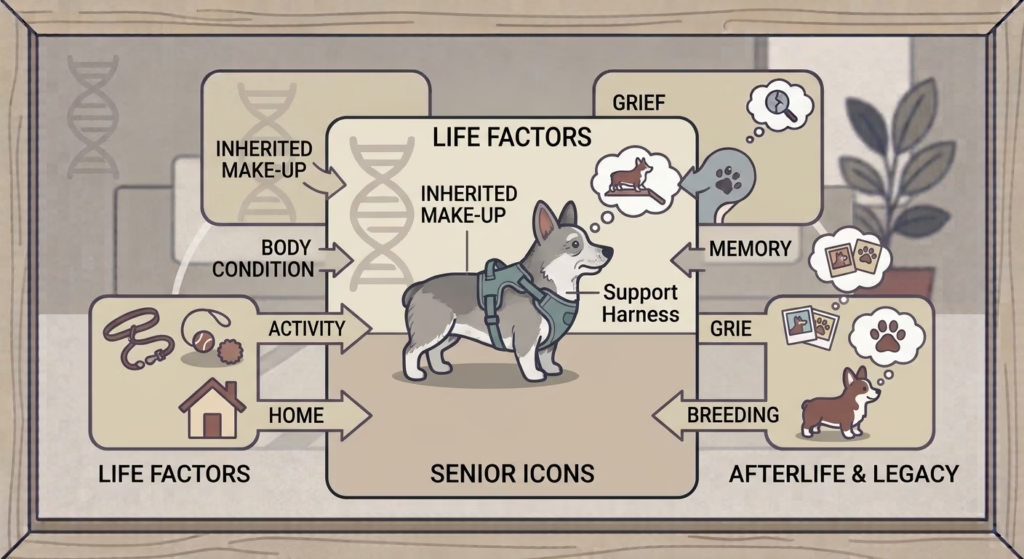
Genetics, weight, activity and home all shape how a Corgi ages, and the end of life shapes grief, memory and breeding decisions in return.
What influences how a Corgi ages?
Inherited make-up. The short-leg, long-back build and the SOD1 and FGF4 variants discussed above set some of the risks before a puppy is a week old. They are explained in full in Corgi Genetics and Inheritance, which covers the genetics of the breed and what health testing can and cannot tell you. Genetics sets the odds, not the outcome: most Pembrokes with the SOD1 mutation never develop DM (Bell, PWCCA).
A lifetime of body condition. Weight is the most controllable influence. The lifetime feeding trial and the large pet-dog study both point the same way: leaner dogs lived longer and developed joint disease later (Kealy et al., 2002; Salt et al., 2019). The effect starts years before the senior stage, which is why the mature-adult years matter.
Activity and enrichment. Dogs that were not active had much higher odds of CCD than very active dogs (Yarborough et al., 2022), and aged Beagles given enrichment and an antioxidant diet kept learning better than expected (Milgram et al., 2004). Neither result proves that exercise or enrichment prevents dementia, but both support keeping a Corgi physically and mentally occupied for as long as it can safely manage.
Home and climate in South Africa. Local conditions change the advice, and each of the following should be checked against a South African veterinary source before publishing. Summer heat is harder on older dogs, which are less able to regulate temperature, so walks belong early or late and cool, non-slip resting places belong indoors. Tick-borne disease, such as biliary fever (babesiosis), remains a risk in many parts of the country, and a senior dog has less reserve to cope with a severe attack, so a tick-prevention plan suited to the Owner’s area is worth asking the veterinarian about. Cold highveld winter nights are hard on stiff joints, and warm bedding off the floor helps. (Local claims in this paragraph are flagged for verification against the South African Veterinary Association or the University of Pretoria’s Faculty of Veterinary Science.)
Access to veterinary care, and money. Senior care is more expensive than adult care: more visits, more tests and more medication. The cost of care, and the availability of a veterinarian within reach, shape what can be offered. [Original input needed: typical local costs for senior screening, rehabilitation and home euthanasia, with a date, and any payment arrangements the programme knows of.]
Other illnesses and medicines. Senior dogs often have more than one condition at once, and each changes the others. Arthritis pain can look like dementia, kidney disease can limit which painkillers are safe, and some medicines increase thirst and urination, which can lead to house-soiling that is wrongly blamed on the brain. This is why a single veterinarian who knows the whole picture, and a current list of everything the dog takes, is worth more than any one treatment.
Household routine. A dog left alone for long stretches is harder to monitor, and a dog with early cognitive changes may become anxious when alone. If the household is empty for hours, a midday visit from a family member or sitter, and a camera for checking how the dog rises and settles, make early changes easier to see.
What does a Corgi’s ageing influence?
The Owner’s own wellbeing. Caring for a dog that needs lifting, medication and night-time attention is demanding, and decisions made in exhaustion can feel worse afterwards. Planning ahead, and sharing the load with family members or a mobile veterinary service where one is available, protects the Owner as well as the dog.
Grief, memory and legacy. How the final stage goes shapes the grief that follows. Adams and colleagues found that euthanasia and the support received from the veterinary team were among the main predictors of grief severity (Adams et al., 2000). A decision made with time, information and a plan tends to leave less to regret. The grief itself, and what it shows about the bond, is covered in Grief as Evidence.
The next generation of dogs. Late-life outcomes are the most valuable data a breeding programme can get, and they are the hardest to collect. DM and late-onset disc disease show up years after a dog has left the breeder’s care. Bell’s recommendation for the breed is an open pedigree database of pathologically confirmed DM cases, so that families with true risk can be identified without discarding healthy breeding stock (Bell, PWCCA). Owners can contribute by telling the breeder what happened and when. [Original input needed: how the programme asks for and records late-life health reports from Owners, and how that information is used.]
Key takeaway. You cannot change a Corgi’s genes, but you can change its weight, its floors, its routine and its plan. Most of senior corgi care is those four things.
What Does Day-to-Day Senior Corgi Care Look Like?
This is the section most readers come for. The steps below follow a rough order: set up the veterinary plan, make the home safe, manage weight and movement, watch for pain and confusion, and plan for the end.
Build a senior health plan with your veterinarian
Book a senior check-up and ask the veterinarian to write down a plan. A good plan names the schedule for visits (typically twice a year, more often once there is a diagnosis), the baseline tests to be done and repeated, the dog’s current weight and body and muscle condition scores, and what changes should prompt an earlier visit.
Ask three specific questions. What is my dog’s most likely late-life problem, given its family history and what you find today? What would you want me to report between visits? And is there anything here that would change how you approach pain control, surgery or anaesthesia, such as a bleeding disorder or kidney or heart findings? Write the answers down; they become the dog’s care plan.
Make the home easier on a long back
A Corgi’s spine bears the brunt of falls, jumps and slips, so most of the home changes target those three things.
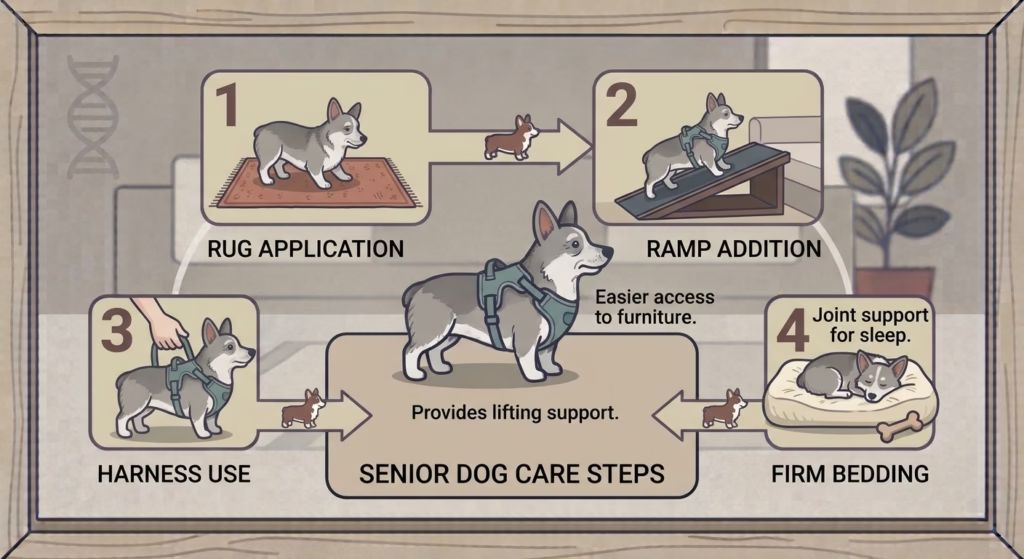
Four home changes, non-slip floors, ramps, a support harness and a firm bed, remove most of the daily strain on a senior Corgi’s back and hips.
- Cover slippery floors. Tiles and polished wood are where many old dogs first start to struggle. Rugs, runners, yoga mats or rubber-backed mats along the dog’s usual routes give grip. Trimmed nails, and trimmed hair between the pads, help too.
- Replace jumps with ramps. A ramp or steps to the sofa, bed and car stops the repeated landing on stiff joints. Introduce it with treats while the dog is still agile; many older dogs refuse new things.
- Use a support harness. A harness with a handle over the back or a hind-end lift sling lets the Owner help a wobbly dog up steps and into the car without twisting the spine. Never lift a Corgi by the front legs, and always support the chest and rear together.
- Choose a firm, warm bed. Orthopaedic foam supports stiff joints. In winter, keep it off cold floors.
- Raise the bowls and cut the stairs. Slightly raised food and water bowls can ease neck strain. If the house has stairs, gates at the top and bottom stop a dog that cannot judge them from falling.
Keep weight and food on track
Weigh the dog monthly, on the same scale, and check body condition with your hands. You should be able to feel the ribs under a thin covering, and see a waist from above. If the ribs have disappeared, ask the veterinarian for a plan to remove the extra fat slowly. Treats count; many Corgis add weight from them, not from meals.
A senior diet should be chosen with the veterinarian, because the right one depends on the dog’s kidneys, heart, teeth and muscle. Two points are worth knowing in advance. Healthy older dogs do not automatically need less protein, and restriction is a treatment for diagnosed kidney disease, not a default for age. And a dog that is losing weight without trying needs an examination, not a richer diet.
Keep moving, safely
Short, frequent, flat walks suit a senior Corgi better than one long outing. Avoid fetch with sudden stops, jumping for toys and rough play with younger dogs. Swimming and hydrotherapy are low-impact options, and a canine rehabilitation therapist can build a home programme of controlled exercises. For a dog showing early DM signs, the Kathmann study described above is the evidence that structured, supervised movement is worth starting early (Kathmann et al., 2006).
Watch for pain and confusion
Check the dog the same way each week: how it rises, how it climbs one step, whether it flinches when the back or hips are touched, how it sleeps, and whether it still greets familiar people. The monthly gait video makes change visible. Use the DISHAA headings (disorientation, interactions, sleep, house-soiling, activity, anxiety) as a prompt for what to note. If night-time restlessness appears, ask about pain control before assuming dementia.
A worked example
This is a hypothetical illustration, not a case from this programme.
Imagine Biscuit, an 11-year-old Pembroke. His Owner notices that his back toes scuff on the morning walk and that he now hesitates at the top of the steps. She films him walking on the lounge floor. Over the next fortnight, she also notes that he paces for an hour around 2 a.m.
At the veterinary visit she shows the video and the notes. The veterinarian examines Biscuit’s spine and reflexes, checks his hips and knees, and runs blood and urine tests. The tests are unremarkable, but the examination finds back pain and hind-limb weakness. Biscuit is started on pain relief for a suspected disc problem and referred for a neurological opinion, because DM is also possible at his age.
At home, the Owner lays rugs down the hallway, buys a ramp for the sofa and a hind-end support sling, and starts a short physiotherapy programme the therapist has shown her. She scores Biscuit on the HHHHHMM questions every Sunday, and the veterinarian and she agree, in writing, on three signs that would prompt an earlier visit: refusing food for a day, not being able to rise unaided, and pain that medication no longer controls. Four months later, Biscuit’s night pacing has settled once his pain was managed. The plan has done what it was meant to: found a treatable problem early, kept the dog moving, and given the Owner a record to decide from.
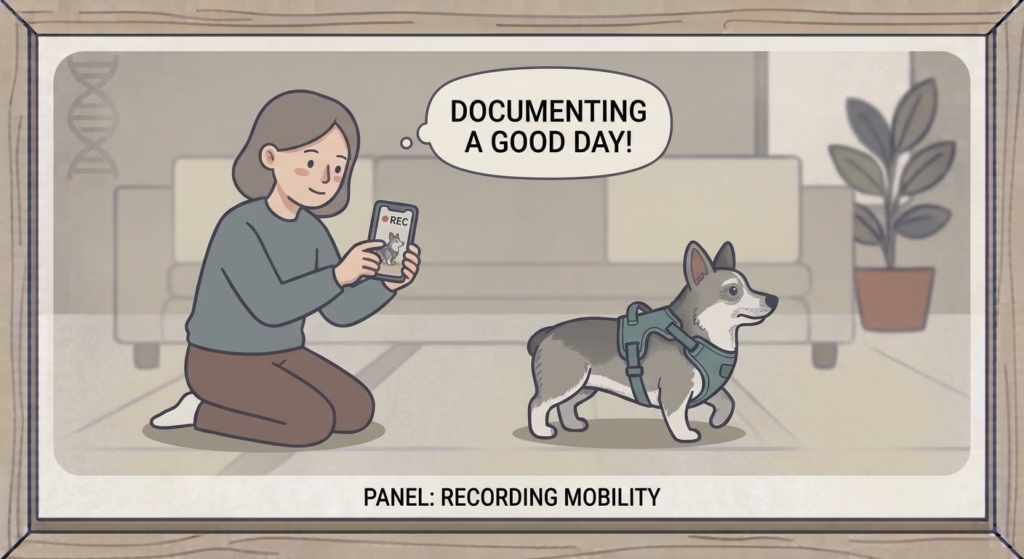
In this illustrative case, filming the gait and logging night-time restlessness gave the veterinarian evidence that changed the diagnosis and the plan.
 Red Flags — see a veterinarian the same day if your senior Corgi
• suddenly cannot use, or drags, one or both back legs, or cries out when touched along the back
• collapses, or cannot stand
• breathes with effort at rest, with an open mouth, or has pale or blue gums
• has a tight, swollen belly, or retches repeatedly without bringing anything up
• strains to pass urine or has not urinated in 12 to 24 hours
• has a seizure, or suddenly loses sight
• refuses food and water for more than a day
Call the veterinarian ahead of travelling and say how urgent it is. Do not give human painkillers: several are dangerous for dogs.
Success criteria — you will know senior care is working when: your dog’s weight is steady or slowly falling toward a lean target; it rises, climbs and settles with less effort than before; it sleeps through most of the night; it still takes interest in food, family and at least two or three favourite things; and its quality-of-life scores are stable from month to month.
Plan the end before it arrives, quality of life and euthanasia
Make a plan while the dog is stable, not in the middle of a crisis. A written plan has four parts.
- Agree on the measures. Pick the quality-of-life tool you will use, such as HHHHHMM, a good-day and bad-day calendar, or a simple list of the dog’s three favourite things. Use the same one each week.
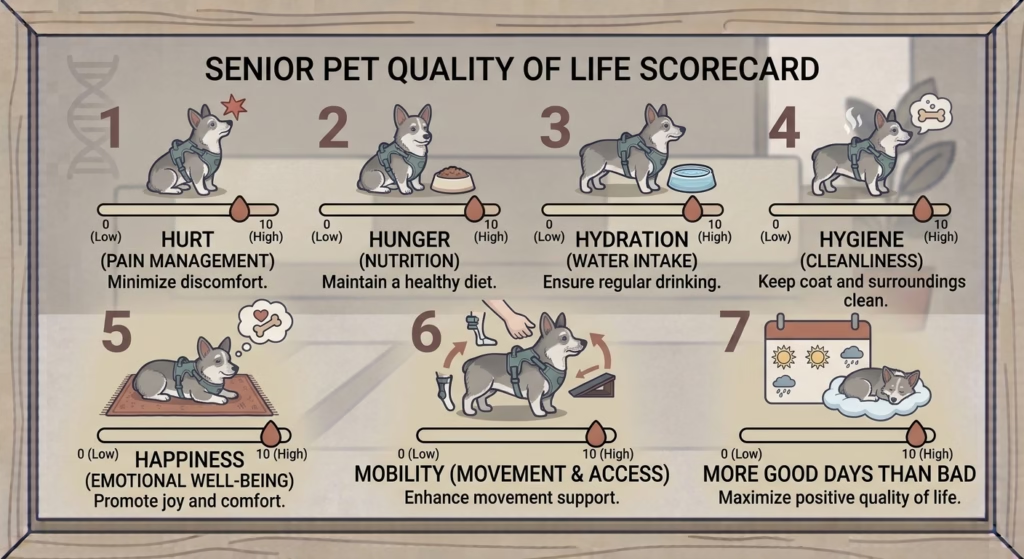
The seven HHHHHMM factors turn a vague worry into seven questions that can be scored and tracked each week.
|
 What Do People Get Wrong About Old Dogs?
“Slowing down and night-time restlessness are just old age.” They often are not. In one survey of older community dogs, an estimated 14.2% showed signs consistent with cognitive dysfunction, yet only 1.9% had been diagnosed by a veterinarian (Salvin et al., 2010). Pain and sensory loss produce similar behaviour and are more treatable than most Owners expect.
“A positive SOD1 test means degenerative myelopathy is coming.” For Pembrokes it does not. Bell reports that more than half of the breed tests homozygous “at risk”, yet only about 1.1% of those dogs develop clinical DM, and a clear result rules DM out while a positive one cannot confirm it (Bell, PWCCA).
“DM is painful, so a dog with it should be put down at the first signs.” Bell describes DM itself as not painful, with a slow course of six months to two years from first signs to dragging of the hind legs (Bell, PWCCA). The decision turns on mobility, hygiene, comfort and the dog’s own enjoyment, and any coexisting pain from discs or arthritis should be treated in its own right.
“I will just know when it is time.” Many Owners do, but many are unsure, and uncertainty is not a failure of love. Structured prompts such as HHHHHMM exist because the decision is hard to make from instinct alone, and the evidence behind such tools is limited (Belshaw et al., 2015). A written plan made in a calm week helps more than waiting for certainty.
Do Pembroke and Cardigan Corgis Age Differently?
Cardigan Welsh Corgis are a separate breed, larger and heavier-set than Pembrokes, and the American Kennel Club lists a Cardigan lifespan of 12 to 15 years against 12 to 13 for the Pembroke. That small gap does not tell an individual Owner much. Cardigans share the long-back, short-leg build and its disc-disease risk, so the home-safety and weight advice in this guide applies to both.
Where the breeds diverge, take care not to carry Pembroke figures across. The SOD1 and DM numbers in this article come from Pembroke data and should not be assumed to match Cardigans. Cardigans also have their own inherited eye disease concerns, such as progressive retinal atrophy, which belong in a Cardigan-specific discussion and eye screening plan with a veterinary ophthalmologist. Neither breed’s senior years should be planned from a breed average alone: the individual dog’s examination findings decide the plan. Where this guide says “Corgi” without a qualifier, the general principles (weight, floors, pain control, planning) hold for both breeds. Where it cites a number, treat it as a Pembroke number. Cardigan Owners should ask their veterinarian about eye examinations from middle age, and should expect to adapt rather than copy the DM and SOD1 figures. The genetics behind each breed’s risks is covered for Pembrokes in the linked Applied Pillar below.
 Where Should You Read Next?
Three pieces extend this one, in different directions. Corgi Genetics and Inheritance explains the FGF4 and SOD1 variants behind the risks above and what testing can and cannot tell you. Grief as Evidence looks at what the pain of losing a dog shows about the bond. Physical Development in the Corgi shows how the body that is now ageing was built.
Check your understanding.
Try these before the FAQ:
- Night-time pacing in a 12-year-old Corgi could be pain, confusion or both. What would you do first, and why?
- A Pembroke’s SOD1 result comes back “at risk”. What does that tell you, and what does it not?
- Which of the seven HHHHHMM factors would you act on first if the total looked acceptable but one score was low?
- Which three changes would you and your family agree, today, would mean it is time to talk to the veterinarian about euthanasia?
 Senior Corgi Questions, Answered
How long do Corgis live?
Pembroke Welsh Corgis typically live 12 to 15 years, according to the Pembroke Welsh Corgi Club of America, and the American Kennel Club gives 12 to 13. Cardigans are listed at 12 to 15.
These are breed averages, not promises. Weight, injuries, inherited disease and chance all move an individual dog above or below them. Lean dogs live longer on average, as shown in studies of Labradors and of pet dogs generally (Kealy et al., 2002; Salt et al., 2019), so body condition is the most controllable factor. Plan senior care from about nine years old, not from the day a problem appears, and treat any figure on the internet that cites an unnamed “study” with caution.
When is a Corgi considered senior?
A Corgi is usually considered senior at about 9 to 10 years old, when it enters the last quarter of its expected lifespan. Some Owners and veterinarians start senior-style care at 8.
The 2019 AAHA life stage guidelines define “senior” by remaining lifespan, not a set age, because size and breed change the timeline (Creevy et al., 2019). For a Pembroke expected to live 12 to 13 years, a quarter of that is about three years. Starting twice-yearly check-ups, baseline tests and a weight and mobility record around eight or nine gives you a comparison point for everything that follows.
What are the most common senior Corgi health problems?
The most common are arthritis, disc disease, weight gain, dental disease and sensory decline, with degenerative myelopathy and cognitive dysfunction less common but important. Which one a given dog gets varies.
No verified, breed-wide prevalence table exists for all of these in Pembrokes, so be wary of lists that give exact percentages. What the evidence does support is the mechanism: a long back and short legs load the spine and joints for life, and the breed carries FGF4-related disc risk and, often, the SOD1 variant. A senior check-up looks for each of these, which is why regular examinations beat waiting for symptoms.
How can I help my old Corgi with mobility problems?
Start with the floor, the furniture and the weight. Non-slip rugs, a ramp to the sofa and car, a support harness and a lean body make the biggest immediate difference. Pain control and rehabilitation come next.
A veterinarian can prescribe pain relief and examine the spine to tell arthritis, a disc problem and degenerative myelopathy apart, which matters because they are managed differently. Short, flat walks suit better than one long outing. In a small study of dogs with suspected DM, those given intensive daily physiotherapy survived longer on average than those given none (Kathmann et al., 2006). Ask about a canine rehabilitation therapist early, not after mobility is lost.
Does my senior Corgi have arthritis, and what helps?
Signs include stiffness after rest, reluctance to jump or climb, slower walks, licking a joint, and changes in mood. Only a veterinarian can confirm arthritis, and treatment usually combines several approaches.
Current AAHA pain guidelines recommend assessing pain at each visit and treating it with more than one method together, such as prescribed medication, weight control, rehabilitation and home changes (Gruen et al., 2022). Weight matters most: in the lifetime Labrador study, lean-fed dogs developed hip osteoarthritis later and needed treatment about three years after the control group (Kealy et al., 2002). Never give a human painkiller to a dog without veterinary advice, because several are dangerous for dogs.
Can Corgis get IVDD when they are old?
Yes. Intervertebral disc disease is often thought of as a middle-aged problem, but a disc that degenerated years earlier can herniate or bulge in a senior dog, often after a jump or a slip.
The FGF4 retrogene on chromosome 12 is linked to early disc degeneration in chondrodystrophic dogs (Brown et al., 2017). The signs range from a hunched back and pain when touched to wobbling, scuffing or sudden hind-leg weakness. Sudden weakness needs a veterinarian the same day, because early treatment gives the best chance of recovery. Hind-end signs in an old Corgi can also come from DM or arthritis, so an examination is how they are told apart.
How do I know if my Corgi has dementia?
Look for the DISHAA pattern: disorientation, changed interactions, disturbed sleep, house-soiling, altered activity and new anxiety. Staring at walls, getting stuck in corners and night-time pacing are typical early signs.
Cognitive dysfunction is a diagnosis of exclusion, so a veterinarian must first rule out pain, sensory loss and illness, which can look the same. In a Dog Aging Project analysis of 15,019 dogs, the odds of CCD rose 52% with each year of age (Yarborough et al., 2022). Rating scales such as the CCDR help track change (Salvin et al., 2011). Routine, scent games and good night lighting help, and a veterinarian can advise on diet and medication available locally.
What should I feed a senior Corgi?
Feed a complete, balanced diet in measured amounts, chosen with your veterinarian, aiming for a lean body with good muscle. There is no single best senior food, because the right choice depends on the dog’s kidneys, heart, teeth and weight.
Weigh the dog monthly and feel the ribs: you should feel them under a thin covering. Healthy older dogs do not automatically need less protein. Restricting protein is a treatment for diagnosed kidney disease, and a dog losing weight while eating normally needs an examination. Treats count toward the daily total. Lean-fed Labradors lived a median of 1.8 years longer than their pair-mates (Kealy et al., 2002), so small, steady portions matter.
Is it normal for a senior Corgi to sleep more or pace at night?
Sleeping more is normal with age, but pacing, panting or restlessness at night is not something to dismiss. It can signal pain, cognitive dysfunction, thirst from a medical condition, or a need to toilet.
Note when it happens and what precedes it. If it follows a hard day’s activity, suspect pain; if it comes at the same hour with no trigger, think cognitive changes; if the dog also drinks and urinates a lot, ask for blood and urine tests. In one study, dogs with higher cognitive scores also showed more signs of musculoskeletal pain (Animals, 2023), so treating pain first is sensible. Do not start medication without veterinary advice.
What is a quality-of-life scale for dogs?
It is a structured checklist for judging whether a dog’s days are still good. The best-known in end-of-life care is HHHHHMM: Hurt, Hunger, Hydration, Hygiene, Happiness, Mobility and More good days than bad.
Each factor is scored from 0 to 10, and Villalobos’s original format treats a total above 35 as acceptable for continuing hospice-style care. A review of canine quality-of-life tools found only 11 of 52 had any evidence of reliability or validity (Belshaw et al., 2015), so use the scale as a conversation prompt, not a verdict. Score it weekly, watch the trend, and act on any low score for Hurt, Hunger or Mobility even when the total looks fine.
How do I know when it’s time to euthanise my dog?
When pain or distress cannot be controlled, when your dog can no longer eat, stand or keep clean even with help, or when bad days consistently outnumber good ones, it is time to speak to your veterinarian about euthanasia.
There is rarely a perfect moment. Use the quality-of-life scale you have been tracking, agree triggers with your family in advance, and ask the veterinarian for an honest assessment. The 2016 AAHA/IAAHPC guidelines describe both planned euthanasia and hospice-supported natural death as legitimate paths (Bishop et al., 2016). If you are asking the question, the dog is probably already close to the point where the conversation is warranted.
What happens during dog euthanasia, and can it be done at home in South Africa?
A veterinarian usually gives a sedative first, then an injection of an overdose of anaesthetic. The dog loses consciousness within moments, and death follows within minutes. It can be done in a clinic or, where available, at home.
The eyes may stay open, and a deep breath or muscle twitch can follow death; these are reflexes. In South Africa, sedation and euthanasia are carried out by registered veterinary professionals, and some offer home visits, though availability varies by area. (Verify against the South African Veterinary Council and local providers before publishing.) Ask in advance about the visit time, the cost, who will take care of the body, and whether you can stay.
Should I let my dog die naturally, or is palliative care enough?
Either can be a good choice, but natural death is not automatically gentler. It needs a family prepared to give medication and nursing and a veterinarian ready to step in if comfort fails.
The AAHA/IAAHPC guidelines call this “hospice-supported natural death”: comfort measures continue under veterinary supervision until the dog dies on its own (Bishop et al., 2016). It suits some dogs and families, for example when decline is slow and well controlled. If pain, breathing difficulty or distress cannot be managed, euthanasia is the kinder option. Discuss the plan, and the circumstances under which you would change it, with your veterinarian before it is needed.
How do I cope with losing my Corgi, and where can I find pet loss support in South Africa?
Grief after a dog dies is normal and can be severe. In one Ontario survey of 177 clients, about 30% reported severe grief, and the strongest predictors were the strength of attachment, euthanasia, and a lack of support (Adams et al., 2000).
Tell someone close what you are feeling, allow time off if you can, and do not let others dismiss the loss. Many veterinary practices can recommend counsellors or support groups. [Original input needed: verified South African pet-loss support options with current contact details.] If grief stops you eating, sleeping or functioning for weeks, speak to your doctor or a counsellor, as you would after any significant loss.
What if I cannot afford treatment for my senior Corgi?
Tell your veterinarian honestly what you can spend. Many conditions have several treatment levels, and a plan that focuses on pain relief, weight and home changes costs far less than extensive investigation.
Ask for an itemised estimate, which treatments give the most comfort for the least cost, and whether payment arrangements are possible. Cost should never be hidden behind a vague “it’s his age”; a clear conversation is better for the dog and for you. Prioritise pain control and basic nursing, which cost relatively little and improve daily life the most.
 Sources
- Adams CL, Bonnett BN, Meek AH (2000). Predictors of owner response to companion animal death in 177 clients from 14 practices in Ontario. JAVMA 217(9):1303–1309. https://doi.org/10.2460/javma.2000.217.1303
- Awano T et al. (2009). Genome-wide association analysis reveals a SOD1 mutation in canine degenerative myelopathy that resembles amyotrophic lateral sclerosis. PNAS 106(8):2794–2799. https://doi.org/10.1073/pnas.0812297106
- Bell JS. Canine degenerative myelopathy and genetic testing in Pembroke Welsh Corgis. Pembroke Welsh Corgi Club of America (undated). https://pwcca.org/Canine-Degenerative-Myelopathy-and-Genetic-Testing-in-PWCs
- Belshaw Z, Asher L, Harvey ND, Dean RS (2015). Quality of life assessment in domestic dogs: an evidence-based rapid review. Vet J 206:203–212. https://www.ncbi.nlm.nih.gov/pmc/articles/PMC4641869/
- Belshaw Z, Yeates J (2018). Assessment of quality of life and chronic pain in dogs. Vet J 239:59–64. https://doi.org/10.1016/j.tvjl.2018.07.010
- Belshaw Z (2017). Decision making and welfare assessment in canine osteoarthritis. PhD thesis, University of Nottingham.
- Bishop G et al. (2016). 2016 AAHA/IAAHPC End-of-Life Care Guidelines. JAAHA 52(6):341–356. https://doi.org/10.5326/JAAHA-MS-6637
- Coates JR et al. (2007). Clinical characterization of a familial degenerative myelopathy in Pembroke Welsh Corgi dogs. J Vet Intern Med 21:1323–1331.
- Creevy KE et al. (2019). 2019 AAHA Canine Life Stage Guidelines. JAAHA 55:267–290. https://doi.org/10.5326/JAAHA-MS-6999
- Kathmann I et al. (2006). Daily controlled physiotherapy increases survival time in dogs with suspected degenerative myelopathy. J Vet Intern Med 20(4):927–932. https://pubmed.ncbi.nlm.nih.gov/16955818/
- Kealy RD et al. (2002). Effects of diet restriction on life span and age-related changes in dogs. JAVMA 220(9):1315–1320. https://pubmed.ncbi.nlm.nih.gov/11991408/
- Salt C et al. (2019). Association between life span and body condition in neutered client-owned dogs. J Vet Intern Med 33(1):89–99. https://pubmed.ncbi.nlm.nih.gov/30548336/
- Salvin HE et al. (2010). Under diagnosis of canine cognitive dysfunction: a cross-sectional survey of older companion dogs. Vet J 184(3):277–281.
- Salvin HE et al. (2011). The canine cognitive dysfunction rating scale (CCDR). Vet J 188:331–336. https://doi.org/10.1016/j.tvjl.2010.05.014
- Villalobos AE (2004). Quality of life scale helps make final call. Veterinary Practice News, September 2004.
- Yarborough S et al. (2022). Evaluation of cognitive function in the Dog Aging Project. Sci Rep 12:13316. https://doi.org/10.1038/s41598-022-15837-9
- Pembroke Welsh Corgi Club of America, Health and Genetics (lifespan 12–15 years). https://pwcca.org/Genetics-and-Health. American Kennel Club breed profiles (12–13 years Pembroke, 12–15 years Cardigan): confirm against the AKC pages directly.
- Animals (2023) 13:2203, cross-sectional study of cognitive dysfunction and medical conditions in 804 geriatric dogs. https://doi.org/10.3390/ani13132203 (confirm authors at fact-check).
- † Written from memory, to be verified and hyperlinked: Parker HG et al. (2009), Science 325:995–998; Brown EA et al. (2017), PNAS 114:11476–11481; Lawler DF et al. (2008), Br J Nutr 99:793–805; Landsberg GM et al. (2012), Vet Clin North Am Small Anim Pract; Milgram NW et al. (2004), Exp Gerontol 39; Brown DC et al. (2007), Am J Vet Res 68:631–637; Gruen ME et al. (2022), 2022 AAHA Pain Management Guidelines, JAAHA 58:55–76; Bowlby J (1980), Loss: Sadness and Depression; Doka KJ (1989), Disenfranchised Grief; AVMA Guidelines for the Euthanasia of Animals, 2020 edition.