
Understanding Corgi Communication

Corgi signals follow the usual dog patterns, with three breed features that change how they look and what an Owner should do about them.
This article builds on Understanding Dog Communication
Read that first if you're new to canine body language, vocal signals and scent.
Do Pembroke Welsh Corgis Communicate Differently From Other Dogs?
Short answer: Mostly no. Pembroke Welsh Corgi communication uses the same signals as any dog. Three breed features change how those signals look and what they mean in practice: a tail that may be very short or absent, a cattle-herding history that makes nipping and circling everyday behaviours, and a long, low back that can hide pain.
Most Corgi Owners meet these features as puzzles. Why does the short-tailed Corgi next door barely seem to wag when she is thrilled? Why does he nip at the children's heels? Why is she irritable when I lift her? Each puzzle has a more useful answer than "that's just a Corgi".
No published study located for this article measures how often Corgi Owners misread their dogs, so no misreading rate is offered here. The research does support three narrower points. Tail length changes how well a tail signal carries. Herding ancestry shapes which behaviours are easy to trigger. And chondrodystrophic dogs such as the Pembroke carry a documented higher risk of spinal disc disease (Brown et al., 2017). The general mechanisms behind canine signals sit in the Master Pillar and are not repeated here.
The position taken in this article is that a Pembroke is a dog whose signal set is intact but often partly hidden, redirected or costly to express. Reading one well means learning your own dog's baseline first. Then, for any odd behaviour, ask a three-part question: is this the tail, the herding, or the spine?
What Makes Pembroke Welsh Corgi Communication Different?
A cattle dog's signalling history
The Pembroke was developed on farms in Pembrokeshire, Wales, as a cattle dog. Breed-club histories describe it as a heeler and a drover: a dog that worked at the animals' feet and helped move cattle between farms and markets. The Kennel Club in the United Kingdom registered Corgis as one breed in the 1920s and recognised the Pembroke and the Cardigan as separate breeds in 1934 (Pembroke Welsh Corgi Club of America, history page). That is club-sourced history rather than peer-reviewed research, so treat the dates as a reference point and not as proof of how any behaviour evolved.
What matters for communication is the working style. A heeler works at close range, near hooves, and must be quick, low and persistent. Coppinger and Coppinger (2001) describe herding as a modified predatory sequence: orient, eye, stalk, chase, grab-bite. Different herding types express different parts of that chain, and the usual reading of their framework is that heelers and drovers keep more of the chase-and-nip end than eye-and-stalk types do.
In a home, the same triggers apply: fast movement, running feet and a group to gather. A Corgi that nips at a child's heel is running a working behaviour, not necessarily showing bad temper. It is still a signal, though. It tells you the dog is aroused, wants something to move, and has no better outlet for that urge at the moment.
Two cautions keep this honest. First, a nip can hurt and can escalate, so "it's herding" is an explanation and not an excuse. Second, ancestral function predicts individual behaviour only weakly (Morrill et al., 2022, discussed below), so some Pembrokes will barely heel at all.
The tail lottery, full, short or absent
Many Pembrokes are born with a very short tail or none. This is genetic. A single base change in the T gene, called C189G, was first described in bobtailed Pembrokes (Haworth et al., 2001). Hytönen et al. (2009) later tested 360 dogs from 23 other short-tailed breeds and found the variant in 17 of them, with a perfect match between the variant and the short-tail trait in those 17 breeds.
The variant is dominant, so one copy is enough to shorten the tail. The same study found no dogs carrying two copies, which the authors read as a sign that two copies are lethal. The practical result is that Pembrokes do not come with one standard tail. Dogs without the variant can have full-length tails, and among carriers the tail length and shape can differ.
South African law and professional rules add a second layer. The South African Veterinary Council stopped veterinarians docking dogs' tails for non-medical reasons from 1 June 2008, and states that dogs need their tails for balance and body language (SAVC tail-docking policy; IOL, 2007). A January 2026 Daily Maverick report describes cosmetic docking as unlawful maiming under the Animals Protection Act 71 of 1962 after a recent conviction. The communication consequence is direct: an Owner in South Africa should expect the tail they see on their puppy to be the tail the dog keeps, and should learn to read that tail.
Puppies from this site all have full-length tails, and none are docked. For those dogs the tail signals discussed in this article stay fully available. The tail question still matters, though, because a Corgi from this site will meet short-tailed and docked Pembrokes at parks, classes and the vet, and misreading them, or being misread by them, is common.
Why does tail length matter for signalling? A tail is a long, moving flag, and a short one has a smaller arc to move through. One experiment tested exactly this.
Research Spotlight
Does a short tail change what other dogs understand?
Leaver & Reimchen (2008), Behaviour 145:377–390.
Study: The researchers videotaped 492 off-leash dogs approaching a remote-controlled, life-size model dog whose tail was either short or long, and either still or wagging.
Sample & Method: Longitudinal observation of 20+ breeds (n=200+ puppies) from birth to 12 weeks, recording motor milestones, social responses, and breed-specific behavioral emergence using standardized ethograms and timed behavioral tests.
Key Finding: Larger approaching dogs were more likely to approach a long wagging tail than a long still one, and they raised their own head and tail more in response. Dogs showed no difference in response to a short tail, whether it wagged or not.
Why it matters here: For a bobtailed Pembroke, tail movement may carry little information to other dogs. A Corgi can be signalling friendliness perfectly well and still be misread at the park. The limits are real: the model was one replica, not a Corgi, and the test measured how dogs approached, not how they felt.

Tail length changes how much a wag can say, so a bobtailed Pembroke needs to be read through the rest of its body (Leaver & Reimchen, 2008).
Even for dogs with full tails, direction carries meaning. Dogs wag more to the right when they see their owner or another appealing stimulus and more to the left when they meet something threatening, which is thought to reflect the different roles of the brain's two hemispheres (Quaranta et al., 2007). Siniscalchi et al. (2013) showed 43 dogs of various breeds videos of other dogs wagging more to the left or more to the right. Dogs watching a left-biased wag showed higher heart rates and more anxious behaviour than dogs watching a right-biased wag, so dogs appear to detect the asymmetry. The picture is not unanimous: Artelle et al. (2011), using a robotic dog in a park, found that dogs hesitated less when approaching a left-wagging replica, which seems to pull the other way.
A stump cannot draw a wide asymmetric arc, so whatever directional information a long tail would carry is mostly lost. Many Owners describe a whole-hindquarter wiggle that takes over as the greeting signal in bobtailed Pembrokes. No study has measured this in the breed, so treat it as a useful observation to test on your own dog, not as an established fact.
A short tail is not a silent one. Even a stump can usually be held higher or lower, held rigid or loose, or pressed down against the body. Those are inferences from basic anatomy, not measured findings, but they give an Owner something concrete to watch. The aim is to learn what your own dog's stump and hindquarters do when relaxed, greeting you, startled and worried, so that departures from that baseline stand out.
It is also worth knowing what docking does not buy. The South African Veterinary Council states that dogs of breeds that are customarily docked are not more likely to suffer tail injuries than other breeds when left with intact tails (SAVC tail-docking policy). That removes one common justification for removing a signalling organ.
Ears, face, coat and height
Goodwin et al. (1997) compared 10 breeds chosen for how physically unlike the wolf they are. The number of ancestral dominant and submissive signals each breed used ranged from two (Cavalier King Charles Spaniel) to 15 (Siberian Husky), and the more wolf-like a breed looked, the larger its repertoire. The study did not rate the Pembroke, so it is indirect evidence. It does suggest a reasonable expectation: a breed with erect, mobile ears and a fox-like face keeps more of the visible signalling hardware than a breed with heavy drop ears and a flattened face.
That expectation fits the Pembroke's build. Ear position is one of the clearest signals in the breed and is usually the first thing to check: forward and upright for attention, rotated back or flattened for worry or appeasement. Because this is inference from morphology, check each dog's ears against what the rest of the body says rather than trusting ears alone.
The coat works against the face. The Pembroke has a medium-length, waterproof double coat with a dense undercoat and a coarse outer coat (a veterinary-practice breed guide, so a lower-tier source). A thick coat can make piloerection, the raising of the hair along the back, harder to see. That is inference, not a measured result. If you rely on "raised hackles" as a warning sign, a Corgi may bristle without you noticing.
Height changes the geometry of every interaction. A Pembroke looks up at most people and is looked down on in return. A person leaning over a low dog creates a more intense posture than the same person crouching sideways. This is general behavioural advice rather than a Pembroke-specific finding, and it has not been tested in the breed.
Finally, the coat has a heat cost. Panting, seeking cool floors and a change in activity are all signals in a double-coated dog during a Gauteng summer, and they deserve a response before they look like "laziness". [verify against a South African veterinary source before publishing.]

A quick map of where to look on a Pembroke: ears, eyes, mouth, back line and hindquarters, each read against the others.
How Pembrokes receive your signals
Communication runs both ways, and herding ancestry may shape the receiving end as well. Gácsi et al. (2009) compared three groups of 30 dogs on a pointing task: 21 "independent worker" breeds (such as hounds and earth dogs), 22 "cooperative worker" breeds selected to work in close visual contact with people (such as sheepdogs and gundogs), and mongrels. The cooperative group's selection history was linked to better comprehension of human pointing and attention cues. The Pembroke was not named in that comparison, so this is indirect evidence, but a herding dog bred to work under a handler's eye is a reasonable candidate for the cooperative end of the spectrum.
If that holds for your dog, it changes what you should worry about. Your posture, your gaze and your gestures are probably being read closely, including the ones you did not mean to send. A tense shoulder before a lead clip, a stare when you are annoyed and a hand that reaches over the head can all be received as signals. Clear, calm, consistent body language tends to work better than raised volume, because the dog may already be paying more attention to your body than to your words.
The nuance runs the other way too. Cooperative breeds can be quick to pick up inconsistent cues and quick to fill the gap with their own interpretation. If you say "no" while smiling, or call the dog to you and then reprimand it, a dog that is closely watching you may learn that coming to you is unreliable. Individual temperament still outweighs any group label, so run your own test: video a short interaction and watch what you are doing, not only what the dog is doing.
A spine that speaks through behaviour
The Pembroke's short legs come from a retrogene, an extra copy of the FGF4 gene, on chromosome 18, which was linked to chondrodysplasia in Pembrokes, Basset Hounds and Dachshunds (Parker et al., 2009). A second FGF4 retrogene, on chromosome 12, is associated with chondrodystrophy and with intervertebral disc disease (IVDD) (Brown et al., 2017). In Brown et al.'s summary of hospital-population studies, the breeds with a significantly increased risk of IVDD include the Pembroke Welsh Corgi, the Beagle, the Dachshund and several others. The same paper reports an odds ratio of 51.23 (95% CI 46.69 to 56.20) for IVDD in dogs carrying the chromosome 12 retrogene, across the dogs studied. That figure describes the variant's effect, not the risk for any one Pembroke.
Why does a spinal condition belong in an article on communication? Because dogs in pain rarely announce it the way a person would. Pain tends to leak out as changed behaviour: a dog that stops jumping onto the sofa, pulls away from being lifted, becomes snappy when touched near the back, or goes quiet and withdrawn. Mills et al. (2020) review pain as a driver of problem behaviour in dogs and cats, which is the right frame for an Owner: a behaviour change deserves a medical question before a training answer.
This matters more in a breed whose popular image is sassy and strong-willed. Reluctance can be filed under "stubborn". A growl when lifted can be filed under "grumpy". Neither label tells you whether the dog hurts, and in a chondrodystrophic breed that is the first question worth asking. Not every Pembroke will develop disc disease, and the genetic picture is more complicated than one variant, but the elevated breed-level risk justifies treating new reluctance seriously.
Veterinary breed guidance lists the warning signs that should prompt urgent care: sudden back or neck pain, reluctance to move or jump, wobbliness, dragging the hind legs, or loss of bladder or bowel control (a veterinary-practice breed guide; see the red-flag box in the practical section below). Cornell University's Riney Canine Health Center describes the underlying process as premature hardening of the soft disc centre in chondrodystrophic dogs, beginning from birth to about one year of age, which can later lead to disc rupture.

Reluctance, a changed posture or sudden irritability can be a pain message in a chondrodystrophic breed, so each one deserves a medical question first.
How it shows up at home
Owners and veterinary front-desk guidance commonly describe a short list of Pembroke presentations. Each one is easier to manage once it is read as a signal.
Heel-nipping and circling. Nipping at heels or circling people and other pets is commonly described in the breed, especially around fast movement such as running children (a veterinary-practice breed guide). Read it as arousal plus a working urge. It is most likely when the dog has had too little exercise, when children run, or when a visitor arrives and the household speeds up.
How do you tell heeling from fear or conflict? As informed inference rather than a validated test, a working-pattern nip tends to be low, directed at moving feet, often from behind, and delivered by a dog with a loose, forward-leaning body and bright attention. A fear-driven or conflict-driven bite tends to come with a stiff or frozen body, a hard stare, a growl, or a dog that is backing away. If you cannot tell the difference, or the nipping breaks skin, treat it as a reason to involve a qualified behaviour professional and not as something to correct at home.
Alert barking. Pembrokes are commonly described as vocal alert barkers. Barking is context-dependent, and the acoustics carry information. In a study of barks from the Mudi, a Hungarian herding breed, human listeners categorised the situations in which barks were recorded well above chance, and having owned that breed made almost no difference (Pongrácz et al., 2005). Emotion ratings tracked pitch and the gaps between barks. A follow-up reported that rapid bark sequences were rated as more aggressive and slower sequences as less so (Pongrácz et al., 2006). The Mudi is not the Corgi, so use this as a method, not a verdict: listen to pitch and spacing, and note when the barking happens.
A simple log makes the method concrete. For a week, note the time, the trigger (a gate, a delivery, a child running), how long the barking lasted, and whether it stopped when you looked at the trigger or only when you looked at the dog. A Corgi that stops once you acknowledge the trigger is probably reporting something. A Corgi that keeps going while looking at you is probably asking for something. Both are communication, but they need different responses. This reading is informed inference, not a tested rule.
The side-eye. Showing the whites of the eyes while turning the head away is commonly described by behaviourists as a sign of discomfort or a request for space. Breed-lifestyle content sometimes presents it as "sass". That framing is a risk because it invites an Owner to laugh at, or push through, a signal that means "this is too much". Look for a stiff body, a closed mouth and a tail or rear end held still.
Whole-body wiggling. Many Owners describe a happy Corgi as one whose entire hindquarters swing. That is consistent with the loss of a visible tail arc discussed above, but remains unmeasured in the breed.
Splooting. The flat, legs-behind lying position is popular online. No study explains it in Pembrokes. It is commonly linked to cooling and stretching. If it is new, accompanied by stiffness, or the dog seems unable to settle any other way, treat it as a reason to check the back and hips with a vet.

The herding sequence, from orienting to nipping, shows why a Corgi's heel-nip is a working pattern that can be redirected instead of simply stopped.
What does not differ
It is easy to overclaim breed uniqueness, so it is worth saying plainly what stays the same. The grammar of dog communication is shared. A play bow still means "what follows is play". Lip-licking, yawning, turning away and freezing still read the same way in a Corgi as in any other dog. Meaning still depends on the whole body and the context, not on one signal.
One large study makes the broader point. Morrill et al. (2022) are cited here because they test the claim that "breed predicts behaviour" directly.
How much does breed explain about behaviour?
Study: Morrill et al. (2022), Science 376:eabk0639.
Sample & Method: The researchers surveyed the owners of 18,385 purebred and mixed-breed dogs and genotyped 2,155 of them, to test how well breed ancestry predicts behaviour.
Key finding: Breed explained just 9% of behavioural variation among individual dogs. Breed tendencies did align, weakly, with ancestral function, and a few traits such as responsiveness to direction were somewhat more breed-predictable than others.
Why it matters here: The Pembroke-specific points in this article (tail, herding, spine) describe tendencies and constraints, not guarantees. Your own Corgi's baseline is a better guide than the breed label, and no trait should be assumed just because a Corgi "should" have it.
The comparison below sums up the article's argument so far. It describes tendencies, not certainties.
| Signal area | Universal dog pattern | Pembroke pattern |
| Tail | Position and wag direction carry mood | May be short or absent; read hindquarters and body instead |
| Arousal | Chase and grab-bite parts of the predatory sequence vary by dog | Heel-nipping and circling are commonly reported working behaviours |
| Pain | Often shows as behaviour change | Higher breed-level IVDD risk raises the stakes of "grumpy" or "stubborn" |
| Ears and face | Ears and brow move with mood | Erect ears are an easy first read; thick coat may hide raised hair |
| Meaning of signals | Same across breeds | Same: play bow, lip-lick and turning away are read as in any dog |
Do a Corgi's Signals Change as It Grows?
For most of a Pembroke's life, the stages described in the Master Pillar apply as written. Three breed-specific points are worth adding, and they are labelled by how well supported they are.
Puppyhood and adolescence: a gap, not a finding. Owners commonly report that heel-nipping and circling appear once a Corgi puppy is mobile and meets running children, but no breed-specific developmental study located for this article documents when these behaviours begin. Treat the timing as unknown. What can be said is that early, calm handling and early outlets for chasing and tugging are sensible, because they give the herding urge somewhere to go before it becomes a habit.
Two further puppy-stage points are sensible but unproven in Pembrokes. First, a tail, whatever its length, is visible from the first weeks, so a baseline can be filmed early and refilmed at six and twelve months as the body and coat change. Second, veterinary advice for chondrodystrophic puppies commonly includes limiting repeated stair climbing and jumping while the skeleton is growing, which is worth raising with your vet at the first check.
Early adulthood: the spine is already changing. In chondrodystrophic dogs, premature hardening of the soft disc centre begins early, from birth to about one year of age, and can later lead to disc rupture (Cornell University Riney Canine Health Center). The dog may look perfectly well for years. For communication, that means a young, bouncy Corgi is not automatically a low-risk one, and a new reluctance to jump or be lifted at four years old deserves the same attention as it would at nine.
Senior years: gait as a message. Degenerative myelopathy is a late-onset spinal cord disease. A variant in the SOD1 gene was identified as a risk factor in several breeds, including the Pembroke (Awano et al., 2009). Early signs usually involve the hind end: scuffing or knuckling of the paws, a wobbly gait and hindquarters that seem to tire. Owners often read this as ageing. It is worth reporting to a vet early, because a dog that "does not want to" jump may be unable to.

Three points on a Pembroke's timeline where the breed's signalling and spinal risks differ, from early handling to a changing gait in the senior years.
How Do I Read and Respond to My Corgi's Signals?
Each recommendation below ties back to one of the three features: the tail, the herding history or the spine. Most are informed practice and not tested treatments, and none replaces advice from a vet or qualified behaviour professional.
Learn your own dog's baseline, starting with the hindquarters
Because tail length varies, a breed description cannot tell you what your dog's tail does. Film short clips of your Corgi in four situations: relaxed on the floor, greeting you at the gate, meeting a new dog or person, and mildly worried (for example, at a vacuum cleaner at a distance). Watch the clips side by side. Note what the stump or tail, the hindquarters, the ears, the mouth and the eyes each do.
This works because you are building a personal reference rather than relying on a general chart. It tends to expose differences that are hard to see live, such as a wiggle that begins in the shoulders when the dog is excited and in the hips when it is conflicted. What commonly fails is guessing from a single moment: a still tail on a bobtailed dog can mean calm, concentration or fear, and only the rest of the body will tell you which.
A simple baseline notebook, built from those clips, can follow this layout:
| What to watch | Relaxed baseline to record | A change worth a closer look |
| Stump or tail and hindquarters | How they sit and move when calm and when greeting you | Held rigid, clamped down, or suddenly very still |
| Ears | Resting position and how often they swivel | Pinned back, or locked forward for long periods |
| Eyes and brow | Soft eyes and easy blinking | Whites showing, or a fixed, hard stare |
| Mouth | Loose and slightly open | Tightly closed, or repeated lip-licking |
| Back line and gait | Level back and easy jumping | Hunching, hesitating at steps, or a wobbly hind end |
When meeting other dogs, do not rely on the tail to do the introducing. Leaver and Reimchen's (2008) results suggest a short tail carries less information to approaching dogs. Choose calm, unhurried introductions at a distance, keep the lead loose, and watch the other dog's body as well as your own.
A workable sequence, offered as informed practice and not a tested protocol, is to walk the two dogs in parallel at a distance that both can tolerate, then close the gap gradually along a curved path rather than head-on. Let them sniff for a few seconds, then move apart before either stiffens. If the other dog goes still, stares or raises its hackles, calmly increase distance. Your Corgi's low height and short tail make a rushed, head-on meeting a poor way to start.

Filming the same dog in four situations builds a personal baseline that a short tail on its own cannot provide.
Give the herding drive a job
Because heel-nipping and circling are working patterns triggered by movement, the most effective response is to give those patterns an acceptable outlet. Chasing and retrieving games, structured tugging with clear start and stop cues, and "find it" games all use the same motor pattern without a person's heels. Short, frequent sessions tend to beat one long one for a dog whose arousal climbs quickly.
For households with children, management matters more than correction. Keep a baby gate or pen available so the dog can be separated before the household speeds up. Teach children to stand still and "be a tree" if the dog starts to circle, and to avoid running and squealing near it. When the dog nips, redirect to a toy and step out of the way, rather than shouting or pushing the dog away, which can add more arousal to a dog that is already excited.
Visitors need a plan as well. Ask guests to ignore the dog for the first couple of minutes, to avoid reaching over its head, and to crouch sideways if they want to greet it. For a low dog that is used to being looked down on, this removes the most intense posture from the first meeting.
What commonly backfires is punishment. Punishing a nip or a growl can teach a dog to hide the warning while keeping the feeling behind it. This is widely held behaviour-professional advice and not a finding specific to Pembrokes. A calm, consistent plan, plus a qualified behaviour professional if nipping breaks skin or happens without an obvious trigger, is the safer route.
Tell play from herding that has tipped over
Corgi play can look rough: chasing, bumping, nipping and circling. A play bow, with the front end down and the rear up, is widely described as a signal that what follows is play (Bekoff, 1995). Dogs also use attention-getting behaviours to start and sustain play, and they adjust them to whether the partner is watching (Horowitz, 2009).
A simple pause test is a way to apply this at home, offered as informed practice. Stop the game for a few seconds. If the dog re-engages, shakes off, and invites more with a bow or a bounce, it is probably play. If the dog stays fixed on the target, stalks, or the other animal tries to leave, the game has tipped from play toward herding or conflict, and it is time to separate and calm.
The side-eye deserves the same respect during play and at rest. If your Corgi shows the whites of its eyes and turns its head away, give it space and remove the pressure instead of laughing it off. A signal that is acknowledged is less likely to escalate into a growl.
Treat barking as a message with a type
Use the log described earlier to sort barking into types. If the dog is alerting to a trigger such as a gate, a delivery or a neighbour, acknowledge it once ("thank you, I see"), then calmly redirect the dog to a mat or a chew. If the dog is barking at you with no external trigger, it is probably asking for something: attention, food, a game or relief. Rewarding every request teaches the dog that barking works, while ignoring it completely can leave a real need unmet. Check basic needs first, then respond to quiet.
Pitch and spacing are useful cues. In the Mudi study, listeners rated faster, higher-pitched sequences as more aroused (Pongrácz et al., 2005, 2006). A sudden change in a familiar pattern, such as new high-pitched yelping when you touch the back, is the most important thing to notice because it may mean pain, not an alert.
Treat the back as a communicator
For a breed with elevated disc disease risk, handling is part of communication. Veterinary advice for chondrodystrophic dogs commonly includes supporting the hindquarters when lifting, limiting repeated jumping on and off furniture, using ramps or steps, and keeping body weight lean. Ask your vet to tailor this to your dog, including a body condition score and a target weight, because extra weight adds load to a back that is already at elevated risk. Weigh the dog regularly, not only when it looks heavier. [verify against a veterinary source before publishing.]
Treat each small change as data. A dog that hesitates at the bottom of the stairs, avoids the sofa it used to climb, yelps when lifted, or becomes snappy when you touch its back is telling you something. Check with a vet before calling it attitude.
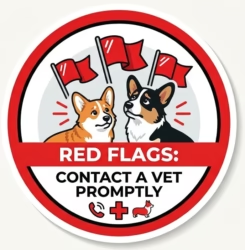 Callout: Red flags: contact a vet promptly
Contact a vet the same day for any of the following in a Pembroke, and go to an emergency vet if the dog cannot stand or walk normally:
- Sudden pain on lifting, crying out, or a hunched, stiff posture
- New reluctance to jump, climb stairs or move
- Wobbliness, scuffing or dragging of the hind legs
- Loss of bladder or bowel control
- A usually friendly dog that suddenly resents being touched near the back or neck
Heat and the double coat
During a Johannesburg summer, treat heavy panting, seeking cold floors and sudden loss of interest in exercise as signals for cooling and rest, not as sulking. Walk in the early morning or evening, provide shade and water, and never leave a dog in a parked car. [verify against a South African veterinary source, such as the South African Veterinary Association, before publishing.]
Worked example: Biscuit and the school-run gate
This is a labelled hypothetical, used to illustrate the method. It is not a real dog or a real case.
Imagine an Owner whose three-year-old Pembroke, Biscuit, has a full-length tail. Every afternoon at the school-run gate, Biscuit barks, circles and nips at the children's ankles. The Owner has been told he is "just being a Corgi" and has started to snap at him, which makes the barking louder.
Step one is the baseline. Filming Biscuit relaxed, greeting and startled shows a stiff, high, still tail at the gate and a hard stare at the running children, not the loose full-body wiggle he shows at the front door. The reading is arousal with a working urge, not friendliness.
Step two is the log. The barking begins as the gate opens and stops when the children stop running, which points to a response to movement. Step three is management. The Owner clips the lead on before the gate opens, brings a tug toy, and teaches the children to walk and stand still.
Step four is a health check. Over a fortnight the Owner also notices that Biscuit has stopped jumping onto the sofa. A vet visit finds early back discomfort, treated with rest and a change to how Biscuit is lifted. The gate behaviour improves as the dog's pain eases and as the routine becomes predictable. The lesson is that herding and spine both contributed, that the tail baseline helped separate arousal from friendliness, and that each needed a different response.

In this hypothetical, a barking, nipping Corgi at the school gate turns out to have both a herding trigger and an unnoticed back problem.
Success criteria
You will know this approach is working when:
- Your dog's baseline is written down or filmed, and you can name two or three signs that depart from it.
- Heel-nipping happens less often, and the dog can take a toy or settle on a mat when children move.
- Barking has a recognisable trigger, and a calm acknowledgement from you usually ends it.
- Any new reluctance to jump, climb or be lifted gets a vet check within days, not weeks.
 Check your understanding
- Why might a short-tailed Pembroke at the park be misread by your Corgi, or misread your Corgi, even when it is signalling friendliness?
- How would you tell a working-pattern heel-nip from a fear-driven bite, and when should you call a professional?
- A Corgi starts avoiding the sofa and yelps when lifted. What is the first question to ask, and why?
- Which two parts of this article describe tendencies instead of guarantees, and why does that matter?
 Where Should I Read Next?
Three links connect this article to the rest of the cluster:
- The foundation: How Dogs Communicate covers the general science of body language, voice and scent that this article builds on.
- The comparison: Understanding Beagle Communication looks at the scent hound's nose-first attention and carrying voice, which makes a useful contrast with the Pembroke's tail, herding and spine questions.
- What Is Your Corgi Actually Saying? Introducing the Corgi Body Language Decoder.
- Dogs are communicating constantly. Understanding Dog Communication.
 Frequently Asked Questions
1. Is it normal for a Corgi to bark so much?
Barking is common in Pembrokes and is usually a signal, not a fault. The breed is commonly described as a vocal alert barker, and barking is context-dependent, with pitch and spacing carrying information (Pongrácz et al., 2005). Keep a one-week log of time, trigger and duration. Barking that stops once you acknowledge the trigger is usually reporting something, while barking aimed at you with no trigger is usually asking for something. A sudden new pattern, especially yelping when touched, deserves a vet check because it can mean pain.
2.Why does my Corgi nip my heels?
Heel-nipping is a herding behaviour. Pembrokes were developed as cattle heelers and drovers, and running feet trigger the same chase-and-nip pattern. It signals arousal and a working urge, not necessarily bad temper. Redirect to a toy, give the dog structured chasing and tugging games with clear start and stop cues, and separate it before the household speeds up or visitors arrive. If nips break skin, come with growling or a stiff body, or happen without any movement trigger, ask a qualified behaviour professional to assess the dog.
3. Why does my Corgi herd my children?
Circling and bumping children is a working pattern triggered by movement and groups, not a sign that the dog is "in charge". It tends to peak during fast play. Teach children to stand still, keep the dog on a lead or behind a gate during chaotic moments, and give it an alternative job such as fetching a toy. Supervise all contact between dogs and children. If the dog stalks, stares or pursues a child who is trying to leave, separate them calmly and seek professional help.
4. Can a Corgi with a short tail still show it is happy?
Yes, but the signal moves to the hindquarters and the rest of the body. A short tail conveys less movement information to other dogs (Leaver & Reimchen, 2008), so many Owners describe a whole-rear wiggle, loose ears, a soft face and a relaxed mouth as the "happy" cluster. That wiggle is unmeasured in the breed, so film your own dog relaxed and greeting you to learn its baseline. Read any single signal alongside the others, since a still stump can mean calm, focus or worry.
5. Why does my Corgi show the whites of its eyes?
The whites show when a dog turns its head away but keeps looking at something, commonly called "whale eye". Behaviourists generally treat it as a sign of discomfort, tension or a request for space, not proof of aggression. Check the rest of the body: a stiff posture, closed mouth and held-still hindquarters add weight to that reading. Give the dog distance and remove the pressure. If it happens when you touch or lift the dog, ask a vet to check for pain.
6. How can I tell if my Corgi's back hurts?
Look for behaviour change: new reluctance to jump or use stairs, yelping when lifted, a hunched or stiff posture, irritability when touched near the back, or withdrawal. The Pembroke is among the breeds with a significantly increased risk of intervertebral disc disease (Brown et al., 2017), so these changes deserve a vet visit, not a training fix. Wobbliness, dragging a hind leg, or loss of bladder or bowel control needs emergency care. Do not wait to see whether it passes.
7. Why does my Corgi growl or yelp when I pick it up?
A growl is a warning and a yelp is usually a pain signal, so both deserve a response. In a chondrodystrophic breed, the first question is whether lifting hurts the back. Stop lifting, do not punish the growl, and book a vet check. When lifting is unavoidable, support the chest and hindquarters together and keep the spine level, then ask your vet to show you the safest technique for your dog. Punishing a growl can teach a dog to hide the warning.
8. Do Corgis with short tails have trouble with other dogs?
Possibly, though no study has tested Pembrokes directly. In a model-dog experiment with 492 dogs, approaching dogs responded differently to a long wagging tail than to a long still tail, but not to a short tail wagging or still (Leaver & Reimchen, 2008). Ears, posture and movement still carry the message. Keep introductions calm and at a distance, let the dogs approach on a curve, and watch the other dog's body for any sign that your Corgi's signals are being missed.
9. What do my Corgi's ears tell me?
Pembroke ears are erect and mobile, which makes them a useful first read. Forward and upright usually means interest or alertness, relaxed and slightly out suggests ease, and rotated back or flattened can mean worry or appeasement. Ears alone are not enough, so check them against the eyes, mouth and hindquarters, and note how your own dog's ears sit when relaxed so that a change stands out. Goodwin et al. (1997) found that breeds that look more wolf-like used more of the ancestral signals, though that study did not test Pembrokes specifically.
10. Is it normal for a Corgi puppy to nip so much?
Mouthing is normal in puppies of every breed, and Corgi puppies may add heel-chasing once they are mobile and meet running people. No breed-specific study documents when this starts, so judge by pattern. Offer chew toys, tug games and short chase games, avoid hand-wrestling, and end play calmly for a few seconds when teeth touch skin, then restart with a toy so the puppy learns what is allowed. If nipping is severe, looks fear-driven, or comes with growling and stiffness, ask a qualified behaviour professional to see the puppy.
11. Why does my Corgi sploot?
Splooting means lying flat with the back legs stretched out behind. No study explains it in Pembrokes, but it is commonly linked to stretching and to cooling on a cool floor. If it is new, comes with stiffness, or the dog cannot settle in any other position, have the back and hips checked by a vet. In a Gauteng summer, also check whether the dog is simply too warm. Treat it as one piece of information, read alongside everything else.
12. Why is my Corgi panting so much in summer?
Panting is how dogs cool down, and a double-coated Pembroke may start sooner in hot weather. Move the dog to shade, offer water and avoid exercise in the heat of the day. Heavy panting with drooling, a bright red tongue, weakness or collapse is an emergency. Walk early or late, never leave a dog in a parked car, and ask your vet about heat safety for your individual dog, especially if it is overweight, older, or already reluctant to move because of back pain.
13. How do I stop my Corgi barking at everything?
Start by working out what it is barking at, using a log of time, trigger and duration. Acknowledge real alerts once, then guide the dog to a mat or a chew. Do not reward demand barking, but meet real needs first. Use management, such as limiting the view through a gate or window, while the dog learns. Persistent barking tends to get harder to change the longer it runs, so involve a qualified behaviour professional early if it is not improving.
14. Does a thick coat hide my Corgi's mood?
It can hide some signals. A dense double coat can make raised hair along the back harder to see, so a bristling dog may look calm. This is inference, not a measured finding. Take photos or short videos of the back line when the dog is relaxed, then when it is excited or worried, to learn what changes. Do not rely on raised hair alone. Check the ears, eyes, mouth, posture and hindquarters, and compare them with your own dog's baseline.
15. Do Corgis read human signals better than other dogs?
This is not proven for Pembrokes. Breeds selected to work in close visual contact with people, such as sheepdogs, were linked to better comprehension of pointing than independent-worker breeds such as hounds, in a study using 30 dogs per group (Gácsi et al., 2009). The Pembroke was not named in that comparison. Treat close attention as a possibility, not a promise. In any breed, clear and consistent body language tends to work better than a raised voice, and filming yourself during a training session can show which cues you are really sending.

 Sources cited
Working-draft style. Each is to be converted to a hyperlinked citation after the human fact-check.
- Artelle, Dumoulin & Reimchen (2011), Laterality 16:129–135: dogs' responses to a robotic dog with asymmetric tail wagging. [secondary description only; verify]
- Awano et al. (2009), PNAS 106:2794–2799: SOD1 mutation in canine degenerative myelopathy. [verify]
- Bekoff (1995), Behaviour 132:419–429: play signals as punctuation. [verify]
- Brown et al. (2017), PNAS 114:11476–11481: FGF4 retrogene on chromosome 12 and IVDD; breeds at increased risk.
- Coppinger & Coppinger (2001), Dogs: A Startling New Understanding of Canine Origin, Behavior and Evolution: herding as a modified predatory sequence. [page reference to confirm]
- Gácsi et al. (2009), Behav Brain Funct 5:31: selection for cooperation and attention.
- Goodwin, Bradshaw & Wickens (1997), Anim Behav 53:297–304: paedomorphosis and signal repertoire.
- Haworth et al. (2001), Mamm Genome 12:212–218: T gene and bobtail in Pembrokes. [verify]
- Horowitz (2009), Anim Cogn 12:107–118: attention-getting behaviours in dog play. [verify; not yet checked against the source]
- Hytönen et al. (2009), J Hered 100:236–240: C189G in 17 of 23 other short-tailed breeds.
- Leaver & Reimchen (2008), Behaviour 145:377–390: tail length and approach by 492 dogs.
- Mills et al. (2020), Animals 10:318: pain and problem behaviour in dogs and cats. [cited from memory; verify]
- Morrill et al. (2022), Science 376:eabk0639: breed explains 9% of behavioural variation.
- Parker et al. (2009), Science 325:995–998: FGF4 retrogene and chondrodysplasia. [verify]
- Pongrácz et al. (2005), J Comp Psychol 119:136–144: human listeners and Mudi barks. Pongrácz et al. (2006), Appl Anim Behav Sci 100:228–240. [verify]
- Quaranta, Siniscalchi & Vallortigara (2007), Curr Biol 17:R199–R201: asymmetric tail wagging. [verify]
- Siniscalchi et al. (2013), Curr Biol 23:2279–2282: dogs see left and right wags differently.
- South African Veterinary Council, tail-docking policy; IOL (2007), tail-docking ban set; Daily Maverick (2026), The unkindest cut.
- Pembroke Welsh Corgi Club of America, history page (club-sourced, lower tier); Cornell University Riney Canine Health Center, CDDY/IVDD page.
END ARTICLE
[…] comparison: Understanding Corgi Communication looks at a herding breed whose short tail and low back raise very different signalling questions […]