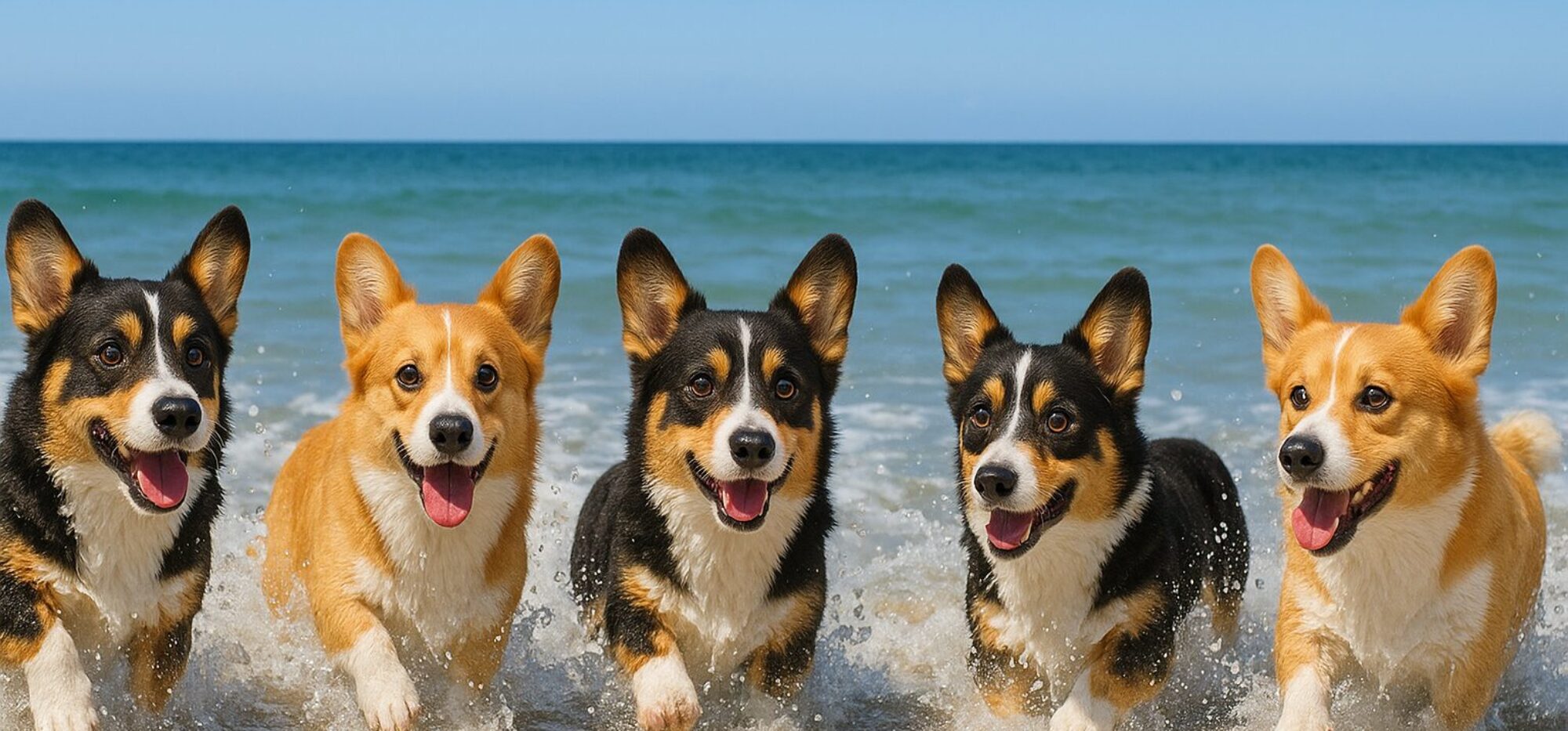
The History of the Pembroke Welsh Corgi
A Welsh Working Dog That Conquered the World
Ancient Beginnings in the Welsh Hills
 Few herding breeds in Britain can claim a lineage as old as the Pembroke Welsh Corgi's. Its story stretches back more than a thousand years into the farmland of south-west Wales, in the county of Pembrokeshire from which it takes its name. The Pembroke is one of two Welsh Corgi breeds, the other being the Cardigan Welsh Corgi, a separate breed with its own distinct ancestry and history.
Exactly how the Pembroke came to be is still debated by historians of the breed. The leading theory traces its origins to Flemish weavers who settled in Pembrokeshire around 1107, having been invited into the region by King Henry I. Those settlers are thought to have brought along small spitz-type dogs, related to today's Schipperke and Pomeranian, which then interbred with the native dogs of Wales. A gentler, more whimsical version of events is also popular among Corgi devotees: that the breed once served as transport for woodland fairies, and that the pale "fairy saddle" marking many Pembrokes carry across their shoulders is a trace of that mythical service.
Whichever account is closer to the truth, the Pembroke had firmly established itself as a working farm dog across Wales by the medieval period. It worked as a heeler, driving cattle by nipping at their heels and then flattening itself to the ground to dodge a kick in retaliation — a method ideally matched to its low, compact frame. Even its name reflects this working purpose: "corgi" comes from the Welsh words *cor* (dwarf) and *gi* (dog). Beyond herding, the dogs also earned their keep as general farm guardians, controlling vermin and raising the alarm at unfamiliar visitors.
The earliest known written reference to a dog of this type appears in the laws of Hywel Dda (Hywel the Good), the tenth-century King of South Wales. For hundreds of years afterward, the breed stayed largely in the hands of farmers in mid-Wales, who prized it purely for its usefulness rather than for any uniformity of appearance. By one early account, the Corgi had in fact been the leading breed of mid-Wales until the Scottish sheepdog gradually took over that role.
Stepping Into the Show Ring
It was not until the early twentieth century that a dedicated group of enthusiasts began to take a serious interest in the Corgi's future — both as a working animal and as a contender in the show ring. In February 1927, the journalist A. Croxton Smith wrote one of the first substantial public profiles of the breed in *The Illustrated Sporting and Dramatic News*, timed to the Corgi's appearance at that year's Crufts. Smith called the breed one of "respectable antiquity," noting both its sporting instincts and its farm-honed work ethic, and he was careful to draw a line between the two emerging varieties — Pembrokeshire and Cardiganshire — each already supported by its own club.
Smith's article laid out distinctions between the two types that still hold true nearly a century later: the Pembrokeshire dog had a fox-like head, ears standing erect, a short tail, and a coat in red or red-and-white, whereas the Cardiganshire dog, while sharing that foxy head, had almond-shaped eyes, a long tail, and a broader palette of acceptable colours. He also quoted breeder D. Edwardes of Cardiganshire at length, who praised the Corgi's versatility: strong for its size, useful in badger-digging and fox hunting, capable of working a shoot the way a spaniel would, an able ratter, and a dependable defender against cattle. Edwardes even recalled a Corgi still active at sixteen years old. Smith ended his piece with a plea that breeders not chase show ring points at the expense of the dog's working ability.
*Source: A. Croxton Smith, "Dogs of the Day — A Little One from Wales," The Illustrated Sporting and Dramatic News, 3 February 1927.*
Captain J. H. Howell, Master of the Pembrokeshire Hounds, did much of the early legwork in bringing the Pembroke to wider attention within the dog fancy. The Welsh Corgi Club was formed to represent the Pembrokeshire variety specifically, while the Cardigan Welsh Corgi Club took on the same role for the Cardiganshire dog.
Official Recognition and a Standard of Its Own
The Kennel Club in the UK gave the breed its first formal recognition in 1925, registering both the Pembroke and the Cardigan jointly under the single name "Welsh Corgi." For a number of years, the two were shown side by side in competition and even crossbred with one another, but supporters of each variety pushed for them to be treated separately. That separation finally came in 1934, when The Kennel Club recognised the Pembroke Welsh Corgi and Cardigan Welsh Corgi as two distinct breeds — a split that has remained in place ever since and allowed each to be developed on its own terms.
The breed standard set out a compact, energetic dog standing 10 to 12 inches at the shoulder and weighing 22 to 31 pounds, with a medium-length, dense, weatherproof coat in red, sable, fawn, or black and tan, usually marked with white. Temperament was given equal weight alongside physical type: the standard asks for a dog that is bold, outgoing, and businesslike — sharp, watchful, and responsive, but never aggressive or jumpy. Compared to its Cardigan cousin, the Pembroke is generally identified by its naturally short or docked tail, sharper-pointed ears, and a lighter, more fox-like build overall.
The Founding of the Welsh Corgi League
 With the Pembroke now standing as its own breed, the formation of a club devoted entirely to it was a natural next step. The Welsh Corgi League was founded in the UK in 1938 — just four years after The Kennel Club's split of the Pembroke and Cardigan — with the specific purpose of protecting and promoting the Pembroke Welsh Corgi, a role it still carries out today for fanciers in Britain and internationally.
Anne Biddlecombe and the Tale of "Corgi Fantasy"
Among the League's founders was Anne G. Biddlecombe, an English Pembroke breeder who would later spend many years as the League's secretary. In the very first official League handbook, published in 1946, Biddlecombe included a poem called "Corgi Fantasy" — and with it, gave the breed something it had previously lacked: a story of where it came from. The poem describes two puppies found by Welsh children on a mountainside, and uses that tale to explain why the Pembroke carries its pale shoulder "saddle" marking: the supposed imprint left behind by fairy riders of the Tylwyth Teg, who are said to still mount the dogs every Midsummer's Eve while people sleep.

A-Biddlecombe - Wales 1962
Composed in a rolling verse style reminiscent of Longfellow's *Hiawatha*, "Corgi Fantasy" was almost certainly meant purely as a piece of literary charm for the handbook, not as a statement of historical fact. Yet the poem took on a life well beyond that original purpose. As it was reprinted in breed publications on both sides of the Atlantic over the following decades, it gradually lost any mention of its author or its date, until it came to be passed around as an "ancient Welsh tradition" — a legend many assumed had been told for centuries. The fairy saddle story remains one of the most cherished tales connected to the breed today, standing as a quiet tribute both to Biddlecombe's talent as a writer and to the deep fondness owners continue to feel for their Pembrokes.
The League's early years lined up with a period of fast-growing public enthusiasm for the breed, fuelled in large part by the Royal Family's widely reported fondness for Pembrokes. The bond between the League and the Crown was apparent from very early on: Queen Elizabeth II, alongside her mother Queen Elizabeth The Queen Mother and her sister Princess Margaret, attended one of the League's first championship shows in 1946 — a notable show of royal support for such a young organisation. The Queen herself never entered her own Pembrokes into competition, but she stayed closely and genuinely engaged with the breed's progress over the years, and several breeders were invited to Windsor to show their stud dogs to her directly.
The Welsh Corgi League continues today as the leading breed club for the Pembroke in the UK. It runs the breed's health survey programme alongside The Kennel Club, organises championship and open shows, publishes the League Handbook, and operates a rescue service for Pembrokes that need rehoming. It remains the first point of contact for both established breeders and newcomers to the breed across Britain.
A Royal Companion

Queen Elizabeth II, Great Windsor Park it Her Corgis (AI Generated)
No part of the Pembroke Welsh Corgi's story has done more to make the breed famous worldwide than its long association with Queen Elizabeth II. That relationship started in 1933, when King George VI brought a Pembroke named Dookie into the Royal Family, and the young Princess Elizabeth quickly grew attached to the breed. On her eighteenth birthday in 1944, she was given her own Corgi, Susan, and many of the Queen's later dogs descended from Susan's line.
Across her reign, Queen Elizabeth II owned more than thirty Pembroke Welsh Corgis in total, and the sight of them following close behind her — at Buckingham Palace, Windsor Castle, and Balmoral — became one of the most recognisable images associated with her reign. Her Corgis travelled with her to official engagements, turned up in countless photographs and formal portraits, and even appeared alongside her in the short film made for the opening ceremony of the 2012 London Olympic Games.
Queen Elizabeth II died on 8 September 2022 at Balmoral Castle in Scotland, at the age of 96. Her devotion to the breed lasted right to the end of her life: in her final years she took in two more Corgis, Sandy and Muick, given to her by Prince Andrew and his daughters. Those two dogs were at Windsor in the days after her death and were present during her coffin's lying-in-state, a quietly moving final gesture. Thanks to the Queen's patronage, the Pembroke Welsh Corgi grew from a regional working dog into a globally recognised emblem of British heritage, and her impact on the breed's popularity around the world is hard to overstate.
The Pembroke Welsh Corgi in the Modern Era
In the years following the Second World War, the Pembroke enjoyed a long run of remarkable popularity in Britain, regularly leading breed registration figures through the 1950s and 1960s. That enthusiasm later cooled to more modest numbers, and by 2009 The Kennel Club had added the Pembroke to its Vulnerable Native Breeds list, after annual UK registrations dropped under 300 — a difficult milestone for a breed so woven into British cultural life.
That slide has since reversed, helped considerably by a wave of renewed international interest sparked by social media and popular culture. The Pembroke's photogenic looks and big personality have suited it perfectly to the internet age, and the breed has built sizeable followings across platforms around the globe. In the United States, the American Kennel Club has regularly placed the Pembroke among the twenty most popular breeds in recent years.
Today's responsible breeders place real importance on health testing and sound temperament. Known health issues within the breed include hip dysplasia, degenerative myelopathy (a progressive neurological disorder for which a DNA test now exists), and certain eye conditions. Breeders with good reputations test routinely for these conditions and are transparent about the results. The strong herding drive bred into the Pembroke is still very much present, and can show up as a tendency to nip at heels or try to herd children and other household pets — something prospective owners should expect and be ready to manage through consistent training and mental engagement.
The Pembroke Welsh Corgi is an active, sharp-minded breed that does best with plenty of exercise, mental challenge, and a close place within family life. Small as they are, Pembrokes are sturdy dogs with real stamina, equally content on a working farm or in a busy, well-exercised household in the city.
The Pembroke Welsh Corgi in South Africa
 South Africa's relationship with the Pembroke Welsh Corgi goes back to the early decades of the twentieth century. The breed is thought to have arrived alongside British settlers and colonial officials, and quickly found favour among the country's farming and dog-showing communities. The Corgi's hardiness, adaptability, and willingness to work suited it well to the range of conditions found across Southern Africa.
Early Foundations
Pembrokes in those early years were imported straight from respected British kennels, and South African fanciers worked hard to keep the quality of the breed consistent. The show scene grew steadily through the middle of the twentieth century, with committed breeders eventually producing dogs that could hold their own internationally.
Influential Breeders and Kennels
A handful of names stand out as especially significant to the Pembroke's development in South Africa, spanning from the mid-twentieth century through to today.
Joy Osborn began breeding Corgis in the 1950s under the kennel name "Corgi Castle," and over the decades that followed built a strong reputation for producing dogs of excellent type and temperament. Her influence on the breed in South Africa was foundational, and the bloodlines she developed went on to shape local breeding programmes for a generation afterward.
Pamela Hunter's "Stonewall" kennel, founded in the 1960s, set another benchmark for quality within the South African Corgi community. Hunter was known for her careful, exacting approach to breeding and her deep familiarity with the breed standard. Stonewall produced many champions and added meaningfully to the gene pool available to South African breeders, helping preserve the vigour and correct type that defined the local Corgi population.
 One of the most distinctive kennel histories in South African Corgi breeding belongs to Hazelmere, whose story spans three continents and more than seventy years. The kennel takes its name from the village of Hazlemere in Oxfordshire, England, where Kay Roos's mother went to recover in the late 1940s after a serious illness she had contracted in Kenya. Her attachment to that village ran deep enough that, once back in Kenya, she formally registered the Hazelmere kennel name in 1946 — initially breeding German Shepherds before turning her attention to Pembroke Welsh Corgis. Her foundation Corgis came from Mrs. Powrie in Nairobi, who had imported the dogs directly from the UK, giving Hazelmere's earliest stock genuine British bloodlines from the very start. When the family later moved to South Africa, the kennel and everything it had built moved with them.
Hazelmere is run today by Kay Roos, who has shaped it into one of the most scientifically grounded breeding programmes in South Africa. Drawing on deep knowledge of canine genetics and structure, Roos brings advanced genomic screening and reproductive techniques into every breeding decision, selecting not just for appearance but for temperament, behaviour, and inherited health. The kennel's current breeding stock is notably international, drawing on bloodlines from the United Kingdom, the United States, Hungary, and Russia, with every dog thoroughly health-screened and assessed for conformation before joining the programme. That dedication to genetic diversity, paired with firm ethical standards and little patience for irresponsible breeding, has helped Hazelmere Corgis win titles both locally and on the international stage.
The Breed in South Africa Today
The Pembroke Welsh Corgi continues to enjoy a strong reputation in South Africa, supported by an active community of breeders and owners under the Kennel Union of Southern Africa (KUSA). South African breeders, like their counterparts elsewhere, have taken on board the wider international push toward health testing and responsible breeding, and the community takes the breed's welfare seriously.
The global surge in the Corgi's popularity has reached South Africa just as it has everywhere else, with social media drawing in plenty of new fans. Responsible breeders continue to remind prospective owners just how important it is to understand the Pembroke's working background and active nature before bringing one home — a dog this clever and energetic is a serious long-term commitment, and one that rewards owners who are equally willing to engage.
Closing Thoughts
From the windswept farms of Pembrokeshire to the halls of Buckingham Palace, and from the British show ring to the homesteads of South Africa, the Pembroke Welsh Corgi has shown again and again that it can thrive wherever it's given the chance. It is a breed shaped by centuries of working alongside people, and defined by its intelligence, loyalty, and that unmistakable spark that has made it one of the most loved dogs anywhere in the world.
Understanding that history — the working drive, the need to stay engaged and busy, the bond it builds with the people around it — is really the starting point for responsible ownership. The Pembroke Welsh Corgi is far more than a charming face or a cultural icon. It is a working breed with real, practical needs, and it rewards anyone willing to take the time to understand it properly.